I tracked over fifty staking dashboards since April, and almost every single one turned into a ghost town within weeks. APR would show up, Discord would go silent, governance would get maybe two votes, then on-chain activity flatlined. Traditional staking pays you for parking capital, not for doing anything – and boredom kills participation fast. Then OpenLedger launched OctoClaw on April 17, and something finally felt different. Instead of stake-and-wait, they tied $OPEN to shared work using Proof of Attribution, where every AI output traces back to its data inputs and contributors get paid when their work actually shapes an output. That small shift flips the whole model. Now you run agents, contribute data, and earn when your work matters. OpenLedger already has nearly a million nodes and over ten AI projects on testnet, plus enterprise names like Walmart and Dubai Tax Authority testing quietly in the background. But the more I watched, the more I realized we are all staring at the wrong side of AI. Everyone obsesses over smarter models and bigger context windows, but the real bottleneck is infrastructure – accountability, liability, and retained economic value. The moment an AI agent starts managing real capital, a hallucination stops being a glitch and becomes a financial catastrophe. Who failed? Without auditable trails, the answer is nobody. That’s why OpenLedger’s choice to build as an Ethereum L2 finally clicked for me. AI agents don’t act like humans – they make thousands of micro-transactions non‑stop, 24/7. Put that on Ethereum mainnet and gas fees would explode. An L2 gives low cost, high speed, and inherits Ethereum’s security without the congestion. Then there’s the mirror effect nobody talks about. OctoClaw doesn’t magically create trading edge – it amplifies whatever discipline or recklessness you already have. A patient trader gets faster execution; a reckless one just automates bad habits faster. That makes permission systems and kill switches more important than the AI model itself. And the deepest layer? Liability. I see OpenLedger not as a contribution reward system, but as forensic memory. When an AI output causes real economic loss, Proof of Attribution leaves residue. That turns provenance into an insurance primitive, not just a dashboard feature. I’m not saying they’ve solved everything – enforcement is messy, legal systems still want human signatures, and developers might route around attribution if it adds friction. But the market isn’t pricing any of this yet. Everyone chases visible intelligence while ignoring the infrastructure for accountability after something breaks. Maybe that’s the real opportunity – building the layers that matter after failure, not just before launch.

Articol
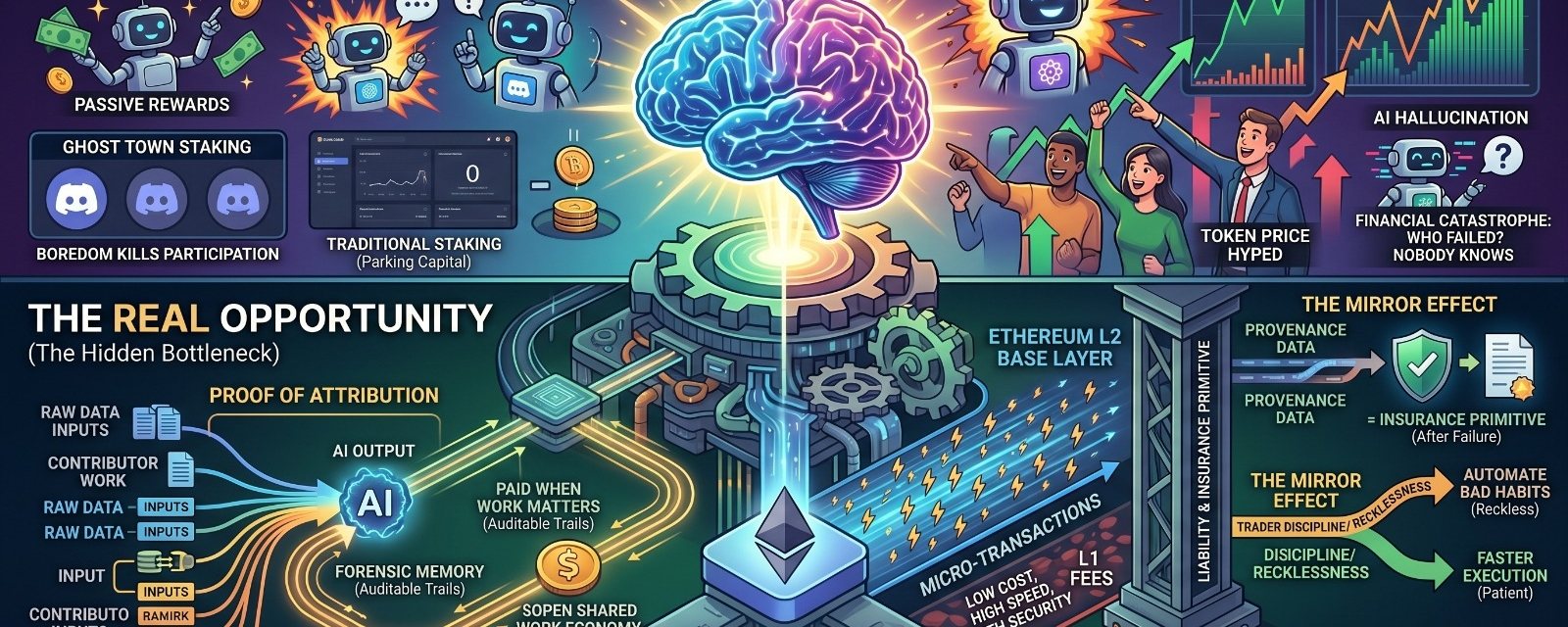
We Are Staring at the Wrong Side of AI – And It’s Costing Us the Real Opportunity
Declinarea răspunderii: Include opinii ale terților. Acesta nu este un sfat financiar. Poate include conținut sponsorizat. Consultați Termenii și condițiile