
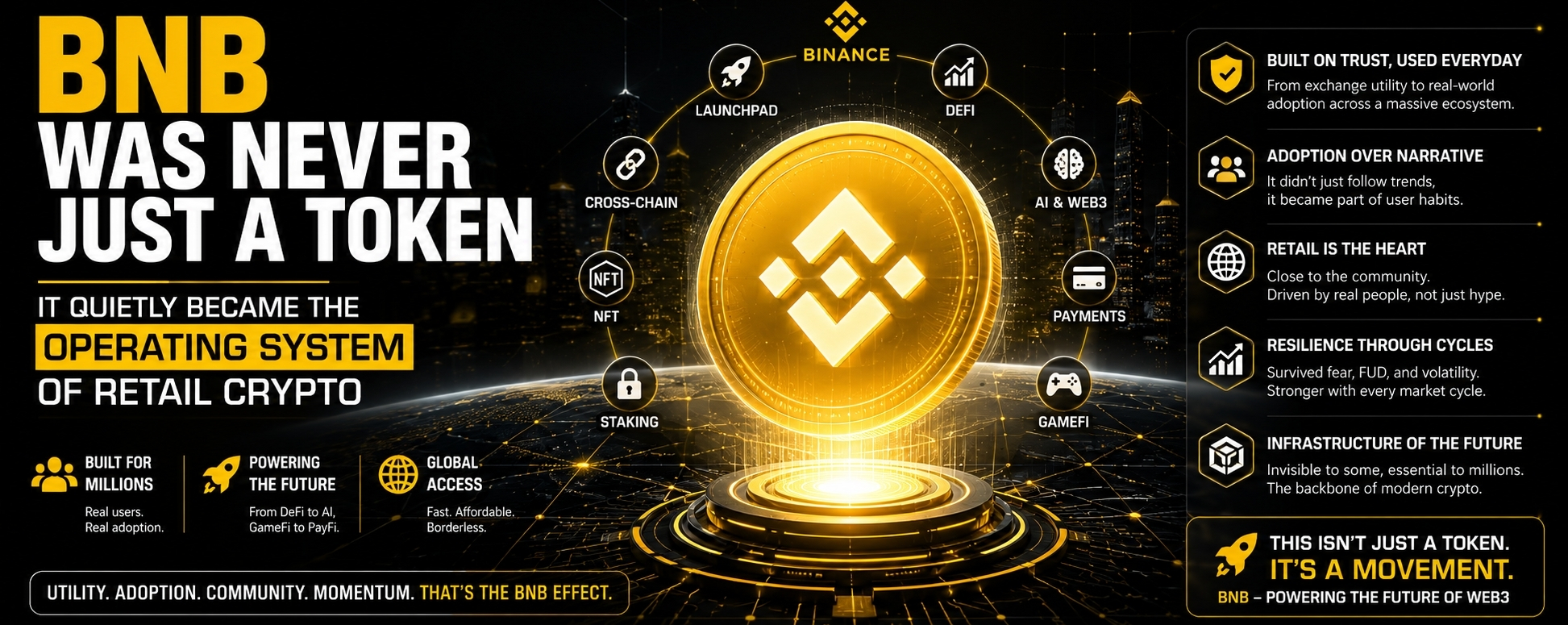
I still remember when most people treated BNB like a temporary exchange discount token. It sat in portfolios almost like a utility coupon, something traders held to reduce fees before rotating into “more serious” assets. Back then, the market was obsessed with flashy narratives. Every cycle needed a hero coin pretending to reinvent finance, while the infrastructure layer quietly kept compounding underneath everyone’s attention.
That is what makes BNB interesting to me now.
The biggest shifts in crypto rarely announce themselves loudly in the beginning. They grow in habits first. You notice people using something repeatedly before they start talking about it philosophically. BNB followed that exact path. It moved from being connected to one exchange into becoming part of how millions of users experience crypto itself. That difference matters more than most people realize.
I think many investors still misunderstand what creates staying power in digital economies. They focus too much on ideology and not enough on behavior. Markets are emotional systems disguised as financial systems. People return to whatever feels fast, familiar, and efficient. Most users do not wake up wanting decentralization theory. They want access, movement, opportunity, and speed without friction. BNB quietly positioned itself at the center of that reality.
What changed my perspective was watching how deeply the ecosystem embedded itself into retail activity during uncertain market periods. Even when sentiment collapsed, activity never fully disappeared. Builders kept launching, traders kept bridging liquidity, communities kept farming opportunities, and new users still entered through familiar rails connected to Binance infrastructure. That consistency says more than social media hype ever could.
There is also a psychological layer here that the market rarely discusses honestly. Trust in crypto is fragmented. Most people pretend they are purely decentralized maximalists while still relying on centralized platforms for execution, liquidity, onboarding, and security. The industry built an identity crisis around this contradiction. BNB sits directly inside that tension. Instead of fighting the reality of user behavior, it adapted around it.
That adaptation may end up being its biggest strength.
I think the future crypto economy will not be dominated by chains that simply claim the highest technical purity. It will be dominated by ecosystems that reduce cognitive load for normal people. That sounds less revolutionary on paper, but it changes adoption curves dramatically. The average user does not care about philosophical wars between ecosystems. They care whether an app works instantly, whether fees remain low, and whether opportunities feel accessible.
BNB understood that before much of the market did.
What fascinates me most is how the network evolved beyond speculation into economic coordination. You can see it in payments, gaming, AI integrations, launch platforms, staking systems, creator economies, and cross-chain activity. The token itself almost became secondary to the behavioral gravity surrounding it. That is usually the sign of a maturing digital economy. Real ecosystems stop relying on narrative momentum alone because users begin participating out of habit.
And habits are incredibly hard to replace.
I also think people underestimate how important retail psychology will become over the next five years. Institutions may bring capital, but retail brings velocity. Retail creates culture, memes, transaction flow, experimentation, and network energy. Without retail participation, crypto turns into a sterile financial layer with no emotional pulse. BNB remained unusually close to that retail heartbeat while many projects drifted into abstract promises nobody truly uses.
That proximity creates resilience.
The market often rewards assets that survive multiple emotional cycles without losing relevance. BNB has already lived through regulatory fear, exchange panic, brutal corrections, changing narratives, and endless criticism from competitors. Yet activity keeps returning. That persistence tells me something deeper is happening beneath the surface. The ecosystem no longer depends on temporary excitement alone. It has embedded itself into user routines globally.
I believe the next phase of crypto will revolve around invisible infrastructure rather than loud branding. The winners may not be the projects making the boldest promises. They may be the ones quietly processing millions of interactions while everyone debates the future on social media. In many ways, BNB already operates like that system today.
Not perfect. Not untouchable. But undeniably integrated into how modern crypto functions.
And in markets driven by attention, integration is often more valuable than ideology.