
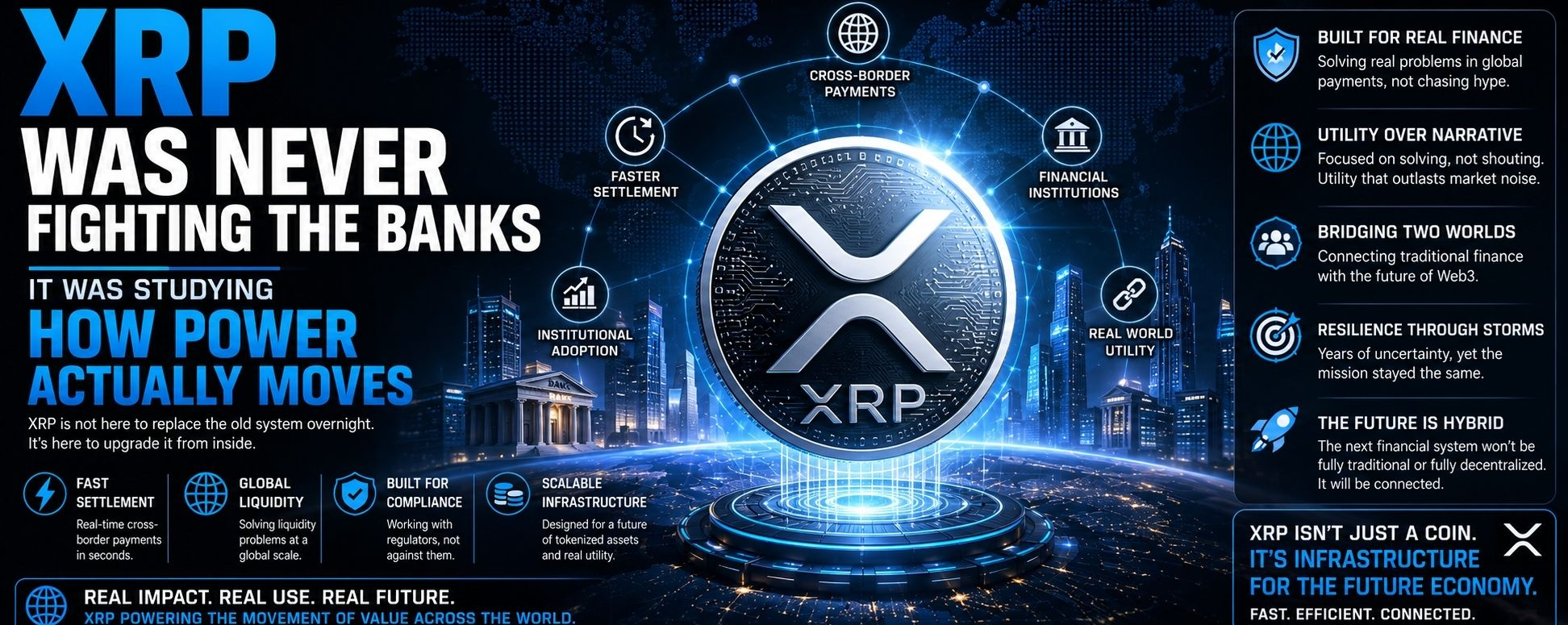
I think one of the biggest misunderstandings in crypto came from how people framed $XRP in the early years. The conversation was always emotional. Either people treated it like the future of global finance or dismissed it completely because it did not fit the rebellious image crypto built around itself. What most missed was something quieter happening underneath the arguments.
$XRP was never trying to look revolutionary in the same way Bitcoin or Ethereum did. It was trying to become usable inside systems that already control global money movement. That difference changed everything.
I remember during earlier market cycles, most crypto communities were obsessed with destruction narratives. Replace the banks. Remove intermediaries. Tear down traditional finance completely. It sounded powerful online, but real financial systems rarely evolve through sudden replacement. They evolve through gradual integration. Infrastructure survives when it learns how to connect with existing behavior instead of pretending the old world disappears overnight.
That is why $XRP stayed relevant even when sentiment turned against it multiple times.
The interesting thing about financial networks is that trust matters more than technology alone. Most people outside crypto underestimate how slow large-scale money movement actually is behind the scenes. Cross-border settlement still contains friction, delays, liquidity inefficiencies, and fragmented communication layers that feel outdated in a world moving at internet speed. Crypto traders see transactions finalize in seconds and forget the traditional system still moves like an aging machine held together by institutional habit.
XRP noticed that gap early.
What changed my perspective over time was watching how the market reacted emotionally whenever XRP entered regulatory discussions. The reactions were never normal. Fear became amplified. Excitement became amplified. That usually happens when an asset sits close to something psychologically important. XRP became symbolic. For some people, it represented institutional adoption finally arriving in crypto. For others, it represented the fear that crypto could become too connected to traditional finance itself.
Both sides missed the deeper reality.
Markets do not reward ideology forever. Eventually they reward efficiency, access, and survivability. That is the phase I think crypto is slowly entering now. The industry is maturing beyond experimental excitement into infrastructure competition. Suddenly the projects attracting attention are not just the loudest communities anymore. They are the ones capable of handling real liquidity, compliance pressure, and international scale without collapsing under complexity.
XRP has spent years operating inside that uncomfortable zone between crypto culture and financial reality.
And honestly, that position may become valuable in ways people still underestimate.
I think many investors are too focused on short-term price narratives to notice how global finance itself is changing psychologically. Governments want faster settlement. Institutions want programmable liquidity. Businesses want cheaper cross-border movement. Emerging economies want alternatives to slow correspondent banking systems. None of these demands care about tribal crypto debates. They care about functionality.
That creates a different type of market opportunity.
The future financial system probably will not belong entirely to decentralized idealists or traditional banks alone. It will likely become a hybrid environment where blockchain infrastructure quietly powers transactions underneath familiar interfaces people already trust. Most users may never even realize they are interacting with crypto rails at all.
That possibility changes how I look at XRP.
Because if the future economy becomes invisible infrastructure rather than speculative theater, projects optimized for movement, liquidity, and interoperability suddenly become much harder to ignore. The market often celebrates narratives before understanding utility. Then years later, utility quietly outlasts the narratives.
I also think XRP’s resilience says something important about market psychology itself. Very few assets survive years of legal uncertainty, endless public criticism, aggressive tribal attacks, and repeated volatility while still maintaining one of the strongest global communities in crypto. Whether people love it or hate it, attention never fully leaves it. That type of persistence usually signals deeper emotional positioning within the market.
And markets are emotional long before they become rational.
What fascinates me now is not whether XRP wins every argument online. It is whether the world slowly moves closer to the exact financial conditions XRP was originally designed for. Faster settlement. Cross-border interoperability. Asset tokenization. Global liquidity coordination. Institutional blockchain usage. Those themes no longer sound theoretical anymore. They are becoming active conversations inside the financial system itself.
That shift matters.
Because sometimes the market spends years mocking an idea before eventually adapting around it.
And XRP feels like one of those ideas.