
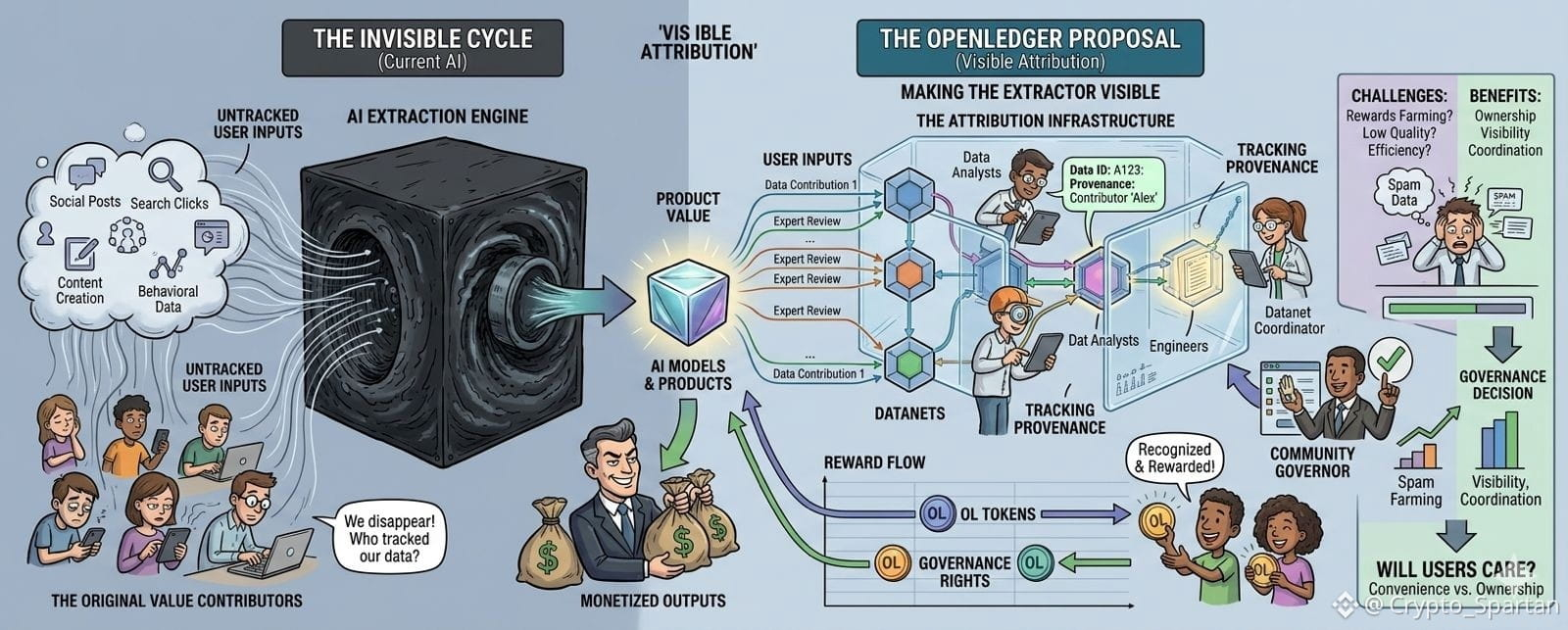
You ever feel like AI is just the same story repeating over and over again with different branding slapped on top.
Every few months its the same cycle. Faster models. Smarter agents. Infinite automation. Everyone acts like these systems just appeared outta nowhere fully intelligent by themselves. But the more I watch how AI actually works, the more weird the whole thing starts feeling.
Because behind all the hype, most AI systems are basically giant extraction machines.
People post, write, click, correct stuff, train behaviors without even realizing it… and all that data gets absorbed into models somewhere in the background. The companies build products on top of it, monetize the outputs, and the people who originally contributed the value kinda disappear from the picture completely.
And honestly thats the part that keeps bothering me.
That’s why OpenLedger caught my attention recently. Not because I think they magically solved AI or anything, but because they’re asking a different question compared to most projects.
Most AI companies ask:
“How do we build smarter models?”
OpenLedger seems more focused on:
“How do we track who actually helped create the intelligence?”
That difference sounds small at first but it’s actually pretty big when you think about it.
Their whole system is built around something called Datanets, where datasets become trackable and attributed instead of just disappearing into some black box forever. So theoretically if data contributes to model outputs later on, the contributors can still be recognized and rewarded inside the system.
The interesting part is that OpenLedger doesnt really feel like a normal AI project to me. It almost feels more like infrastructure for coordinating human knowledge and tracking value flow across AI systems.
And honestly… that might matter more long term than another benchmark flex or another “autonomous agent” demo on Twitter.
Because right now nobody really knows who contributed what once models scale big enough. Data provenance gets blurry fast. The users generating value everyday usually dont even realize they’re part of the infrastructure powering these systems.
But at the same time I’m not fully sold on attribution systems either.
Crypto already showed us what happens when incentives get attached to everything people farm rewards, spam low quality contributions, governance gets messy, and eventually the system starts optimizing around extraction again.
So when I look at OpenLedger, I dont really see certainty. I see tension.
Tension between openness and quality.
Between decentralization and efficiency.
Between rewarding contributors fairly and stopping ecosystems from turning into spam factories.
And honestly I still dont know if normal users even care enough about attribution for this kind of model to fully work. Most people choose convenience over ownership almost every single time. Even crypto users do it.
But AI might slowly change that because human contribution is becoming more invisible as these models improve. The abstraction gets cleaner while the actual people underneath disappear further into the background.
Maybe eventually people start demanding systems that make those contributions visible again.
Or maybe nobody cares as long as the outputs stay useful.
I genuinely cant tell yet.
But I do think OpenLedger is pushing the conversation toward something more important than AI hype cycles. They’re talking more about ownership, incentives, coordination, and who actually captures value once intelligence becomes an always-running system instead of just a standalone product.
And honestly that feels way more interesting to me rn than another flashy demo pretending AGI already arrived overnight.
The extraction machine probably isnt going away anytime soon.
But maybe we can atleast make it visible. #OpenLedger $OPEN
