
I’ve been thinking about something lately that doesn’t fully sit right with how most people are describing AI right now.
We keep talking about AI like it’s just a tool. Something you open, use, and close. A chatbot, an assistant, a productivity layer. Clean and simple.
But the more I look at how systems are actually evolving, the less that description feels accurate.
It feels like we are slowly moving away from “using AI” and toward something more continuous. Something that doesn’t stop when we stop interacting with it.
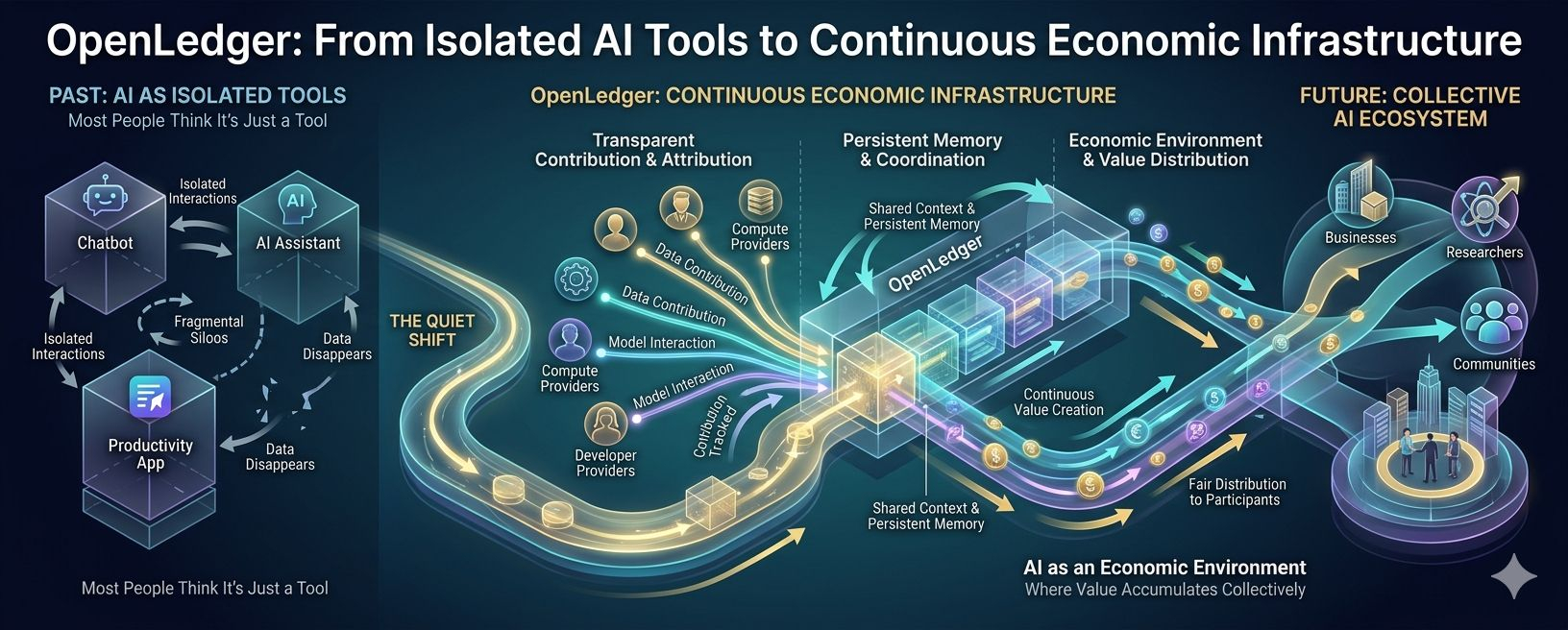
The problem I keep noticing in current systems is not intelligence. AI is already intelligent in many places. The real issue is what happens between interactions. Where does the data go? Who maintains context? How do systems stay aligned when millions of inputs are happening constantly, from different users, in different environments?
Right now, most AI systems reset or fragment in some way. They don’t truly accumulate value in a transparent, coordinated way across participants. Everything is still too isolated. Too disconnected.
And this is where things start to feel incomplete to me.
Because if intelligence is becoming continuous, then infrastructure also needs to become continuous. Not just models responding to prompts, but systems that can carry contribution, attribution, and coordination across time.
While thinking through this, I came across OpenLedger, and I didn’t see it as just another AI project competing in the same space. It felt more like an attempt to restructure how intelligence flows between participants in a system.
At a simple level, the idea is not just about building smarter models. It’s about creating a structure where data contribution, model interaction, and economic incentives are connected in a traceable and persistent way. Where inputs don’t disappear into a black box, but instead remain part of a living system that continues to evolve.
That changes the way you think about AI completely.
Because now it’s not only about what the model can answer, but about how the system remembers, credits, and coordinates the flow of information that shapes those answers over time.
If something like this works at scale, the implications go beyond just better tools.
We might start seeing AI systems that behave less like isolated applications and more like economic environments. Places where value is continuously created, adjusted, and redistributed based on ongoing participation rather than one-time interactions.
That shift also changes user behavior in subtle ways. People don’t just “use” systems anymore. They contribute to them. Even indirectly. Even without realizing it. And that contribution starts to carry weight over time.
What I find interesting, and also slightly uncertain, is whether this kind of structure can actually stay transparent and fair as it grows. Coordination systems are powerful, but they are also fragile. Incentives can drift. Participation can become uneven. And complexity can grow faster than understanding.
So while the idea feels directionally important, it also raises real questions about long-term stability and governance.
Still, compared to many AI narratives that focus only on speed, scale, or automation, this direction feels more structural. Less about what AI can do in isolation, and more about what happens when intelligence becomes part of a continuous system of interaction.
If we extend this forward, I start imagining a world where AI is not something you access, but something you are always partially connected to. Not as a product, but as an environment that quietly evolves based on collective input.
And in that kind of world, the most important layer may not be the model itself, but the infrastructure that manages how intelligence flows between people, systems, and time.
That’s the part I keep coming back to.
Are we building better tools… or are we building continuous economic systems without fully realizing it yet?
What does ownership mean in a system where every interaction becomes part of a shared intelligence flow?
And if AI systems start behaving like economic environments, how do we actually measure value fairly across participants?
I don’t think we have clear answers yet.
But I do think the direction is starting to reveal itself slowly, and OpenLedger sits somewhere inside that transition.
Not as a finished solution, but as part of a larger shift in how intelligence, contribution, and value might eventually connect.
And maybe the real change is not that AI becomes smarter — but that it stops being something separate from the systems we participate in every day.
