
OpenLedger feels like one of those projects I don’t want to hype, because honestly, I’m tired of hyping things in crypto.
But I also don’t want to dismiss it too quickly.
Look, the AI narrative is already messy. Every second project now claims it has something to do with AI. Agents, models, data, automation, intelligence, whatever. Most of it sounds impressive until you actually ask what is happening under the hood.
Then it gets vague.
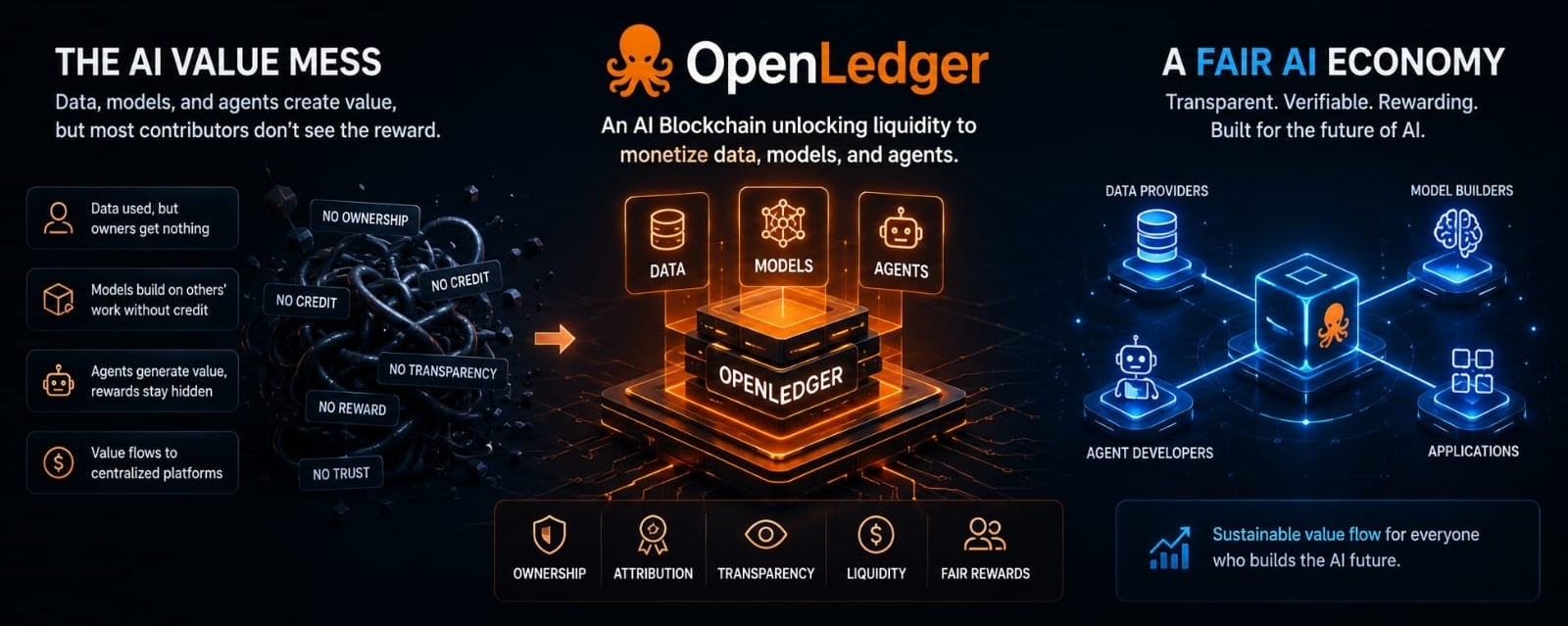
OpenLedger is trying to deal with one part of that mess: how data, models, and agents actually create value, and how that value gets tracked or paid for. That sounds boring. It kind of is. But boring is not always bad in crypto.
Sometimes boring is the thing that was missing.
We’ve all seen what happens when crypto skips the boring parts. Bad airdrops. Fake users. Wallet farms pretending to be communities. Bridges breaking. Points systems turning into emotional damage. People grinding for months only to find out the “loyal users” were just sybil clusters with better scripts.
That’s the trauma.
Crypto loves rewarding noise. It loves rewarding whoever can game the system fastest. Actual contribution often gets buried under bots, hype, and insider timing. So when a project talks about tracking value around AI data and models, I get why that matters.
Not because it sounds cool.
Because the current system is a mess.
Honestly, AI has the same problem crypto had for years: nobody knows who really contributed what. Data gets used. Models get trained. Outputs get sold. Some platform captures the upside. Everyone else is just background material.
That doesn’t feel sustainable.
OpenLedger seems to be aiming at the plumbing behind that. The ugly layer. The place where ownership, access, usage, and payment need to be handled before any of the shiny AI-agent stuff can actually mean something.
It’s not flashy.
It’s just necessary.
But necessary does not mean easy.
The thing is, making a market around data is hard. Really hard. People act like all data is valuable. It isn’t. A lot of data is junk. Some of it is copied. Some of it is outdated. Some of it has legal baggage. Some of it looks useful until nobody wants to pay for it.
So OpenLedger can’t just say, “data has value.”
It has to prove which data has value, who owns it, who can use it, and why someone would pay for it.
That is where the real work starts.
The same goes for models. A model can look good in a demo and still be useless in production. Crypto people love demos. We love dashboards. We love testnet numbers. Then real users show up and everything starts creaking.
Or worse, nobody shows up at all.
So if OpenLedger wants to be more than another AI token story, it has to survive that part. It has to become infrastructure that actually works when nobody is clapping. When there is no campaign. No points hype. No influencer thread explaining why this is “the next big thing.”
Just users trying to get something done.
That’s the test.
And then there are agents.
Look, I know agents are the hot word now. Everyone talks like AI agents are already running businesses and making perfect decisions while we sleep. But most of them still feel fragile. They break. They hallucinate. They need watching. Sometimes they feel less like autonomous workers and more like interns with memory loss.
So building around agents might be early.
Maybe smart early.
Maybe too early.
That’s the uncomfortable part.
OpenLedger might be building rails for something that becomes real later. Agents may eventually need access to data, models, payments, identity, and reputation. If that happens, this kind of infrastructure could matter.
But it might take time.
And crypto is terrible at patience.
The OPEN token is another thing I’d question. Not attack. Question.
Because every token says it has a purpose. Every token has some diagram where it sits perfectly in the middle of the system. But in real life, a lot of tokens are just liquidity events wearing a protocol costume.
So the question is simple: does OPEN actually help the network work, or does it just give the market something to trade?
That matters.
If the token becomes the product, the rest usually starts rotting. The community stops caring about usage. Everyone watches price. Every update becomes “good for token?” Every delay becomes cope. Every partnership becomes fuel for speculation.
We’ve seen this too many times.
That’s why I’m careful with OpenLedger. The idea makes sense, but the category is full of traps. AI is already overhyped. Crypto is already over-financialized. Put them together and you get a machine that can turn a half-built concept into a full-blown narrative overnight.
That doesn’t mean the project is bad.
It means the bar should be higher.
What I like is the problem. Not the slogans. The problem.
AI needs better ways to track contribution. Data owners need better ways to capture value. Model builders need markets that are not completely controlled by giant platforms. If agents become useful, they will need some kind of reliable infrastructure under them.
That part feels real.
But OpenLedger still has to prove it can handle the mess. The boring stuff. Verification. Quality. Spam. Trust. Demand. Real usage. People using it because they need it, not because there is a campaign attached.
That is much harder than launching a token.
Maybe it gets there.
Maybe it doesn’t.
Honestly, the best version of OpenLedger probably would not feel glamorous. It would feel like working plumbing. Something people build on without thinking about it too much. Something that makes AI value less blurry and less dependent on closed platforms.
That would be useful.
Not magical.
Useful.
And in crypto, useful is already a high bar.
So I’m not excited in the loud way. I’m not calling it the future. I’m not pretending this is solved because the idea sounds clean.
I’m just watching it with cautious interest.
Because the mess it is trying to fix is real.
And after enough cycles, that’s all I really ask at the start. A real problem. A difficult build. A reason to exist beyond the chart.
Everything else has to be earned.