
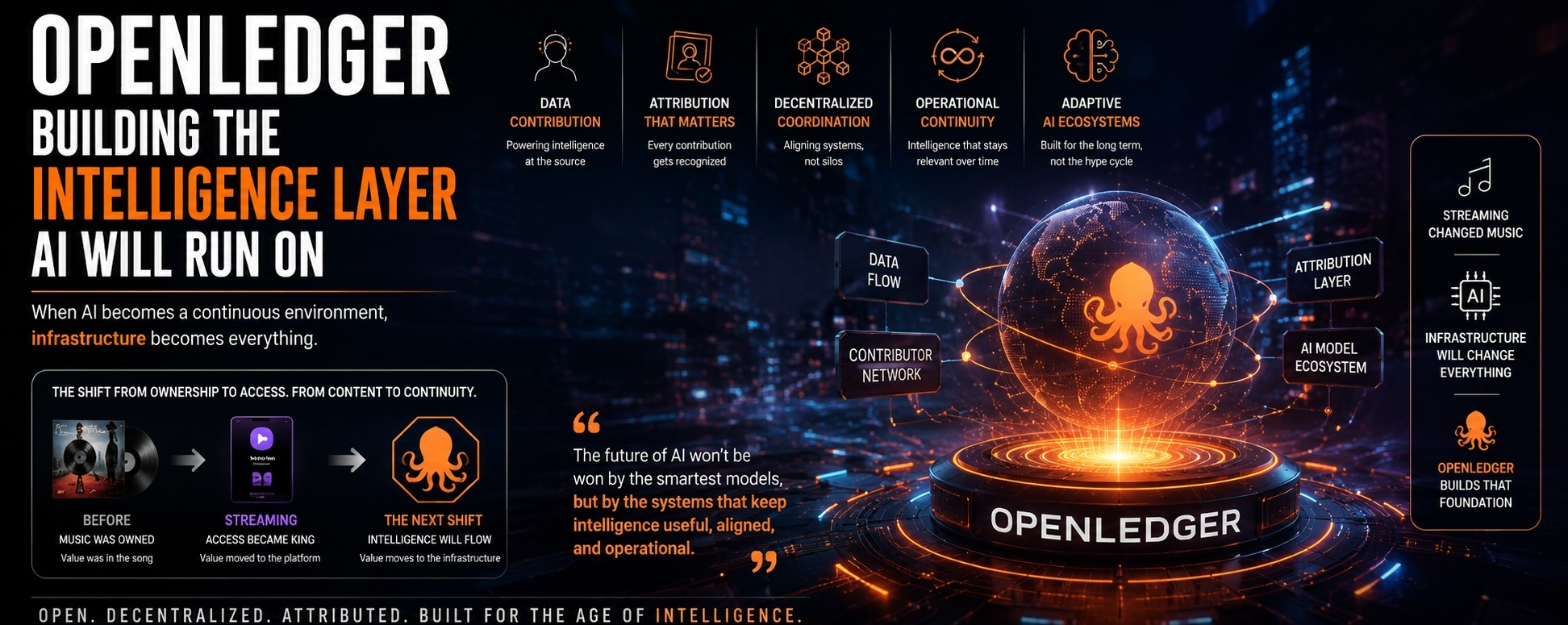
The more I study the direction artificial intelligence is moving toward, the more I feel the industry is slowly shifting away from the old idea of software entirely. Earlier generations of technology were mostly transactional. You opened an application, completed a task, and left. The system itself remained relatively static. AI feels fundamentally different because intelligence no longer behaves like a fixed product. It behaves more like a continuously evolving environment that adapts, improves, coordinates, and operates across multiple layers simultaneously.
That is one of the reasons @OpenLedger started standing out to me recently. Most conversations around AI are still dominated by surface-level competition. People compare models, benchmark performance, speed, and response quality as if the entire future of AI depends only on who generates the smartest output. I think the deeper shift may actually happen underneath the visible layer most users interact with daily.
As intelligence becomes more integrated into digital systems, the infrastructure supporting coordination begins carrying far more importance than people initially expect. Data contribution, attribution, decentralized participation, operational continuity, and adaptive system flow slowly become critical components of maintaining useful intelligence over long periods of time. Without reliable coordination underneath, even highly advanced systems eventually risk becoming fragmented, disconnected, or operationally inefficient.
What makes this interesting to me is that history has already shown similar patterns before. In many industries, the visible product eventually becomes less valuable than the infrastructure controlling long term flow and retention. Streaming changed music consumption forever, but the true power did not simply come from songs themselves. The real dominance emerged from recommendation systems, distribution architecture, behavioral flow, and the platforms coordinating continuous engagement behind the scenes. Most users stopped thinking about ownership entirely because the infrastructure became more important than the individual asset.
I believe AI may gradually move into a similar phase. Over time, intelligence could become so deeply embedded into everyday environments that users stop paying attention to the underlying systems operating beneath the surface. Ironically, that is often when infrastructure becomes most powerful when it becomes invisible. People rarely think about cloud architecture while using applications today, yet modern digital environments would struggle to function without it. The strongest systems often disappear into the background while quietly supporting everything above them.
That possibility changes how I look at $OPEN . I do not see it purely as another short term AI narrative competing for market attention. I see a project attempting to position itself closer to the coordination layer of intelligence itself, where maintaining operational quality, contribution flow, attribution structure, and decentralized continuity may eventually become more valuable than isolated outputs alone.
What fascinates me most is that future AI ecosystems may depend less on singular breakthroughs and more on maintaining sustainable intelligence environments that continue operating efficiently over time. Intelligence can improve endlessly on the surface, but without reliable systems underneath coordinating contribution and operational flow, the long term structure eventually weakens. I think that hidden tension is still massively underestimated across the market right now.
That is why OpenLedger continues holding my attention. Not because it promises instant disruption, but because it appears focused on a layer of AI infrastructure that could quietly become essential once intelligence evolves from isolated tools into persistent digital environments integrated into everyday life.