
I caught myself being skeptical about bridges again.
In crypto, bridges often sound like infrastructure until something breaks. Then everyone remembers that moving assets between networks is not just a convenience feature. It is a trust problem, a security problem, and sometimes a compliance problem.
But the more I think about AI blockchain systems, the more I realize that some kind of reliable movement layer is unavoidable. If data, models, and agents are supposed to become economic assets, they cannot stay trapped inside isolated environments forever.
That is where the EVM Bridge angle around @OpenLedger becomes worth discussing.
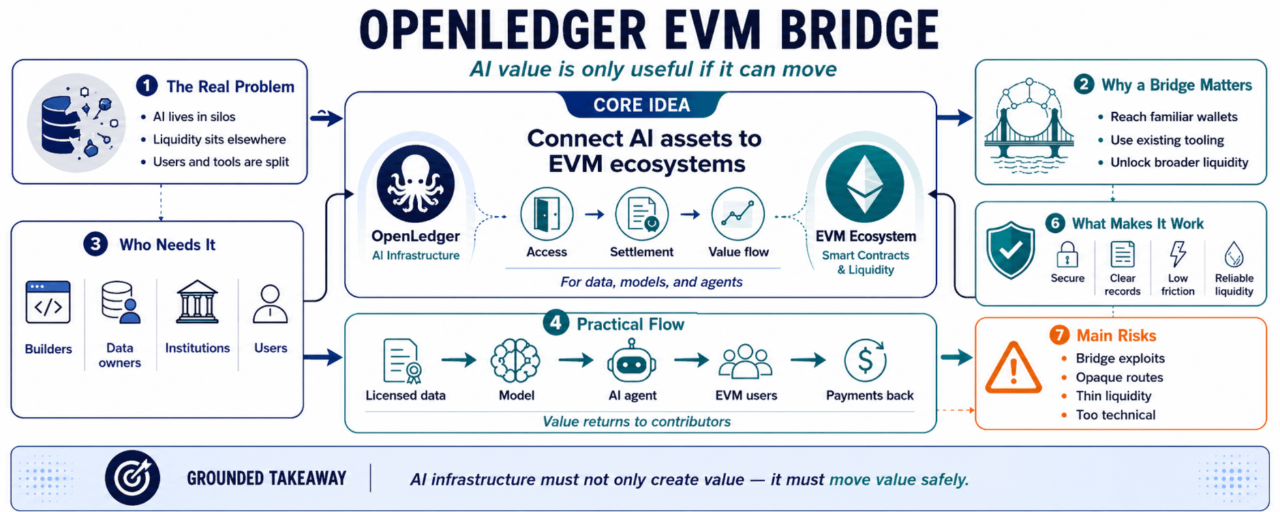
The Real Problem Is Fragmentation
AI already has fragmentation. Models live on different platforms. Data sits in separate databases. Agents are deployed across different tools. Users interact through apps that rarely share context. Builders are forced to stitch systems together with APIs, payment flows, and custom agreements.
Crypto adds another layer of fragmentation. Liquidity may sit on one chain, users may be active on another, and institutions may prefer environments that support familiar tooling. Builders do not want to rebuild everything from zero just to reach the right users.
This matters because infrastructure only becomes useful when participants can actually access it. A brilliant AI network with weak connectivity may still struggle if liquidity, developers, and users are elsewhere.
Why Movement Is Not Just Technical
When people hear “bridge,” they often think about transferring tokens. That is part of it, but not the whole issue.
For an AI economy, movement also relates to settlement. If a model is used by an agent, and that agent creates value for a user, payment may need to move across systems. If a dataset is licensed, value may need to return to the data owner. If an institution uses AI infrastructure, it may need records that explain where assets moved and why.
This is where law and human behavior enter the picture. Users want low friction. Builders want larger markets. Institutions want clear records. Regulators want to understand exposure. Nobody wants to depend on an opaque route that becomes impossible to explain during a dispute. $GUA
So the bridge is not only about access. It is about whether value can move in a way that people are willing to trust.
Where OpenLedger Could Matter
OpenLedger is focused on unlocking liquidity for data, models, and agents. That idea becomes more practical when those assets can connect with broader blockchain ecosystems rather than sitting in a closed lane.
An EVM Bridge could matter because EVM compatibility is where many builders, wallets, tools, and liquidity networks already exist. If OpenLedger can connect its AI-focused infrastructure with familiar EVM environments, it may reduce the gap between AI asset creation and real usage.
For $OPEN , the point is not just movement for movement’s sake. The stronger question is whether value created by AI systems can be settled across networks without forcing every participant into the same silo.
That could make @OpenLedger more usable for builders who already work in EVM-based ecosystems, institutions that prefer established tooling, and users who do not want to learn a completely separate environment just to interact with AI assets.
A Practical Example
Imagine a builder creates a specialized AI agent for on-chain risk analysis.
The agent watches wallet activity, flags suspicious patterns, and helps a compliance team review transactions. The model behind it was trained on licensed data. The agent is deployed through OpenLedger, but the users and liquidity are mostly active in an EVM ecosystem.
Without a bridge, the builder may face extra friction. Users need to move into a separate environment. Payments may become awkward. Settlement records may be split across systems. The compliance team may have to reconcile data manually.
With an EVM Bridge, the workflow could become more realistic. Users could access the agent through familiar infrastructure. Payments and value distribution could move more naturally. The data owner, model builder, and agent creator could receive value without everyone operating in one isolated place.
That is the kind of boring utility that often matters more than a flashy demo.
The Risk Is Bridge Trust
The risk section almost writes itself.
Bridges have a difficult history. Users remember exploits. Institutions remember operational risk. Regulators may ask uncomfortable questions about custody, settlement, and responsibility. Even if the design is strong, perception matters.
OpenLedger would need to make the bridge experience secure, understandable, and reliable. If users feel the bridge adds risk instead of reducing friction, adoption could slow. If the process is too technical, only advanced users may bother. If liquidity remains thin, the bridge may exist but not meaningfully change behavior.
There is also a broader risk: AI builders may care more about simple integrations than cross-chain settlement. If OpenLedger cannot connect bridge functionality to real workflows, it could feel like infrastructure looking for a use case. $AIGENSYN
Grounded Takeaway
The people who would actually use this are builders who want their AI agents and models to reach EVM users, data owners who want value distribution beyond one closed network, institutions that need clearer settlement paths, and users who prefer familiar tools.
It might work if OpenLedger makes movement feel safe, ordinary, and connected to real AI usage. It might fail if bridge risk, low liquidity, or poor user experience outweigh the benefits.
To me, #OpenLedger is interesting here because AI infrastructure cannot only create value. It also has to move value.
Not financial advice.
Would you trust an AI blockchain more if it connected to familiar EVM infrastructure, or would bridges make you more cautious?