
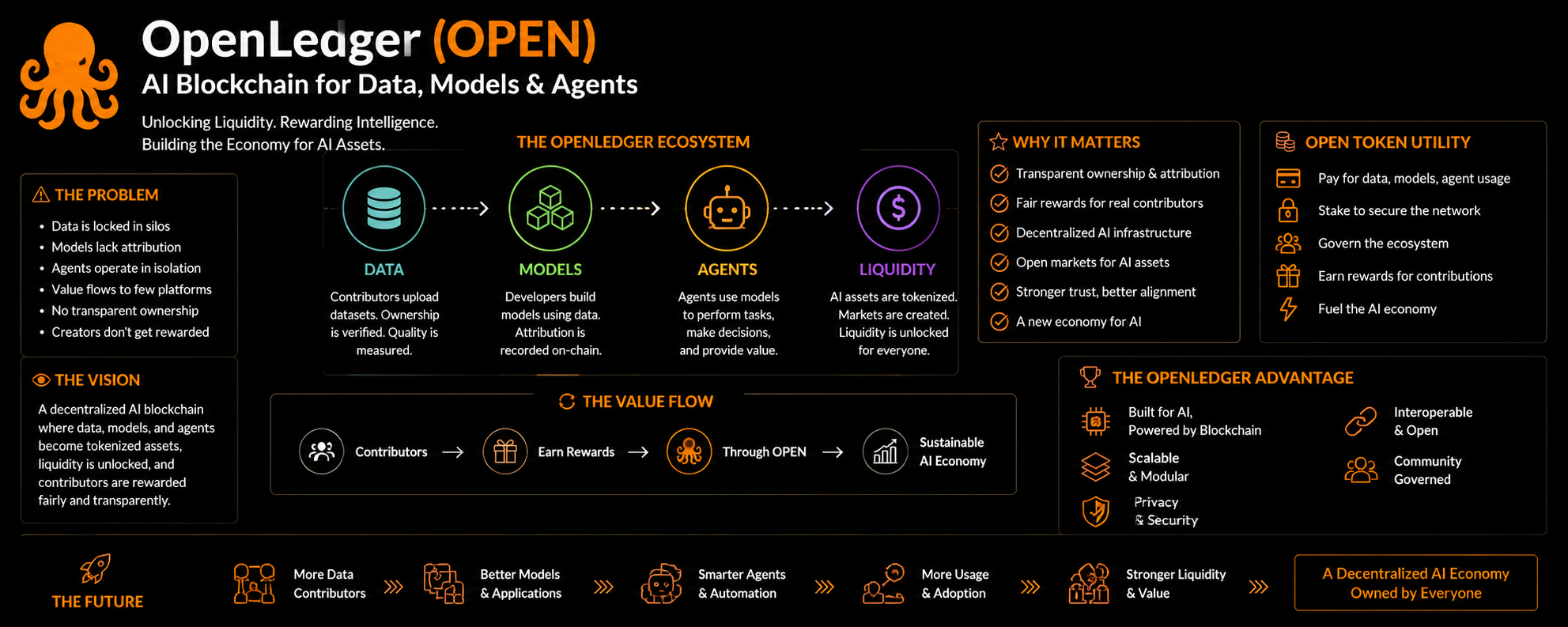
OpenLedger is the kind of project I find myself reading about late at night, usually at the point where I have already gone through too many whitepapers, too many token designs, and too many promises about the next infrastructure layer that will supposedly change everything. I look at it and I understand why it exists. An AI blockchain focused on data, models, and agents makes sense in the current market. It sits exactly where attention is flowing. But that is also why I slow down. I have seen DeFi turn into leverage games, GameFi turn into empty economies, AI narratives stretch far beyond actual usage, modular chains multiply faster than demand, and every cycle teaches the same lesson in a different costume: a good story can carry a token for a while, but it cannot carry a network forever.
I'm watching OpenLedger with interest, but it is not the clean kind of interest where I immediately feel convinced. It is more like that tired curiosity that comes after seeing a hundred projects explain why their architecture is different. The idea sounds useful on paper. Data should be monetized better. Models should have clearer ownership. Agents should be able to coordinate and transact. Contributors should not disappear behind closed AI systems while value moves upward to a few platforms. I get all of that. The problem is that crypto has always been good at describing new economies before proving that anyone needs them badly enough to keep them alive.
I keep asking myself what OpenLedger is really solving in practice. Not in the abstract, because abstractly almost everything in crypto sounds reasonable. I mean in the daily, boring, usage-driven sense. Who comes to OpenLedger because they cannot do what they need elsewhere? Who brings valuable data and trusts the system enough to monetize it there? Who builds models on it because the infrastructure gives them an advantage? Who uses agents because the chain makes coordination better, not just more complicated? These are the questions that stay with me after the excitement fades from the page.
The AI angle is obviously powerful, maybe too powerful. That is what makes me careful. When a project attaches itself to AI, the market often fills in the blanks. People assume demand will come because AI is growing. They assume data will matter because AI needs data. They assume agents will become huge because everyone is talking about agents. But I have learned not to let the market complete the thesis for me. OpenLedger still has to prove that its version of this future has real participants, real transactions, and real reasons to exist beyond being positioned correctly during an AI cycle.
I keep coming back to liquidity, because that word sounds beautiful until I start pulling it apart. Liquidity for data, models, and agents is not the same as liquidity for a token. A token can trade because there is speculation. Data needs quality. Data needs rights. Data needs buyers. A model needs performance. A model needs trust. A model needs distribution. An agent needs to do something useful without becoming another demo that looks clever for five minutes and then disappears. If OpenLedger wants to unlock liquidity around these things, then the hard question is whether the underlying assets are actually worth making liquid.
I have seen enough incentive systems to know that early activity does not always mean much. A network can look alive when rewards are flowing. People will connect wallets, complete tasks, upload things, test features, and talk about future allocations. None of that is useless, but it is not proof by itself. The real test is what remains after incentives shrink. If OpenLedger still has contributors, developers, and users when the reward layer becomes less exciting, then I would pay much closer attention. If participation mostly depends on expected upside from OPEN, then the project is still in that familiar crypto zone where everyone is waiting for value instead of creating it.
OPEN itself is something I would not want to analyze only through price. Price can move for many reasons, especially in a narrative-heavy sector. A token can pump because AI is hot, because liquidity rotates, because traders want exposure, or because the float and timing are favorable. That can happen before the network proves much. What matters to me is whether OPEN becomes necessary inside the system. Does it pay for access? Does it secure validation? Does it coordinate contributors? Does it settle usage between data owners, model builders, and agents? Does it create accountability? Or is it mainly a financial wrapper around a platform that could function without it? That distinction matters more than the chart in the long run.
The attribution idea is probably the part that keeps me interested. AI has a real attribution problem. Data gets absorbed, models improve, outputs are created, and the original sources of value often become invisible. If OpenLedger can make contribution more visible and economically meaningful, that is not a small idea. But I also know attribution is messy. AI does not always produce value in a straight line. One dataset might matter indirectly. One model improvement might come from tuning rather than raw data. One contributor might add quality while another adds volume. If the system rewards the wrong behavior, people will optimize for the reward instead of the usefulness. That is where many crypto economies quietly break.
Trust is another uncomfortable piece of this. OpenLedger is trying to operate in two sectors where trust is already fragile. AI has opacity. Crypto has speculation. When the two combine, the result can either become more transparent or even more confusing. I would need to see whether OpenLedger actually makes data, models, and agents easier to verify. I would need to see whether users can understand provenance, whether developers can rely on the infrastructure, and whether contributors can believe the reward mechanism is fair. Without trust, liquidity becomes shallow. Without trust, the network becomes another marketplace where everyone is unsure what anything is really worth.
I also think about developers, because developers usually reveal the truth faster than communities do. Communities can stay excited around a token. Developers are more practical. They care about tools, documentation, reliability, costs, users, and whether building on a specific stack gives them an edge. If OpenLedger becomes useful, developers should return after the first wave. They should build more than proofs of concept. They should find something there that is hard to get elsewhere. If developer activity only appears around grants, hackathons, or launch campaigns, then I would treat it as early signal at best, not evidence of a lasting ecosystem.
The question of who actually needs OpenLedger still feels central to me. Maybe it is for data owners who want new revenue. Maybe it is for AI developers who need attribution and monetization. Maybe it is for agents that require a neutral settlement layer. Maybe it is for businesses that want auditable AI infrastructure. Each of these users has different needs. If the project tries to speak to all of them equally, the message can become too wide. I have seen that happen before. A project becomes so broad that nobody can explain the first urgent use case. I would rather see OpenLedger dominate one narrow, real problem than describe a giant future economy that has not started forming yet.
What keeps a system like this alive is not announcements. It is not branding. It is not even the initial token listing. What keeps it alive is repeated use. Someone needs to come back because the network helps them earn, build, verify, deploy, or coordinate better than the alternatives. That repeated use has to create economic movement. Data should not just sit there. Models should not just be listed. Agents should not just be a concept. OPEN should not just be held in hope. The parts need to interact in a way that creates a loop. If data improves models, models power useful agents, agents create demand, and that demand rewards contributors through the token economy, then there is something to study seriously.
But I am not there yet. I am still in the watching phase. That does not mean I am bearish. It means I have learned to respect the gap between a thesis and a working market. OpenLedger is pointing at a real problem, and that matters. AI value is becoming more centralized. Data ownership is unclear. Model contribution is hard to reward. Agents will need coordination if they ever become more than scripted tools. There is room for infrastructure here. I just do not want to confuse room for infrastructure with proof that this particular infrastructure wins.
There is also the old crypto problem of time. Markets want quick confirmation, but infrastructure takes longer than traders usually allow. If OPEN gets priced like the future is already here, the project may have to grow into expectations very quickly. That can create pressure. Incentives may need to stay high. Announcements may need to keep coming. Partnerships may need to sound bigger than they are. I have seen that pattern too many times. The healthier version is slower and less glamorous: real users, small but durable demand, developers shipping, and token utility becoming clearer over time.
I find myself curious about OpenLedger because the idea is not empty. I also find myself tired because I have read this kind of ambition before. That mix is probably the most honest place to stand. I do not want to dismiss it just because the market has abused the AI narrative. I also do not want to reward it just because the category is attractive. The only thing that really matters is whether OpenLedger can turn data, models, and agents into a functioning economy where ownership, trust, liquidity, and incentives actually reinforce each other.
So I keep watching. Not with hype, not with certainty, and not with the feeling that I need to be early at any cost. I watch to see whether real usage appears beneath the narrative. I watch to see whether OPEN becomes part of actual network behavior. I watch to see whether developers stay after the incentives. I watch to see whether contributors earn because they added value, not because they gamed a system. I watch to see whether the project survives the quiet moments, because that is usually where the truth shows up. OpenLedger might matter, but it has to prove that it matters when the market stops doing the storytelling for it.
