
Most blockchain projects today still follow a very familiar pattern. A new narrative appears, people rush toward it, tokens rise quickly, communities become loud for a few weeks, and then attention slowly disappears once the excitement fades. I noticed that this cycle has become so common that many people now struggle to separate real infrastructure from temporary market storytelling. The same thing is starting to happen with artificial intelligence. Every day there is another AI announcement, another model launch, another promise that machines will completely transform the world. But underneath all the noise, a much deeper shift is quietly taking place.
I started thinking about how artificial intelligence is changing not only software, but the structure of value creation itself. AI systems are no longer isolated tools. They are becoming networks made of data contributors, models, validators, autonomous agents, and computational infrastructure working together continuously. The more I explored OpenLedger, the more it felt like the project was trying to focus on that hidden layer rather than simply building another AI application designed to capture attention.
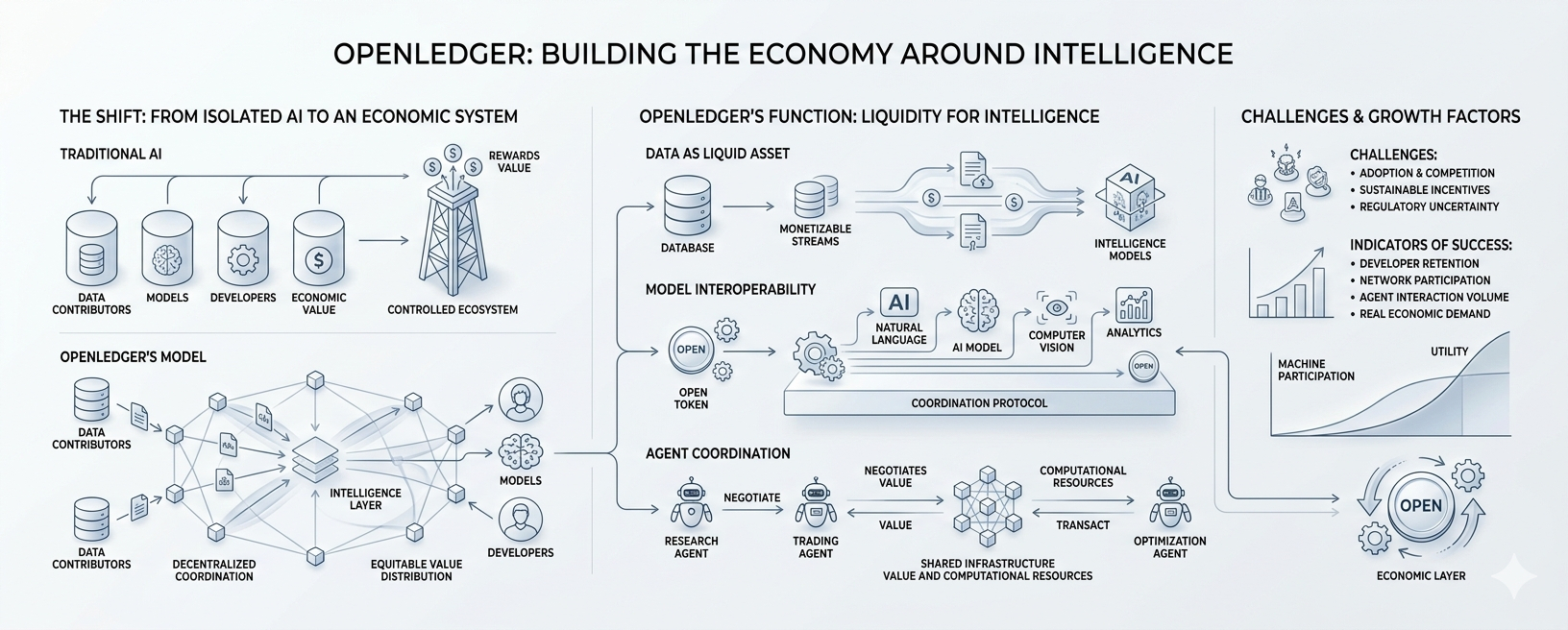
What makes OpenLedger interesting is not only that it combines AI with blockchain technology. Many projects already claim to do that. The difference is that OpenLedger appears to treat intelligence itself as an economic system. That idea sounds abstract at first, but the implications become clearer over time. Most AI systems today operate inside centralized environments where a small number of companies control the models, the data pipelines, the infrastructure, and eventually most of the economic value generated from them. Yet the intelligence inside these systems is often created from contributions coming from millions of people spread across the internet. Data is collected from users. Models are trained on shared information. Developers contribute improvements. Entire ecosystems indirectly help these systems become smarter. Still, the rewards remain concentrated in very few places.
This is where OpenLedger starts becoming relevant. They are trying to build infrastructure where data, models, and AI agents can become economically active participants inside an open network instead of remaining trapped inside closed systems. I noticed that the project repeatedly focuses on liquidity for intelligence, and the more I thought about it, the more meaningful that phrase started to feel. In traditional finance, liquidity allows capital to move efficiently through markets. OpenLedger seems to apply that same logic to machine intelligence itself. Instead of treating data as something static sitting in databases, the network attempts to make it monetizable. Instead of AI models existing only inside isolated platforms, they can potentially interact inside a broader ecosystem. Instead of autonomous agents operating in disconnected environments, they may eventually coordinate economically through shared infrastructure.
The blockchain becomes important here because the problem AI is moving toward is no longer only technological. It is increasingly a coordination problem. Once multiple participants contribute to intelligence creation, questions naturally emerge. Who owns the outputs? Who receives rewards? Who verifies contributions? Who controls access? Who governs the rules of participation? Traditional centralized systems answer these questions internally, but decentralized infrastructure attempts to answer them collectively through transparent coordination mechanisms. I started wondering if this may ultimately become one of the biggest reasons blockchain technology survives long term. Not necessarily because people want decentralization as an ideology, but because large machine economies may eventually require systems capable of coordinating trust across participants who do not fully know each other.
OpenLedger appears designed around that future. The architecture seems built specifically for AI-related interactions rather than simply adapting a general-purpose blockchain toward AI branding. That distinction matters because artificial intelligence introduces very different requirements compared to traditional financial applications. AI systems depend heavily on attribution, continuous computation, verification, and data coordination. A network supporting machine economies needs ways to track contributions, reward participation, validate outputs, and allow different components of intelligence to interact together. It becomes clear that OpenLedger is trying to position itself as infrastructure for those interactions rather than only another token ecosystem searching for market attention.
I noticed that attribution appears to be one of the most important ideas inside the project. In many AI systems today, it is extremely difficult to determine where value truly originates. Data contributors are rarely compensated directly. Smaller developers often struggle to capture economic upside from their work. OpenLedger seems to recognize that future AI ecosystems may depend heavily on attribution systems capable of tracking how information, models, and machine activity contribute to final outputs. That may sound technical, but it could become extremely important as AI systems grow larger and more autonomous over time.
The OPEN token functions as the economic layer connecting activity inside the ecosystem. Like most blockchain projects, the token likely supports staking, participation incentives, governance processes, and transaction coordination. But I noticed that the deeper question is not whether the token exists. The more important issue is whether the network can generate real economic demand beyond speculative trading cycles. Many crypto ecosystems look strong during bullish conditions but weaken once market excitement disappears. Sustainable infrastructure usually depends on whether actual utility continues even when speculation slows down.
For OpenLedger, that utility may eventually come from machine participation itself. If developers begin deploying meaningful AI applications on the network, if datasets become economically valuable inside the ecosystem, if AI agents require infrastructure for transactions and coordination, then the token could become tied to real network activity rather than only investor sentiment. Of course, that future is still uncertain. I noticed that many AI crypto projects currently operate ahead of actual adoption curves. The vision often arrives before the infrastructure is fully needed by the market. That creates both opportunity and risk at the same time.
The broader AI narrative surrounding projects like OpenLedger is also becoming increasingly important. We are seeing artificial intelligence evolve from isolated software products into interconnected systems capable of operating across multiple environments simultaneously. AI agents may eventually negotiate services, purchase computational resources, exchange information, and coordinate actions without direct human supervision. Once machines begin interacting economically with one another, entirely new forms of infrastructure may become necessary. That possibility changes how blockchain technology itself should be viewed. Instead of functioning only as financial rails for human transactions, blockchains may gradually evolve into coordination layers for machine economies.
I started thinking about earlier periods of internet development while exploring this idea. Most people remember the visible applications that became famous, but underneath those applications existed invisible infrastructure layers supporting communication, payments, hosting, indexing, and identity systems. Those infrastructure layers quietly shaped how the digital economy evolved. OpenLedger feels like an attempt to build similar infrastructure for the next phase of intelligence networks. Whether it succeeds or not, the direction itself reflects where parts of the industry are beginning to move.
At the same time, the challenges facing projects like this are very real. Adoption remains one of the biggest obstacles. Developers already have access to powerful centralized AI infrastructure provided by large technology companies. Convincing builders to adopt decentralized alternatives requires more than philosophical arguments about openness or decentralization. The systems must compete in terms of performance, usability, cost efficiency, reliability, and developer experience. That is an extremely difficult challenge, especially in industries moving as quickly as AI and crypto.
Validator incentives also become important in these ecosystems. If networks depend on participants validating AI-related activity, the incentive structures must remain carefully balanced over long periods of time. Poor incentives can easily create low-quality participation, artificial activity, or systems optimized for extracting rewards rather than contributing meaningful value. I noticed that this is where many ambitious blockchain projects quietly struggle beneath the surface. Building the technology is only part of the problem. Building sustainable economic behavior inside the system is often even harder.
Regulation creates another layer of uncertainty. Governments around the world are still trying to understand artificial intelligence and cryptocurrency separately. Projects operating at the intersection of both industries may eventually face complicated questions involving data rights, intellectual property, privacy standards, autonomous systems, and financial compliance. It becomes clear that infrastructure projects like OpenLedger are not simply competing technologically. They are also attempting to navigate environments where legal frameworks themselves are still evolving.
Because of this, success for OpenLedger probably should not be measured only through token price or short-term market performance. I noticed that infrastructure projects often reveal their true strength through quieter indicators over time. Developer retention matters. Network participation matters. The number of meaningful applications being built matters. The ability of the ecosystem to sustain activity during difficult market conditions matters. If autonomous agents eventually begin interacting economically across decentralized systems, then machine participation itself may become one of the strongest indicators of whether networks like OpenLedger are succeeding.
What stayed with me most while thinking about OpenLedger was not necessarily the blockchain itself or even the token economy. It was the realization that intelligence may gradually become its own economic layer inside the digital world. For decades, the internet mainly connected humans to information. The next phase may involve machines interacting with other machines continuously across global networks. In that kind of environment, infrastructure capable of coordinating trust, attribution, ownership, and incentives may become increasingly important.
Whether OpenLedger ultimately succeeds remains uncertain. The technical challenges are enormous. The competition is intense. Adoption may take far longer than many people expect. But I noticed that some of the most important technological shifts often begin quietly before the broader market fully understands what is changing underneath the surface.
And perhaps that is why projects like OpenLedger deserve thoughtful attention. Not because they promise instant transformation or short-term excitement, but because they are attempting to explore what economic systems for machine intelligence could eventually look like if AI continues expanding beyond centralized platforms into open digital ecosystems.
The future of artificial intelligence may not only depend on who builds the smartest models. It may also depend on who builds the systems capable of coordinating intelligence fairly, openly, and sustainably across an increasingly autonomous digital world.
