
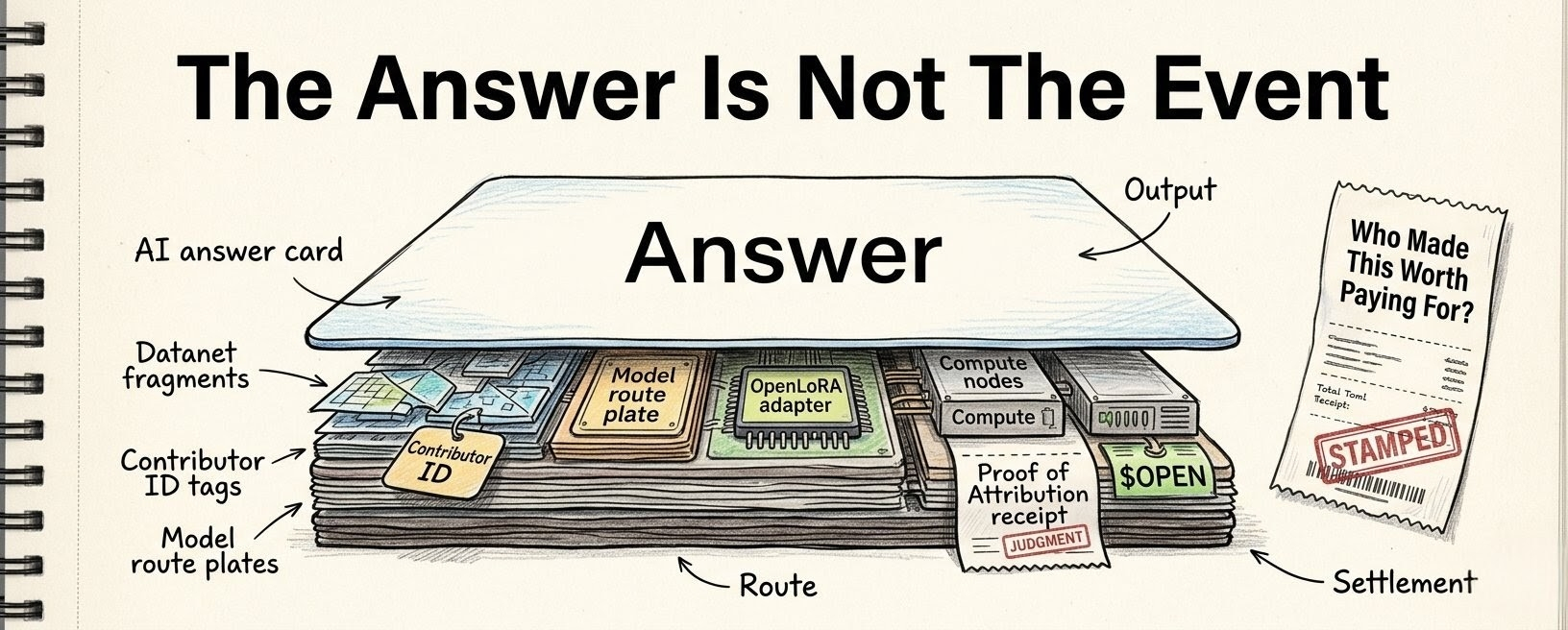
i keep thinking the dangerous thing inside OpenLedger (@OpenLedger ) is not just whether a model is good or bad.
that’s too old of a question now.
the stranger question is whether something inside the stack can start sounding trustworthy before it has actually earned that trust inside the route carrying it.
and the more i stare at OpenLoRA the more i feel that pressure sitting there.
because a specialization layer can look very convincing very fast.
almost too fast.
it comes in narrow, tuned, domain-shaped, cleaner in tone, sharper in language, more certain in texture, and suddenly the output feels like it knows what it’s doing more than the base route did a second earlier.
but what exactly am i trusting then?
the specialization itself?
or the fact that it is standing on top of other layers that were already carrying most of the route weight?
that part keeps bothering me.
because OpenLedger is built in a way where trust does not really come from one place anymore. Datanets shape what enters. base model routes carry broad reasoning. OpenLoRA bends behavior for one context. OctoClaw can turn that output into agent execution. Proof of Attribution traces the route after the fact. OpenLedger ($OPEN) settles around the path if value actually moves.
so when something feels “smart” inside this stack, who earned that feeling.
really?
that is where it gets weird to me.
because specialization can borrow a lot of credibility from its surroundings.
a strong Datanet gives it better raw material.
a decent base model gives it broader reasoning structure.
a clean route gives it coherence.
then OpenLedger OpenLoRA arrives, tightens the domain language, sharpens the stance, maybe makes the output feel more precise, more native, more like it belongs to that exact use case.
and suddenly it looks like the specialization itself is the genius.
maybe it is.
or maybe it is just the most visible bend in the route.
“precision can impersonate route-earned authority.”
that line keeps sitting in my head.
because inside a routed stack, the sharpest layer often gets mistaken for the layer that earned the confidence premium. and inside OpenLedger that problem gets more serious because these outputs do not have to stay as outputs. they can travel. they can enter agents. they can touch execution. they can shape things that settle.
so now the issue is not just stylistic overconfidence.
it becomes route-level overcredit.
like imagine one inference path where the base model does most of the real reasoning work, the Datanet provides strong domain signal, and OpenLoRA mostly bends the tone, format, and narrow behavioral direction enough to make the answer feel “expert.” what happens then? does the specialization get trusted more than it deserves just because it changed the surface in the most visible way?
i think yes.
and i think that risk is bigger than people admit.
because in OpenLedger systems like this the last visible bend often gets mistaken for the most important one. not because it is carrying the whole route, but because it is the part users can feel most directly. maybe OpenLoRA has a version of that problem inside OpenLedger.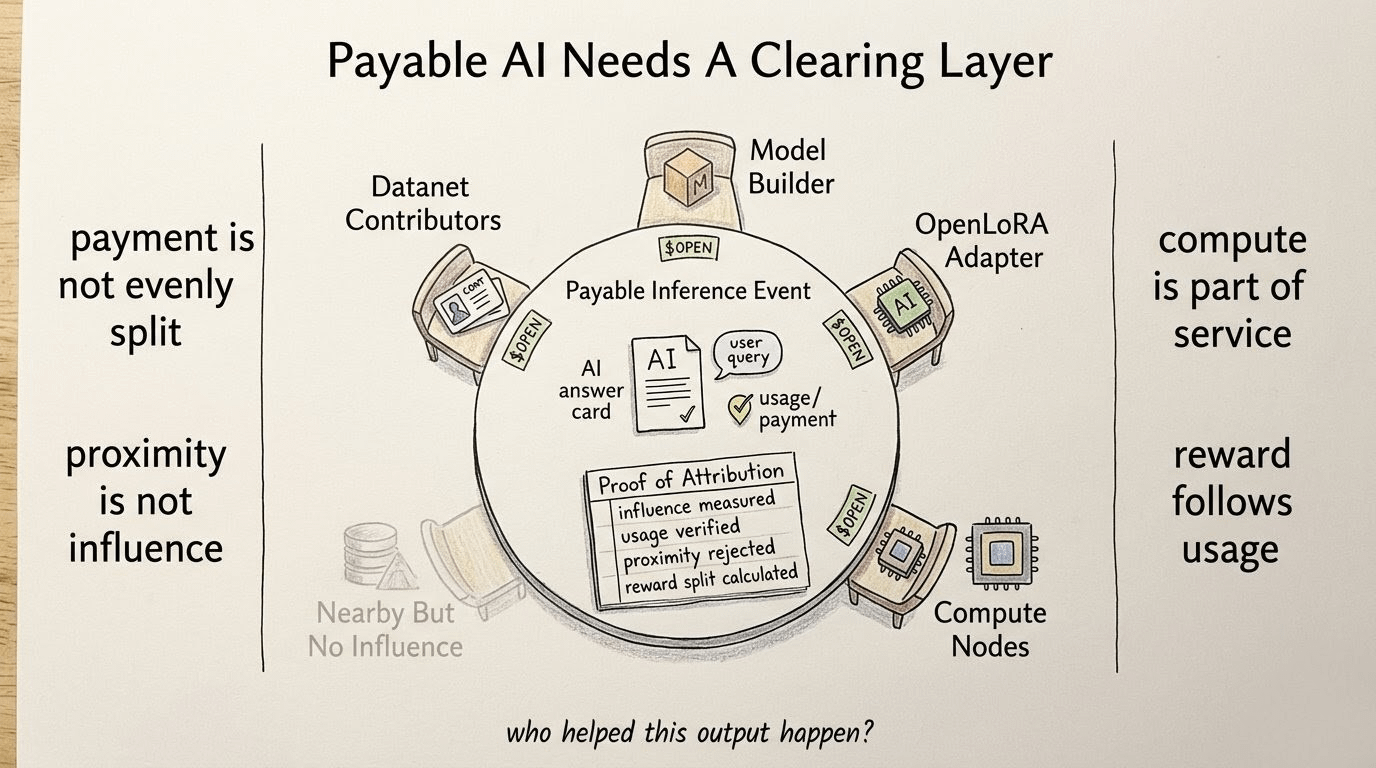
not always. but enough to matter.
and if it does, then OpenLedger has a trust problem hiding inside its specialization logic.
not because specialization is fake.
but because specialization can borrow authority from stronger upstream layers without making that borrowing legible at the same speed the confidence appears.
that is the real part.
because if a Datanet supplies the rare edge-case signal, and the base model carries most of the reasoning skeleton, and then OpenLoRA steps in and gives the answer that final narrow domain texture that makes it sound expensive and competent and “for this exact job,” who gets believed? who gets the trust premium?
probably the last bend.
probably the thing that made the answer feel tailored.
and that feels dangerous to me because tailored is not the same as proven.
“the most visible layer is not always the most load-bearing one.”
that one lands harder the more i think about it.
and this gets uglier once agents enter the picture.
because an agent does not necessarily care about where the feeling of authority came from. if the route is coherent enough, if the output crosses some threshold of usability, if permissions are already there through OctoClaw, then the OpenLedger system may move from specialized tone to specialized action faster than humans are ready for. and now trust is not just psychological. it becomes operational. it becomes execution-eligible. it becomes route consequence.
which layer did the agent trust there?
the whole route, technically.
but in practice maybe the specialization layer did the confidence work that pushed the route across the line. maybe that was the part that made the output feel decisive enough to act on.
that is not small.
especially because OpenLedger is not just trying to make AI modular. it is trying to make it attributable, payable, and execution-capable. which means borrowed trust can get wrapped in receipts and start looking even more legitimate than it should. that is the darkly funny part. once the path is traceable, people may feel even safer, but traceability is not the same thing as deserved confidence. you can perfectly trace a route where one layer borrowed more trust than it earned.
Proof of Attribution will tell you the route.
fine.
but will the route itself tell you which layer merely sharpened the answer and which layer actually carried the underlying intelligence?
will it tell you which part earned the confidence premium and which part only made the route feel sharper?
not so cleanly.
that’s where my head keeps getting stuck.
because OpenLedger makes influence legible after the fact, but users do not read routes neutrally. they react to tone, sharpness, narrowness, certainty. they react to the layer that makes the route feel domain-native. so the danger is not only that the system can show the path. the danger is that people may still overweight the most convincing-looking piece of the path.
which in this case could be OpenLoRA.
and maybe that is unfair to OpenLoRA, but architecture is full of unfairness like that. layers get judged for the effect they create, not only for the technical weight they carry. if a specialization layer makes the answer suddenly feel “medical,” “legal,” “trading-native,” “research-grade,” whatever, then the user may transfer trust to it that was actually produced by the whole stack together.
so what exactly is being trusted.
the adapter?
the route?
the upstream Datanet?
the base model that did the slower invisible work?
or just the fact that the final output stopped sounding generic?
that last one feels very real tbh.
because generic answers trigger skepticism. narrow answers trigger surrender. once something sounds specific enough, people start relaxing around it. and OpenLedger has all the ingredients for that effect to get stronger, not weaker. Datanets narrow context. OpenLoRA narrows behavior. agents narrow execution paths. payable inference narrows value onto the route. the whole system is built around structured narrowing. useful, yes. also a little dangerous, yes.
because narrowed intelligence can feel earned even when part of what it is borrowing comes from layers people are not mentally scoring properly.
and then what happens in failure?
that is where this stops being abstract.
if a specialized answer goes wrong, do people blame the narrow layer because it sounded most responsible? or do they notice the Datanet weakness underneath it? or the base model limit? or the way the route was assembled? maybe Proof of Attribution can show all that later, but later is not the same as first impression. first impression is where trust got allocated. later is where blame gets untangled. those are not the same event.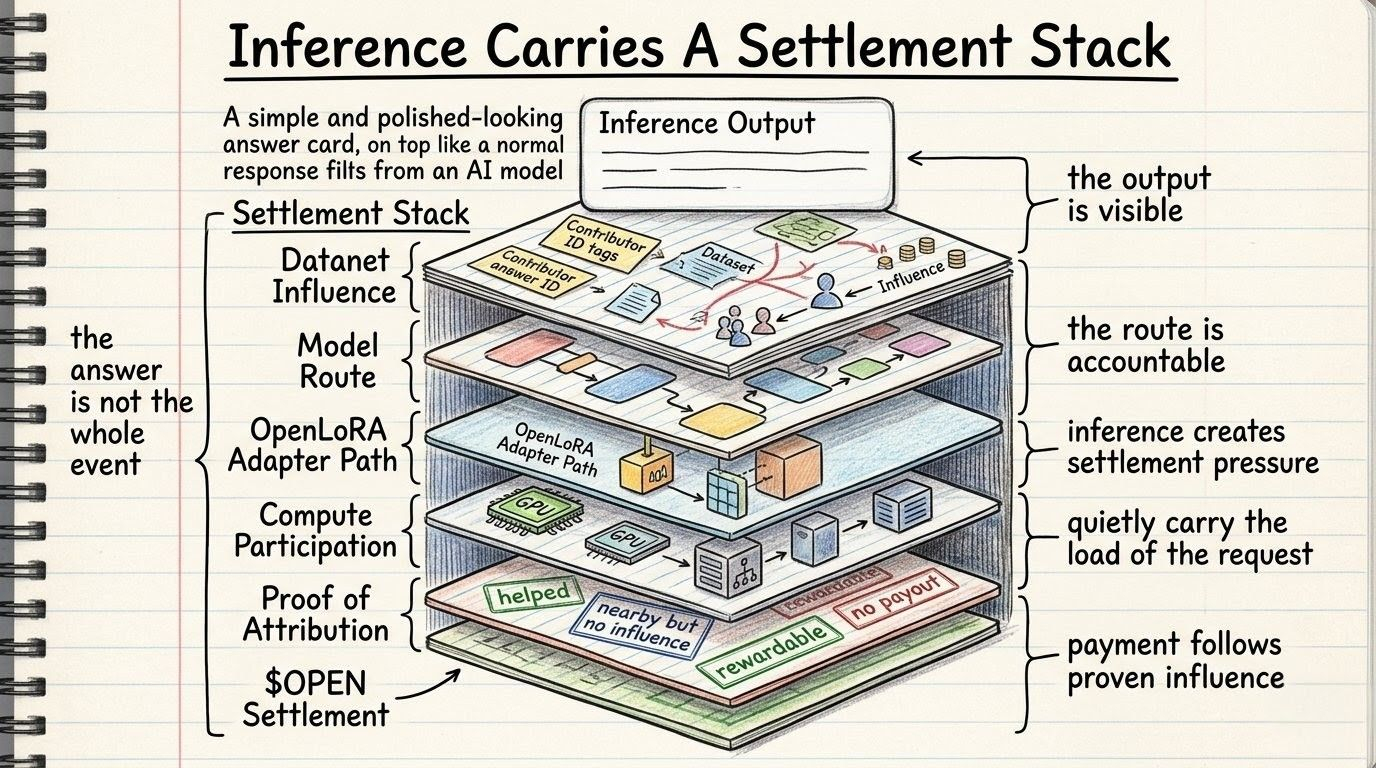
and maybe that is the real asymmetry.
trust arrives fast.
causal understanding arrives late.
that gap can kill you in any system that touches action.
especially in one where the route can become payable and executable.
“borrowed trust can clear faster than borrowed understanding.”
yeah. that feels true.
and i think this is why OpenLedger keeps feeling more serious than the usual AI-chain talk. because once specialization becomes modular and cheap enough to load into live routes, the question is no longer only whether it improves performance. the harder question is whether it amplifies confidence faster than it amplifies justified confidence inside a route that can later be acted on and settled. those are different curves. and if they diverge too much, the stack can start producing outputs that feel more trustworthy than the architecture has really earned.
that would be a very modern failure.
not hallucination exactly.
not fraud exactly.
more like route-level trust inflation.
and trust inflation inside a OpenLedger system built around Datanets, OpenLoRA, agents, attribution, and settlement feels like the kind of problem that can hide for a while because everything looks organized. every layer has a role. every route has receipts. every contribution can be named. very clean. but clean routes can still produce dirty confidence.
that’s the part i can’t shake.
because the market loves specialization. users love it too. everybody wants the domain-native answer, the tuned behavior, the thing that sounds like it belongs exactly where it landed. and OpenLedger is structurally good at producing that feeling. which is powerful. maybe necessary. but it also means the system has to be extremely careful that specialization is not allowed to borrow too much authority from upstream strength and then walk around like it earned the whole route alone.
if it can’t solve that, then specialization becomes a trust multiplier before it becomes a truth multiplier.
and that is a bad trade.
because once agents, capital, workflows, or other execution surfaces begin trusting the most convincing layer more than the most load-bearing layer, the architecture starts rewarding appearance of competence at exactly the moment it should be protecting against it.
i keep coming back to that.
OpenLedger’s real risk might not be that specialized intelligence is fake.
it’s that specialized intelligence can feel fully earned while quietly standing on borrowed trust from Datanets, base models, and route structure underneath it.
and in a stack where outputs can later be attributed, paid, and acted on, that borrowed trust is not a cosmetic problem anymore.
it becomes a route problem.
it becomes an execution problem.
it becomes a settlement problem.
it becomes a system problem.
because the architecture is no longer just producing answers.
it is producing confidence surfaces that can become executable surfaces.
and if those surfaces get ahead of what was actually earned, then the route may still be traceable, the payment may still settle, the agent may still act, the receipts may still look beautiful.
but the trust was inflated before the truth was proven.
and that is exactly the kind of mistake a system like OpenLedger cannot afford to price too cheaply.