
I spent last Tuesday scrolling through the same AI-crypto noise everyone's tired of. Another "decentralized intelligence" project. Another token promising to fix what Big Tech broke. I almost closed the tab. Then something small kept bothering me—not the pitch, but the gap underneath it.
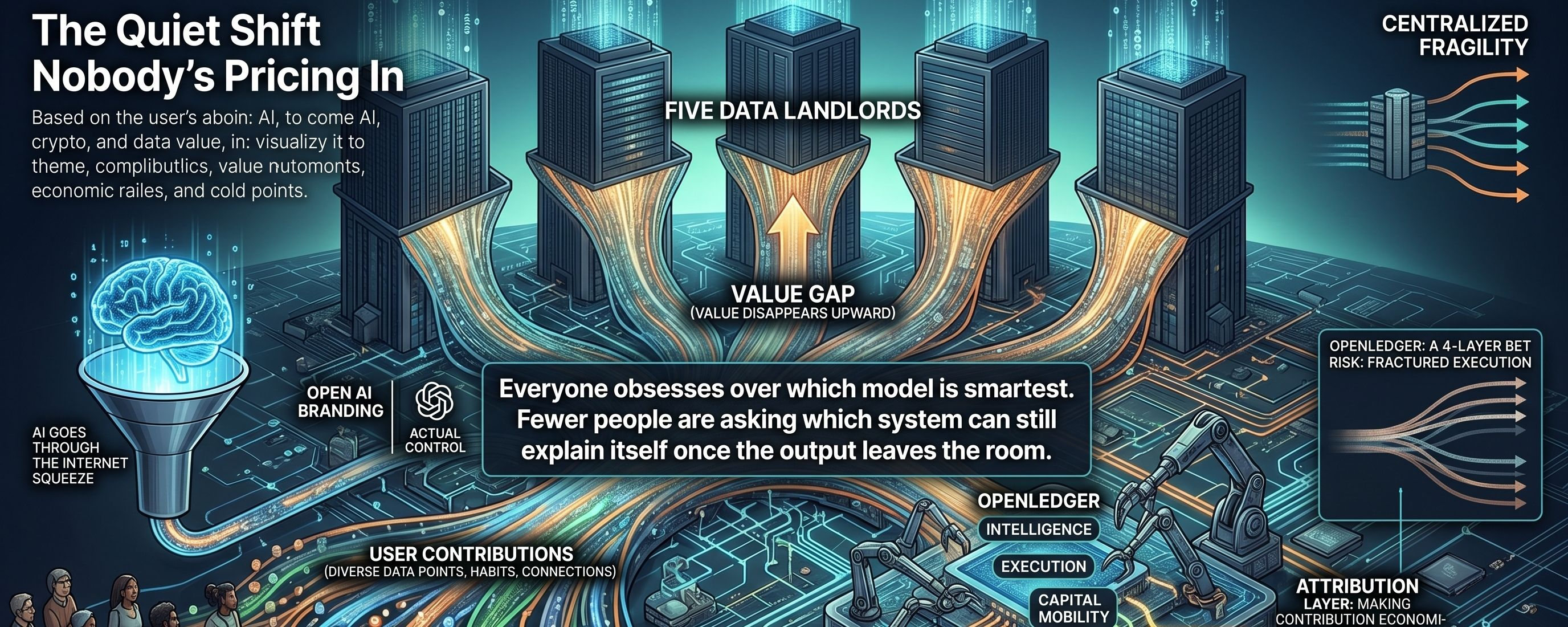
Here's what I actually think is happening. We're watching AI go through the same squeeze the internet did twenty years ago. The weird part isn't that this is unfair—it's that we've started calling it "open AI" while five landlords control every door. That's not open. That's just good branding.
OpenLedger caught my attention not because it solved this, but because it pointed at the right pressure point. Most crypto-AI projects invent problems. This one at least named a real one: the value disappears upward. Users train these systems every day through searches, conversations, corrections, habits. The machine gets smarter. The user gets… convenience. Maybe. Meanwhile the economic output consolidates into entities that act like they built the intelligence alone. They care about whether a system can keep extracting efficiently. This one can, until it can't.
What changed my mind slightly was thinking about what happens when AI stops being a tool you query and starts being an agent that operates. Not "hey assistant, summarize this." More like autonomous systems executing workflows, moving liquidity, making decisions inside infrastructure without a human pause button. Once that transition happens—and it's already starting—the payment rails matter. Banks won't work for machine-to-machine coordination at global scale. That's actually the first time blockchain stopped sounding like a 2021 meme to me. Not because crypto bros were right. Because autonomous systems need native economic infrastructure, and the current one was built for humans signing papers.
But here's where I get skeptical again. OpenLedger talks about four layers: intelligence, execution through something called OctoClaw, capital mobility across chains, and attribution for payments. That's a massive surface area to defend. OpenAI only needs to win AI. LayerZero only needs to win bridges. When you try to win four battles simultaneously, you're not a platform—you're a bet that everything converges in your direction. History says that usually fails. Crypto is full of "good ideas" that died because execution fractured across too many promises.
The attribution piece is what kept me thinking though. Not because it's revolutionary, but because the market is sleepwalking into a liability problem. Right now AI outputs are treated like disposable interactions. But once those outputs start influencing insurance approvals, trading systems, hiring decisions, or creator rankings, "where did this come from" stops being philosophical and becomes legal. Companies currently optimize for hiding data lineage. I think that flips. Not because transparency is virtuous—because opacity becomes expensive when regulators and enterprise buyers start asking hard questions. The first system that can prove provenance without collapsing under its own weight might capture something the current leaders don't own.
Still, the hard part isn't the vision. It's the coordination. Decentralized data quality is a nightmare. Bad data scales faster than good data when you pay for volume. Governance breaks. Incentives attract farming behavior. Communities chase token price instead of infrastructure. I've seen this cycle enough times to know the graveyard is larger than the success stories.
What I keep coming back to is simpler. The internet already had an era where users created massive value while platforms captured the ownership. AI risks repeating that at a scale that makes the first wave look small. If OpenLedger—or anything like it—can make contribution economically visible instead of invisible, the relationship between user, data, and model changes. That's a big if. The token could crash. The incentives could hollow out. The whole thing could become another farming playground.
But the direction matters. Not because it's guaranteed. Because the alternative—where a few companies own the entire intelligence infrastructure forever, and everyone else just rents access to what they helped build—sounds like a worse equilibrium. Not evil. Just fragile. And markets eventually price fragility, even if they do it slowly.
I'm not convinced OpenLedger wins. I'm convinced the problem they're pointing at is real, and that most people are still looking at the wrong layer. Everyone obsesses over which model is smartest. Fewer people are asking which system can still explain itself once the output leaves the room. That's a different kind of competition. Less exciting. Probably more durable