
I keep thinking about how casually people give pieces of themselves to AI now.
A question here. A correction there. A preference. A reaction. A small decision. It feels harmless because each interaction is tiny on its own. But when billions of people do it every day, something enormous starts forming underneath the surface. A new kind of economy. One built not only on data, but on human judgment itself.
That is the part most people still do not fully see.
AI models are not magical machines appearing from nowhere. They are shaped by human behavior at massive scale. Every conversation, every correction, every uploaded document, every pattern of thought becomes part of a larger system learning how humans think, respond, compare, choose, and communicate. People are constantly helping train intelligence systems, often without realizing how much value they are creating in the process.
And yet the ownership of that value usually flows in one direction.
That tension sits quietly underneath the entire AI industry right now, and it is exactly why OpenLedger feels interesting to me.
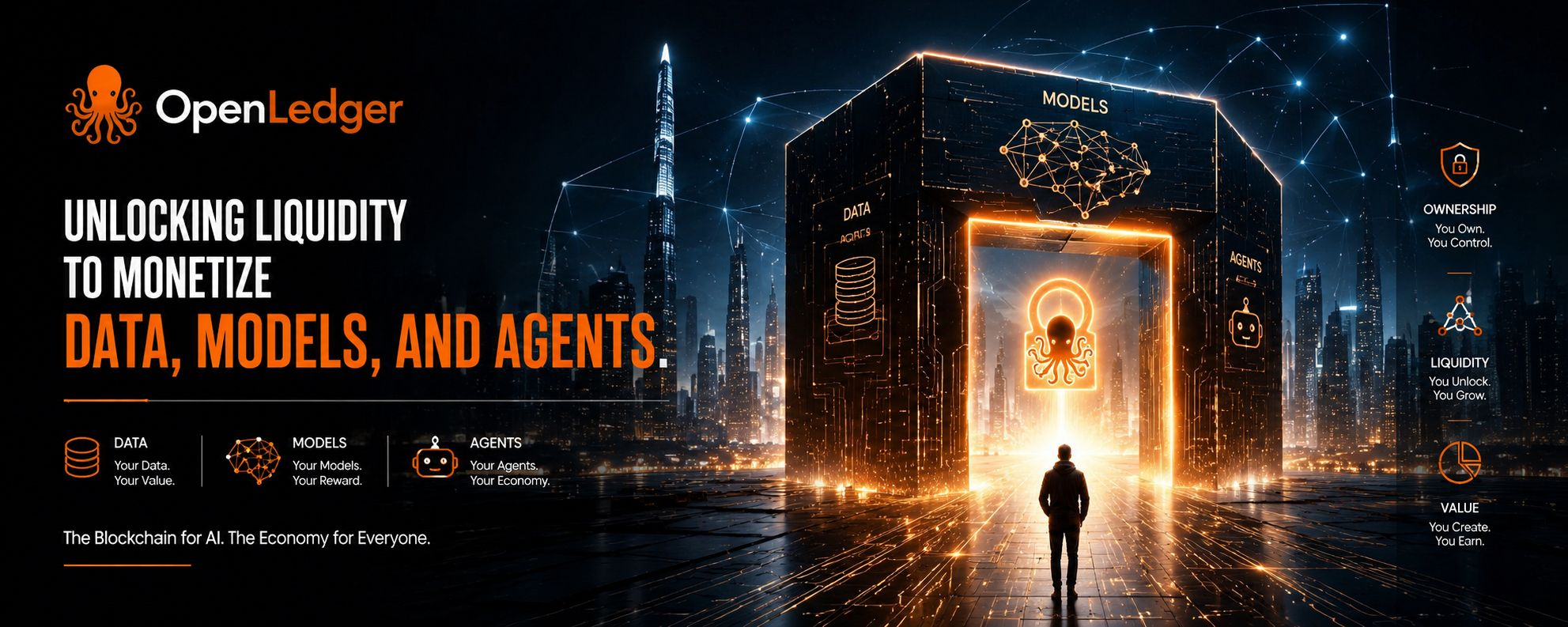
The project is trying to approach AI from a different angle. Not just as software people use, but as an economic network made up of data, models, agents, and human contribution. Instead of treating intelligence like a closed product controlled by a few companies, OpenLedger seems to view it more like shared infrastructure that people can participate in, contribute to, and potentially benefit from.
The deeper I look into AI, the more I realize the future may not belong to the companies with the flashiest interfaces. It may belong to the systems that organize intelligence in a fairer and more transparent way.
Because right now, most AI systems operate like black boxes. People put information in, receive outputs back, and never really know where the value goes. The process feels smooth on the surface but invisible underneath. OpenLedger appears to be trying to change that by building a blockchain-based layer where data, models, and AI agents can exist with clearer ownership, traceability, and economic structure.
That sounds technical at first, but the idea behind it is actually very human.
People want to feel that their participation matters.
Not just socially. Economically too.
The internet trained an entire generation to create enormous value for platforms without owning any part of what they helped build. Social media monetized attention. Platforms monetized behavior. AI is now starting to monetize intelligence itself. Human thinking patterns are becoming part of the infrastructure powering the next generation of technology.
OpenLedger seems built around the belief that this should not remain completely invisible forever.
What makes this especially important is the rise of AI agents. We are slowly moving into a world where AI systems will not only answer questions but also perform actions. They will research information, manage workflows, negotiate services, automate decisions, and interact with other systems on behalf of users. Once AI becomes active instead of passive, questions around trust and ownership become much more serious.
How do you know where an AI model came from?
Who contributed to improving it?
Who owns the data behind it?
How are contributors rewarded?
How do autonomous agents interact financially without relying entirely on centralized control?
These are not abstract questions anymore. They are becoming infrastructure questions.
That is where blockchain technology actually makes sense in this conversation. Not because blockchain is trendy, but because it creates systems for verification, coordination, and transparent ownership between people and machines that do not necessarily trust each other.
OpenLedger seems to be positioning itself right at that intersection between AI and decentralized infrastructure.
And honestly, I think the timing matters.
The AI industry right now feels incredibly powerful but also strangely fragile. A small number of companies control enormous parts of the ecosystem. Most users have very little visibility into how these systems operate beneath the surface. At the same time, society is becoming more dependent on AI every month. That combination creates tension. People enjoy the convenience, but they are also beginning to sense how much invisible power is accumulating underneath these systems.
Projects like OpenLedger feel like an early attempt to respond to that shift before it becomes permanent.
Of course, none of this is simple.
Building decentralized AI infrastructure is extremely difficult. AI systems require huge computational resources. Verifying data quality at scale is complicated. Open networks can attract spam, manipulation, and low-quality contributions. Governance becomes messy. Incentives can distort behavior. There is always the risk that systems designed to distribute value eventually become captured by speculation instead.
Those risks are real.
But I also think the bigger risk is pretending these questions do not matter.
Because AI is no longer just another software trend. It is slowly becoming part of the foundation underneath modern life. Education, finance, healthcare, media, communication, work — AI systems are moving into all of it. And whenever infrastructure becomes this important, ownership starts mattering.
Who controls intelligence infrastructure?
Who benefits from the value AI creates?
Who participates in the upside?
Who stays invisible inside the system?
The reason OpenLedger stands out is because it is trying to build around those questions instead of ignoring them.
Not loudly.
Not dramatically.
Just structurally.
And maybe that is the most important thing about projects like this. They are not only building technology. They are quietly challenging the assumption that the future of AI must belong entirely to closed systems controlled by a small number of players.
The internet once changed how humans shared information.
AI may change how humans share intelligence itself.
And the systems that organize that shift could end up shaping the next era of the digital world far more deeply than people realize today.
