I didn’t take it seriously at first…
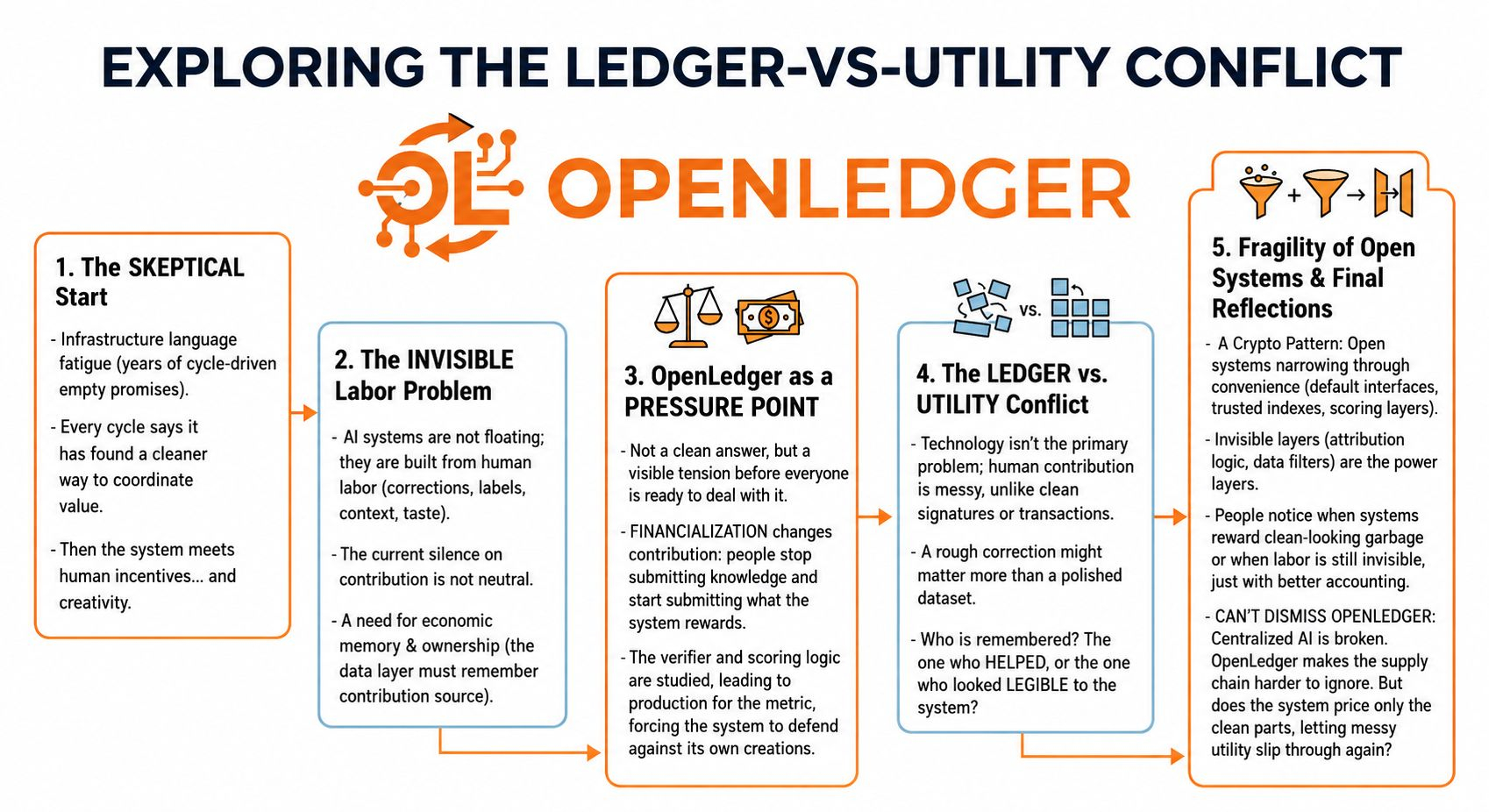
not because OpenLedger sounded empty. more because I’ve heard this kind of infrastructure language for years, and after a while it starts to carry its own fatigue. every cycle says it has found a cleaner way to coordinate value. every cycle says the old extraction points are finally being replaced. every cycle sounds more reasonable than the last one.
then the system meets incentives.
then people become very creative.
Maybe that’s too harsh. I know the problem underneath is real. AI systems are not floating above human labor. they are built from it. corrections, labels, prompts, examples, feedback loops, domain knowledge, taste, context. all the small inputs nobody talks about once the model starts sounding competent.
and that silence is not neutral.
I keep coming back to attribution.
There is something almost unavoidable about it. if human contribution is feeding machine intelligence, then maybe the system should remember where that contribution came from. maybe ownership cannot stay vague forever. maybe the data layer needs some kind of economic memory, even if that memory is imperfect.
OpenLedger seems to sit near that question.
not as a clean answer. I don’t trust clean answers here. more like a pressure point becoming visible before everyone is ready to deal with it.
but attribution changes once it becomes worth money.
That’s where things start to feel uncomfortable.
once data becomes financialized, contribution stops being simple. people stop submitting what they know and start submitting what the system rewards. they study the verifier. they learn the scoring logic. they produce for the metric. and then the system has to defend itself against behavior it helped create.
It works in theory. Most things do.
The problem isn’t really the technology… or not only the technology. it is that human contribution is messy in ways infrastructure does not like. a signature is clean. a transaction is clean. but usefulness is not. originality is not. judgment is not. a rough correction might matter more than a polished dataset. something valuable might only become valuable later, after other inputs have changed the model around it.
so who gets remembered?
the person who helped, or the person who looked legible to the system?
That part keeps bothering me more than it should.
and then there’s the older crypto pattern. open systems slowly narrowing in practice. not through one obvious betrayal, but through convenience. default interfaces. trusted indexes. scoring layers. operators maintaining the boring parts while everyone else talks about the vision.
AI-data infrastructure feels especially fragile there because the invisible layers are the actual power layers. attribution logic, data filtering, contribution scoring, model coordination. nobody watches those forever. people only notice when the system starts rewarding clean-looking garbage, or when contributors realize they are still invisible, just with better accounting around it.
still, I can’t dismiss OpenLedger.
centralized AI has made that impossible. closed datasets, vague ownership, invisible labor, extraction hidden under polished products. that version already feels broken.
maybe OpenLedger makes the supply chain harder to ignore.
maybe that matters.
or maybe once the incentives get sharp enough, the system learns to price only the clean parts of human contribution, while the messy parts — the parts that made the intelligence useful in the first place — slip through again.