

continuous on-chain execution without a local machine sounds powerful. the undocumented access architecture is the part worth understanding first.
i had been putting off looking at OctoClaw's cloud configuration specifically because i assumed it was a convenience feature. run the agent on a server instead of your laptop. same behavior, different machine. i finally sat down properly this week and started going layer by layer through the actual architecture — and somewhere in the middle of it i realized i had been framing the wrong question the entire time. the interesting question isn't what OctoClaw does in cloud mode. it's what happens to your on-chain execution access when the agent never stops running.
what pulled me back in was a specific detail in the documentation. OctoClaw's cloud config separates the execution layer from the interface layer — meaning the agent maintains live connections to on-chain data streams and executes workflows continuously, without requiring your local machine to stay active. that sentence sounds straightforward until you sit with what it actually means. an agent with on-chain execution access running on infrastructure you don't physically control, operating around the clock, without manual confirmation at each step. i opened the technical docs and started looking for the permission architecture specifically.
the setup, as documented, works like this. OctoClaw running in cloud configuration can analyze market sentiment in real time, execute strategy-based trades, track whale movements, and interact with on-chain yield flows — all continuously, all on openledger's blockchain where every action is recorded and timestamped. the AltLayer RaaS infrastructure underneath openledger's OP Stack rollup handles the execution environment. every on-chain action the agent takes is immutably recorded auditable by anyone, verifiable after the fact. that auditability is real and it matters. it's what separates this from a cloud-deployed bot running on centralized infrastructure where the execution record lives in a private database.
what the permission architecture actually looks like
what makes this structurally different from local deployment is a specific property that i don't think gets discussed enough. in a local setup, your execution access and your machine's uptime are coupled you stop the process, the access stops. in cloud deployment, those two things are decoupled. the agent's access to on-chain execution persists on infrastructure running independently of any action you take locally. i spent time looking for documentation on how that access is scoped. can you define execution limits maximum position sizes, maximum transaction frequency, specific contract interactions the agent is permitted to make? the technical docs describe the capability but not the permission boundary architecture at that level of detail.
the part that specifically made me pause was the revocation question. openledger's bridge contracts have been audited by OpenZeppelin and Trail of Bits that audit trail is public and the canonical bridge architecture inherited from the OP Stack carries those security guarantees. that's a real foundation. but bridge security and agent execution permission scoping are different problems. when i went looking for documentation on the fastest path to stopping a cloud-deployed agent that is behaving outside intended parameters an emergency stop mechanism, a permission revocation flow that specific architecture is not publicly documented at the detail level i was looking for. i went through the docs twice.
the thesis that makes this worth watching anyway
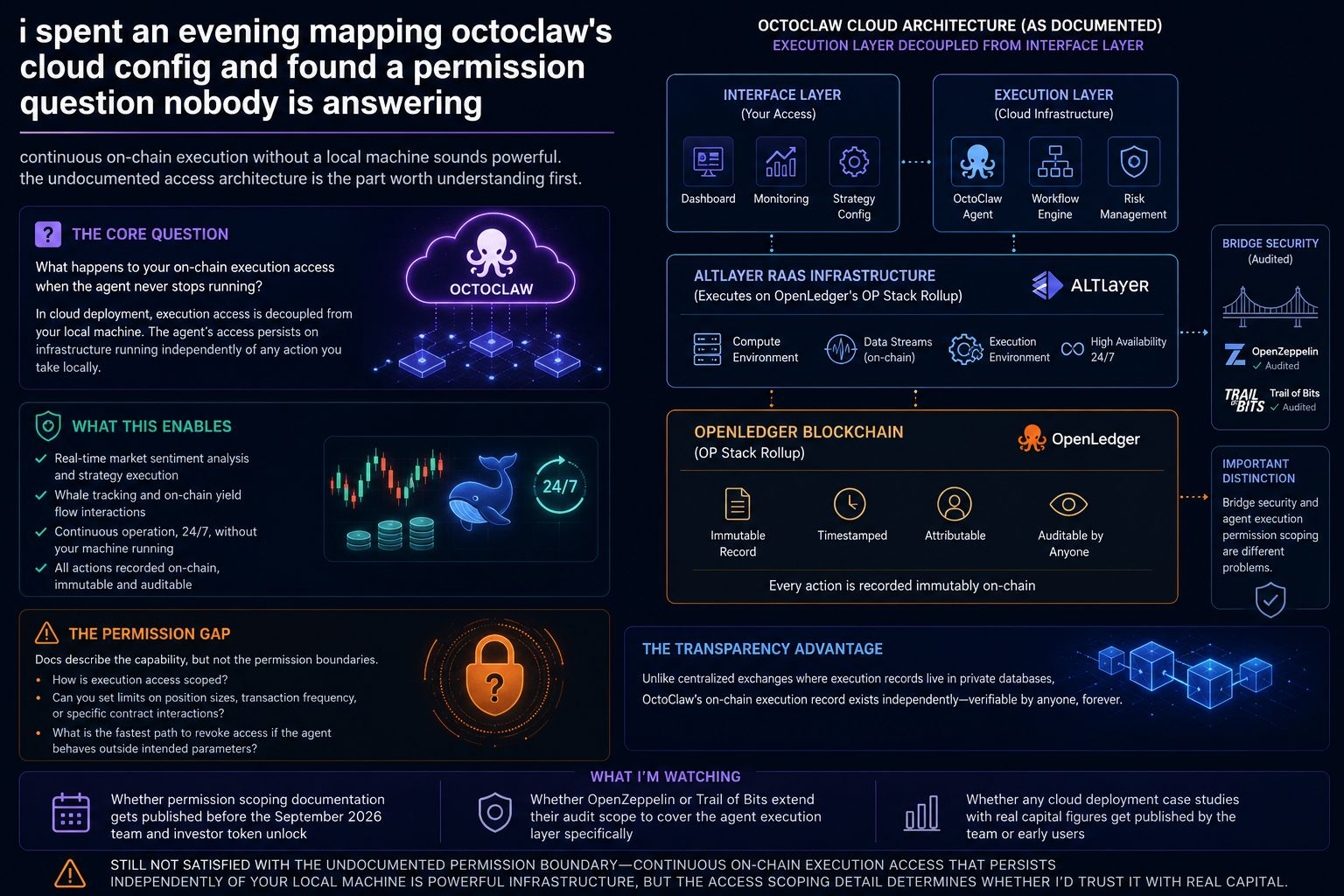
what i kept coming back to is the transparency layer underneath all of this. every action OctoClaw takes on-chain is recorded on openledger's blockchain immutable, timestamped, attributable. that is not a minor feature. most automated trading infrastructure operates on centralized exchanges where the execution record is controlled by the exchange. when something goes wrong with a bot on Binance, your only source of truth is Binance's logs. when OctoClaw executes on openledger, the record exists independently of any company, independently of openledger itself. that architecture is the correct long-term design for autonomous agent infrastructure.
what i'm watching: whether permission scoping documentation gets published before the September 2026 team and investor token unlock, whether OpenZeppelin or Trail of Bits extend their audit scope to cover the agent execution layer specifically, and whether any cloud deployment case studies with real capital figures get published by the team or early users.
still not satisfied with the undocumented permission boundary continuous on-chain execution access that persists independently of your local machine is powerful infrastructure, but the access scoping detail determines whether i'd trust it with real capital.
