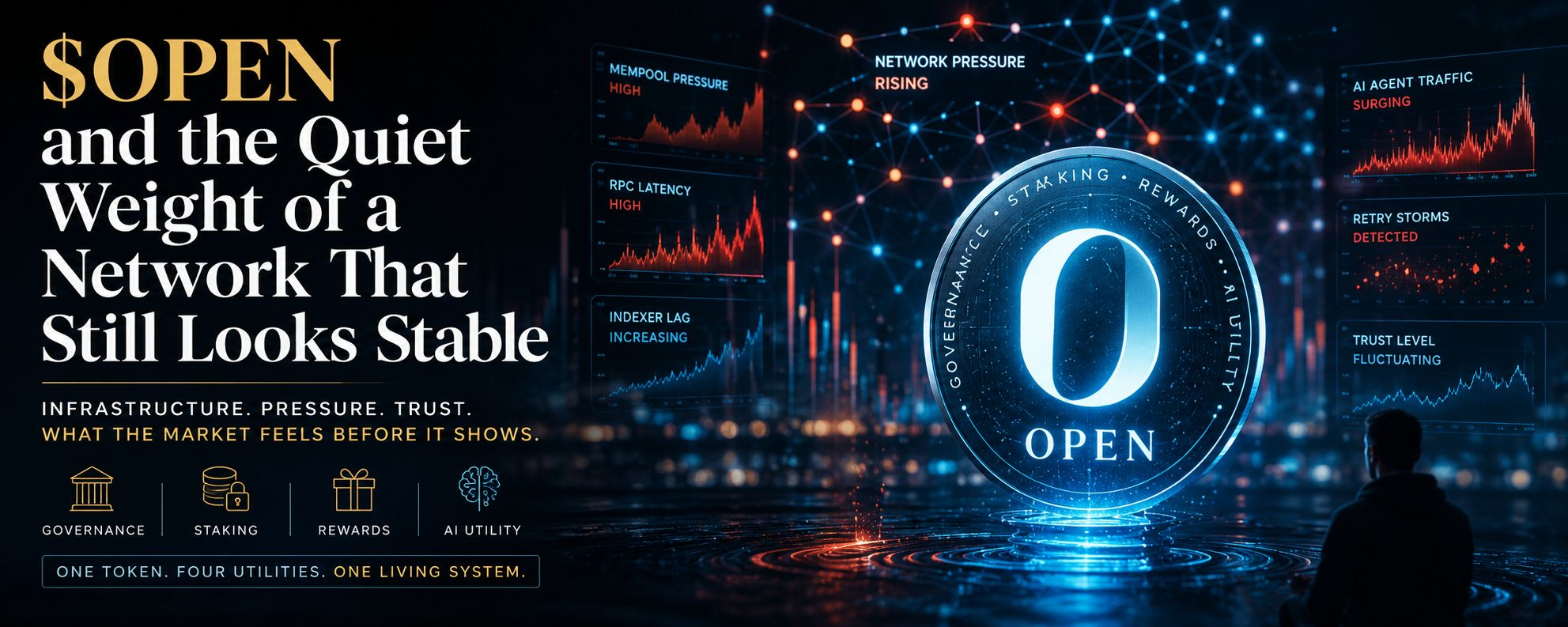
I kept watching the screen because nothing looked wrong, which is usually when I start paying attention.
The market was moving in that soft, unsettled way that makes people refresh more often than they admit. Prices were not collapsing, not surging, just drifting with enough friction to make every delay feel personal. A wallet would load a little slower than expected. A pending transaction would sit there long enough to make me question whether it had actually gone anywhere. The chain still finalized. The explorer still looked clean. But the feeling was different. It felt heavy.
That is where OPEN became interesting to me. Not as a slogan, not as a tidy token diagram, but as a system that seemed to carry its own pressure back into itself. Governance, staking, rewards, AI utility — on paper, those can look like separate lanes. In practice, they start to matter only when they begin to affect one another. Stake here, and you change your position in the network. Earn there, and participation starts to feel less optional. Use the AI layer, and suddenly the system is not just holding value; it is carrying traffic, intent, retries, and expectation all at once.
That is when the infrastructure starts to speak.
You can feel validator propagation before you can explain it. You do not need a dashboard to sense when blocks are still arriving but the rhythm has changed a little. RPC bottlenecks show up the same way. Not as failure, but as hesitation. The user does not know the exact reason. They just know the screen is not answering as quickly as it should. Indexer lag adds another layer to that unease, because the chain may be moving while the surface of the system is still catching up. Consensus can be intact and still feel fragile to the person waiting for confirmation.
I think that is the part most people miss. Trust does not disappear in one moment. It thins.
A small delay becomes a second check. A second check becomes a third. Traders quietly widen slippage. Bots begin rebroadcasting failed transactions with the kind of patience that is not really patience at all. Retry storms start looking normal because everyone is trying to outrun the same friction. Under AI-driven transaction bursts, shared-state contention becomes less theoretical and more like a crowded hallway. The system is still working, but it starts to feel crowded from the inside.
That feeling matters because it changes behavior before it changes outcomes. Users become more cautious without announcing it. They stare at pending transactions too long. They stop assuming the bridge will settle immediately. They notice when oracle updates land close enough to market activity that the timing begins to feel uncomfortable. Failed liquidations stop being abstract edge cases and start feeling like part of the emotional weather of the network. Nothing has broken yet. But the confidence has already started adjusting.
That is the trade-off every serious blockchain ends up living inside. Decentralization gives the system its shape, but performance decides whether people are willing to keep trusting it while it is under load. Low-latency architecture can make everything feel smooth, until the smoothness is tested by too many simultaneous actions. Scheduler pressure rises. Stress spreads quietly. The network has to prove that it can remain coherent without becoming brittle.
What I keep coming back to with OPEN is that the design seems to understand participation as something cumulative. Not just usage, but accumulation. Every action has a way of feeding back into the next one. That can be elegant when the network is calm. It can also feel unforgiving when the market gets noisy, because systems that rely on participation have to survive the exact moments when people become less patient, less certain, and more aware of every extra second.
By the time I stopped refreshing, the chain still looked fine. That was the part that stayed with me.