
I’m noticing something that feels almost invisible to most people watching the AI industry today.
Everyone is talking about the next breakthrough model, the next AI application, the next billion-dollar startup, but very few people are paying attention to the resource that powers everything underneath.
Data.
Not just datasets sitting on servers, but human knowledge, human experience, human creativity, human expertise, and the billions of interactions that teach machines how to understand the world.
When I start looking deeper into artificial intelligence, I notice that the entire industry is built on contributions from countless people who rarely receive recognition for the value they create. Researchers publish discoveries. Developers write code. Communities share information. Businesses generate unique datasets. Everyday users create content through their normal activities.
Yet most of the economic value created from that intelligence flows toward centralized platforms.
I started asking myself a simple question.
What happens when intelligence becomes the most valuable asset on Earth?
Not software.
Not hardware.
Not even money.
Intelligence.
The ability to learn, reason, predict, automate, and make decisions.
The more I thought about that question, the more I realized that the future AI economy may not be about building the smartest models. It may be about building the fairest system for distributing the value those models create.
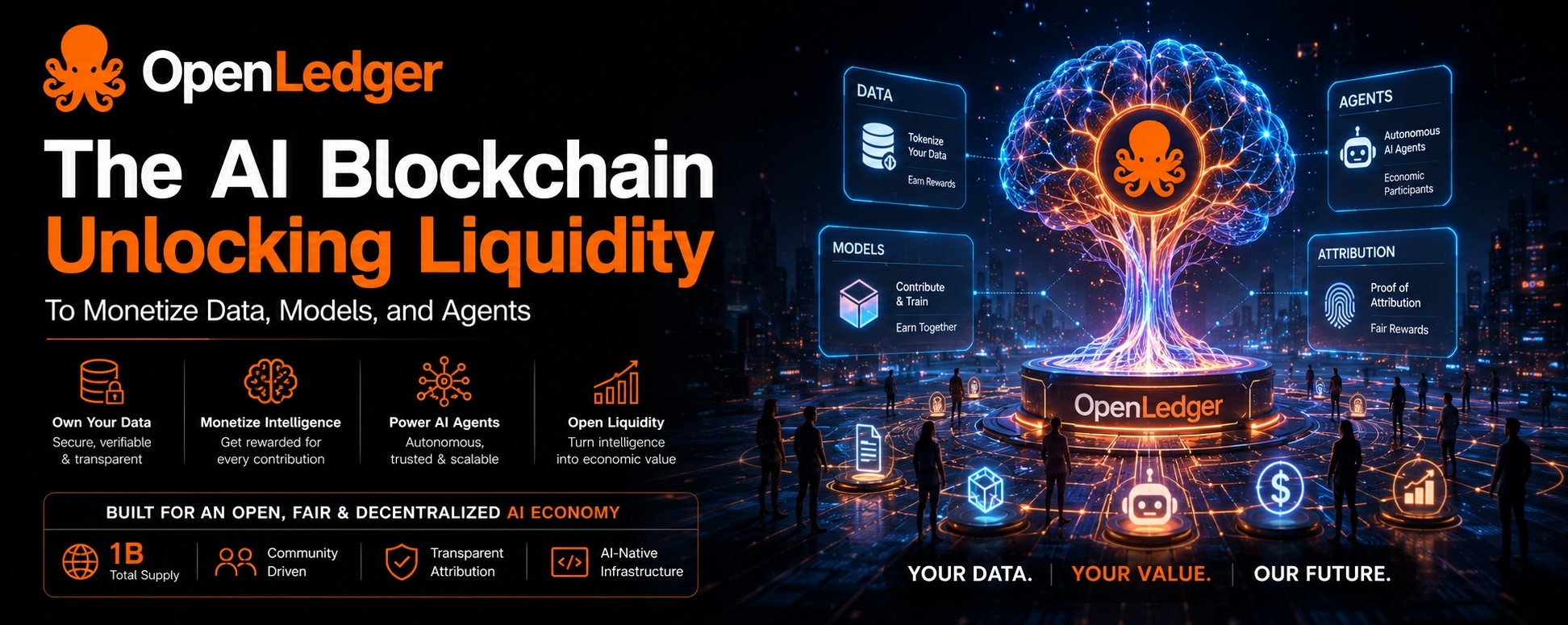
That is why OpenLedger caught my attention.
When I first came across OpenLedger, I assumed it was another blockchain project trying to attach itself to the AI narrative. The market is full of those. New projects appear almost every day promising to revolutionize artificial intelligence through decentralization.
But when I started studying the architecture more carefully, I noticed that OpenLedger is approaching the problem from a completely different angle.
Instead of asking how AI can improve blockchain, it asks how blockchain can create a better economy for intelligence itself.
That distinction sounds small.
I think it changes everything.
For decades, data has behaved like a hidden commodity. Companies collect it, store it, refine it, and transform it into products worth billions of dollars. Yet the people who contribute that data rarely participate in the value generated from it.
I’m noticing that this imbalance is becoming more visible as artificial intelligence grows more powerful.
The better AI becomes, the more valuable data becomes.
The more valuable data becomes, the more important ownership becomes.
The more important ownership becomes, the more people begin questioning who actually deserves the rewards.
OpenLedger appears to be built around that exact problem.
What fascinates me is that the project treats data as a productive asset rather than a static resource.
Traditionally, information is collected, used, and often forgotten. OpenLedger introduces the idea that data can remain economically connected to the value it generates long after it enters an AI system.
When I start thinking about the long-term implications, the concept feels surprisingly powerful.
Imagine a future where knowledge behaves like capital.
Every contribution has measurable value.
Every dataset has economic utility.
Every participant has a stake in the intelligence economy.
Instead of intelligence being extracted, intelligence becomes shared.
I noticed that this vision becomes even more interesting when combined with the rise of AI agents.
Many people still imagine AI as chat interfaces answering questions.
I think that picture is already becoming outdated.
I’m noticing a shift toward autonomous systems capable of making decisions, coordinating workflows, managing resources, and interacting with digital environments without constant human supervision.
These agents will need infrastructure.
They will need identity.
They will need payment systems.
They will need verification mechanisms.
They will need trust.
And perhaps most importantly, they will need economies.
When I start connecting these trends together, OpenLedger begins to look less like a blockchain project and more like an attempt to build economic infrastructure for a machine-driven future.
That future may arrive gradually.
Or it may arrive faster than most people expect.
History shows that major technological revolutions often appear slow until suddenly they feel inevitable.
The internet followed that pattern.
Smartphones followed that pattern.
Cloud computing followed that pattern.
Artificial intelligence may be following the same path right now.
What I find most interesting is that OpenLedger is not simply focused on model creation. The project appears focused on value creation.
That difference matters.
Models will continue evolving.
Algorithms will continue improving.
Hardware will continue becoming more powerful.
But the challenge of fairly distributing value across participants may become one of the defining economic questions of the AI era.
I’m noticing that many investors still evaluate AI projects through the lens of short-term hype.
They focus on market cycles.
Token prices.
Announcements.
Partnerships.
Those things matter, but they rarely explain why a technology survives over the long term.
Sustainable systems usually emerge because they solve structural problems.
OpenLedger is attempting to solve a structural problem.
How do we create an economy where intelligence can be owned, attributed, rewarded, and exchanged fairly?
That question may sound abstract today.
I believe it will become increasingly important as artificial intelligence moves deeper into every industry.
Healthcare.
Finance.
Education.
Research.
Manufacturing.
Media.
Every sector is being reshaped by machine intelligence.
And every transformation creates new questions about ownership, incentives, and value distribution.
When I start imagining the next decade, I don’t see a future where a handful of organizations control all intelligence.
I see a future where intelligence becomes an ecosystem.
A network.
A marketplace.
A constantly evolving economy built around contributions from millions of participants.
Whether OpenLedger ultimately becomes a dominant player remains uncertain.
Every emerging technology carries risks.
Execution matters.
Adoption matters.
Competition matters.
The road ahead is never guaranteed.
But I noticed something important while researching this project.
Most blockchain projects talk about tokens.
Most AI projects talk about models.
OpenLedger talks about value.
And in many ways, value may be the most important conversation of all.
Because the real question facing artificial intelligence is not whether machines will become more intelligent.
They almost certainly will.
The real question is who benefits when they do.
The answer to that question could shape the next chapter of the digital economy.
And that is exactly why I believe OpenLedger is a project worth paying attention to.