
I don't usually watch the execution layer this closely. Most of the time you set up the algorithms, check a few logs, and trust the system is doing what it's supposed to do. But today something felt weird before I could even explain why.
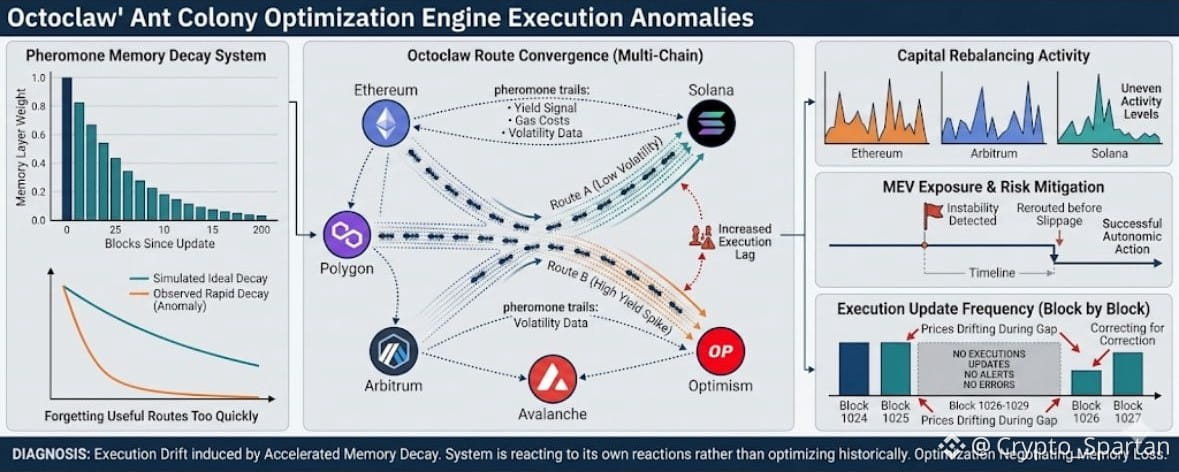
I was watching Octoclaw, OpenLedger's ant colony optimization engine, moving capital across different chains. The concept is actually pretty cool. Real ants find the shortest route to food by leaving pheromone trails for other ants to follow. In Octoclaw, those trails become things like yield signals, gas costs, and volatility data. The system learns from that and keeps adjusting routes to find better opportunities.
At first everything looked normal.
Then I noticed a small flicker.
Routes that should've settled quickly started scattering around. Liquidity was jumping between chains in short bursts. Then suddenly a bunch of capital moved into a low-fee route that wasn't even ranked near the top a few moments earlier. That's part of how ACO works, so I didn't think much of it.
But then something happened that caught my attention.
For about three or four blocks, execution updates just stopped.
No errors. No warnings. No alerts.
Just... nothing.
The screen looked frozen even though it wasn't. During that short gap, prices started drifting away from where they were expected to be. I remember sitting there staring at it thinking, "Not sure why execution shifted..."
That thought kept looping in my head.
The thing that started bothering me was the memory layer. It runs on a decay system where older routing strategies slowly lose importance over time. Makes sense in theory. You don't want old data creating noise forever.
But today it felt like the system was forgetting useful information too quickly.
Not bad routes. Not failed routes.
Just older routes that still had some value.
And that changes everything because ACO relies heavily on history. Even messy history.
I watched some of the strongest trails slowly fade away. New paths were forming faster than the old ones were disappearing. Eventually the system looked split between two "best" routes and neither one could fully win. Capital kept bouncing back and forth between them.
Gas costs started creeping up.
Rebalancing got really active in some places and strangely quiet in others.
Nothing was broken exactly. It just felt uneven.
Almost like different chains were operating on slightly different clocks and the ants were trying to keep up.
To be fair, there was one moment where the system looked brilliant.
A temporary yield spike appeared on a chain and Octoclaw caught it almost instantly. Entry was fast, slippage stayed low, and the exit was clean. The ants converged perfectly. For a second I thought, "Okay, there it is."
But then the system seemed to get a little too confident.
That successful trade pushed a new allocation decision that felt overly aggressive. The strategy layer reacted a bit late, and execution started correcting for its own correction. A feedback loop formed in the background.
Nothing dramatic.
No alarms going off.
Just small inefficiencies slowly stacking up.
That's when I started asking myself a question I couldn't answer.
Is this actually optimization?
Or is it delayed memory correction pretending to be optimization?
I should also mention what worked well.
At one point the risk layer detected instability in a bridge pool and rising MEV exposure. The system rerouted before slippage got worse. No manual input needed. It was smooth and honestly pretty impressive.
So I don't think the engine is broken.
It's just... off.
At least today.
The bigger thing I can't stop thinking about is memory itself.
Memory isn't just storage anymore. It's becoming part of the cost of keeping the system consistent. Every time the decay layer removes information, it's making a decision about what future actions are possible.
And if useful trails disappear too early, the cost compounds over time.
Even while writing this, routes are still changing. Some paths are getting stronger while others fade before they fully form. Every now and then the system starts converging, then suddenly spreads out again.
It's like watching something remember and forget at the same time.
And I keep coming back to that pause.
Three or four blocks.
No updates.
No alerts.
No movement.
Maybe it was normal latency.
Maybe it means absolutely nothing.
Or maybe it's the first sign of execution drift slowly building up underneath everything else.
I honestly don't know.
What I do know is that once I noticed it, I couldn't stop noticing it.
Maybe real-time execution is always just delayed memory correction.
Maybe optimization isn't a destination at all. Maybe it's just a constant negotiation between what a system remembers and what it chooses to forget.
Octoclaw is a really smart design. Most days it works great.
But today, watching those ants almost walk in circles, I realized something.
A system that forgets too fast doesn't really optimize.
It just reacts to its own reactions.
And that's the question I'm still thinking about.
Are we actually building intelligence?
Or are we just building really expensive amnesia?#OpenLedger $OPEN @OpenLedger