
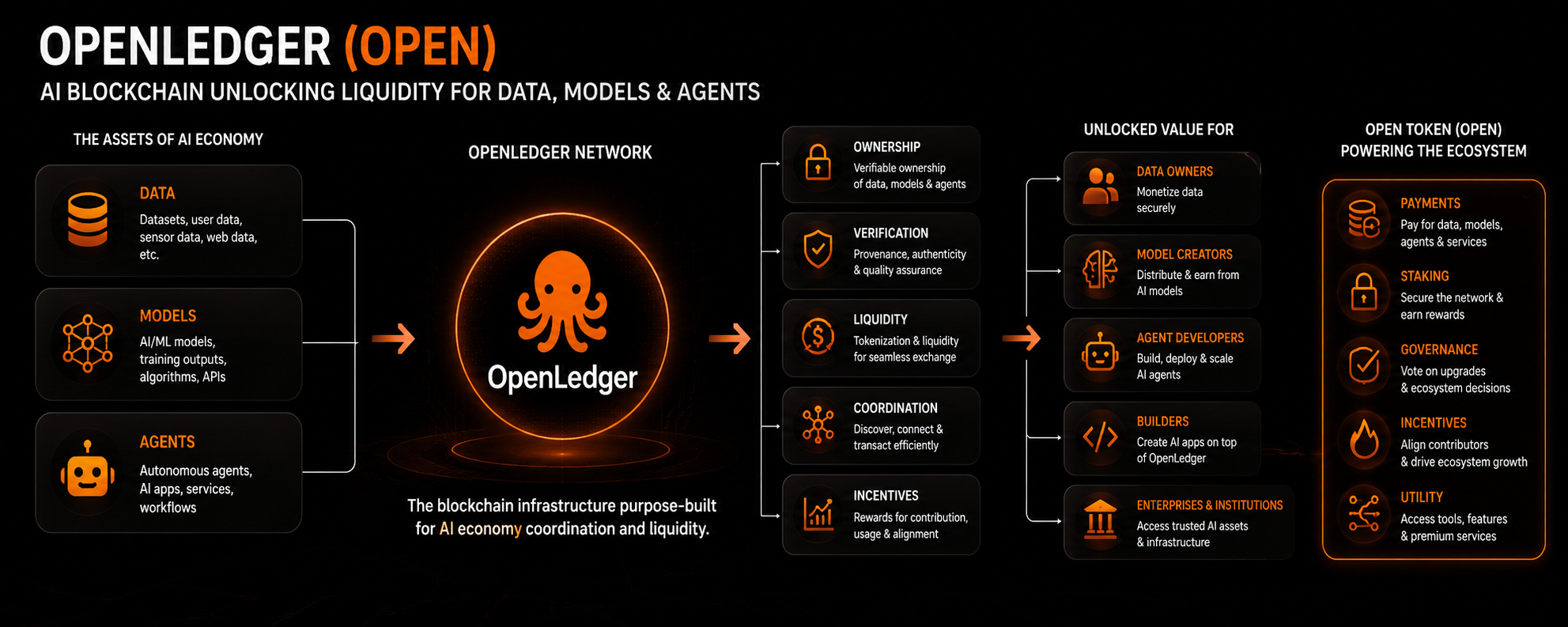
I’m looking at OpenLedger (OPEN) late at night, and honestly, it has that familiar feeling I get after reading too many crypto papers in one sitting. The idea sounds clean at first: an AI Blockchain unlocking liquidity for data, models, and agents. It fits the current cycle almost too well. AI is hot, agents are becoming a serious talking point, data is finally being treated like an asset, and crypto is once again trying to place itself underneath the next big technology shift. Part of me understands why OpenLedger matters. Another part of me is tired enough to ask the question I probably should have asked earlier in every cycle: who actually needs this, and who keeps using it when the incentives stop?
I’ve seen this pattern before. DeFi came with the promise of open finance. GameFi came with the promise of owned economies. Metaverse projects promised new worlds. Modular chains promised cleaner architecture. Restaking promised better capital efficiency. AI crypto now promises intelligence, automation, data ownership, agent economies, and machine-to-machine markets. Some of these ideas were not wrong. That’s the tricky part. The market often starts with a real idea and then stretches it until everything sounds bigger than it is. So when I look at OpenLedger, I don’t want to dismiss it just because it sits inside a crowded narrative. But I also don’t want to give it credit just because the words around it sound important.
What OpenLedger is trying to do is interesting because it points toward a real problem. AI needs data, but data is messy. Models can create value, but pricing and ownership around them are still unclear. Agents may eventually need identity, settlement, permissions, and liquidity if they are going to act across digital markets. OpenLedger seems to be saying that all of this needs an economic layer, some kind of blockchain-based coordination system where these assets can move, be monetized, and maybe become liquid. That is not a bad thesis. In fact, it is one of the more believable AI-crypto theses if it is executed properly. But that “if” is doing a lot of work.
The thing I keep circling back to is usage. Not the kind of usage that shows up during a campaign. Not wallets created because people think there might be rewards. Not volume that appears because traders are chasing the newest AI ticker. I mean real usage. Someone has data and wants to monetize it. Someone else needs that data and is willing to pay for it. A model creator wants distribution. An agent needs a reliable layer to transact or coordinate. Developers build because OpenLedger gives them something they cannot easily get elsewhere. If that loop exists, then OPEN becomes more interesting. If it does not, then the whole thing starts to look like another beautifully packaged idea waiting for demand to arrive.
I don’t say that with hostility. I say it because after enough cycles, I’ve learned that crypto is very good at producing believable futures. The problem is that believable futures do not always become usable systems. A project can describe a massive market and still fail to capture it. A token can sit next to a powerful trend and still not become necessary. That is what I am trying to figure out with OpenLedger. Is it actually becoming part of the AI economy, or is it mainly offering crypto a way to speculate on the AI economy?
Liquidity is the word that makes me slow down. Everyone in crypto loves liquidity. It sounds productive, but it can also hide a lot. Liquidity for data, models, and agents sounds powerful, but what exactly is becoming liquid? Is a dataset being priced because it has measurable demand? Is a model earning because people use it in real workflows? Are agents generating transactions that require this infrastructure? Or is liquidity mostly forming around OPEN because markets like the story? There is a huge difference between liquidity that supports real economic activity and liquidity that only exists because the token is interesting for a season.
Trust is another problem that doesn’t disappear just because a blockchain is involved. If anything, it becomes more visible. Data can be low quality, duplicated, stolen, outdated, or legally unusable. Models can be exaggerated. Agents can be risky if nobody knows who controls them or what permissions they have. If OpenLedger wants to build a serious layer around AI assets, it has to solve more than settlement. It has to deal with provenance, reputation, access, verification, and accountability. Otherwise, it risks creating a marketplace where things move quickly but nobody is fully sure what they are buying.
That is where I feel both curious and cautious. OpenLedger is not aiming at a small problem. It is trying to sit near the economic backend of AI. If the project can help data owners, model builders, developers, and agent systems coordinate in a cleaner way, then it could matter. But I’ve also seen too many projects confuse “big problem” with “automatic adoption.” The world may need better AI-data infrastructure, but that does not mean the world will choose OpenLedger. Builders need a reason. Institutions need trust. Users need simplicity. Liquidity providers need returns. The token needs a real function beyond existing as the market’s entry point into the story.
OPEN itself is something I would watch carefully. A token can make a system more aligned, but it can also make everything noisier. If OPEN is used for access, staking, settlement, governance, reputation, or incentives, then I want to know whether that use is natural or forced. Forced utility can create demand on paper. Natural utility shows up when people use the token because the system works better with it. That difference matters. A token attached to real network activity can become durable. A token attached mainly to expectation becomes dependent on attention.
And attention is not something I trust anymore. I’ve watched projects become the center of the market for three months and then slowly turn into old screenshots. I’ve watched ecosystems announce partnerships, grants, roadmaps, integrations, and “next billion user” visions, only for the real user base to disappear when rewards dried up. So with OpenLedger, I would want to see what happens after the easy excitement fades. Do developers keep building? Do data providers keep contributing? Do model creators earn anything meaningful? Do agents actually use the rails? Does liquidity stay because it is useful, or does it leave because the next narrative opened somewhere else?
The incentive question is probably the most important one. Incentives can bootstrap a network, and I don’t think that is automatically bad. Almost every crypto ecosystem uses incentives at some point. But incentives should be a bridge, not the foundation. If people come to OpenLedger only because they expect rewards, then the activity is fragile. If they stay because the system gives them access, revenue, reputation, or better coordination, then the project starts to look real. I always want to know what remains after the rewards become smaller. That is where the truth usually appears.
Developer activity is another signal, but even that needs to be read carefully. I don’t just want to hear that developers are building. I want to know what they are building and whether those products actually depend on OpenLedger. Are they creating useful AI-data tools? Are they building agent systems that need on-chain coordination? Are they making model monetization easier? Are they solving a problem that normal cloud infrastructure or existing chains do not solve well? If the answer is yes, then OpenLedger has a stronger case. If the answer is mostly branding and integrations, then I would stay cautious.
The institutional side is also interesting, even if it complicates the story. Data and AI are not like meme coins. Governments care about data. Companies care about compliance. Institutions care about risk, ownership, and regulation. If OpenLedger wants to deal with data, models, and agents at scale, it may eventually run into questions around privacy, sovereignty, licensing, and jurisdiction. That could become a strength if the project builds trust and structure around these issues. But it could also slow adoption if the system is too open-ended or unclear. Serious data markets cannot survive on vibes alone.
I think that is why OpenLedger feels like one of those projects I cannot easily dismiss, but also cannot easily trust yet. The idea has weight. AI assets probably do need better economic rails. Data probably will need better monetization systems. Agents probably will need some form of identity and settlement if they become economically active. OpenLedger is pointing at a real direction. But crypto has taught me that pointing in the right direction is not the same as arriving there.
What I want from OpenLedger is proof of dependency. I want to see people using it because removing it would make their workflow worse. That is the real test for infrastructure. If a project disappears and nobody’s behavior changes, it was not infrastructure. It was scenery. If developers, data providers, model creators, and agents begin to rely on OpenLedger because it gives them liquidity, trust, coordination, and economic access, then OPEN becomes much more serious.
For now, I’m somewhere between interested and unconvinced. That is probably the most honest place to be. I can see why OpenLedger fits the moment, and I can see why the market may pay attention to it. But I’m not looking for another clean narrative. I’m looking for signs of life underneath the narrative. Real usage. Real builders. Real token demand. Real economic activity. Real reasons for the system to keep running when nobody is cheering.
So I keep watching OpenLedger quietly. Not with hype, and not with dismissal. More like someone who has seen enough crypto cycles to know that the early story is only the first layer. The deeper question is whether OPEN becomes part of an actual AI economy or just another token that passed through the AI narrative at the right time. That answer will not come from the slogan. It will come from usage, incentives, liquidity, trust, and whether people still care when the market stops pretending every new idea is inevitable.
