
Market felt a little directionless today. Nothing was moving with conviction, so I ended up doing what I always do when I don't want to stare at charts — I started pulling threads on things I'd bookmarked weeks ago and never actually read.
One of them was about the EU AI Act deadline. August 2026. Companies must be able to show regulators exactly where their training data came from, prove it was sourced legally, document it, and hand over access to datasets on request. Up to 7% of global revenue as a penalty if they can't. I read it twice because that number didn't feel real. Then I started thinking about what "proving where your data came from" actually means in practice for an AI company that scraped the web for three years.
That's when I went back and looked at OpenLedger #OpenLedger again.
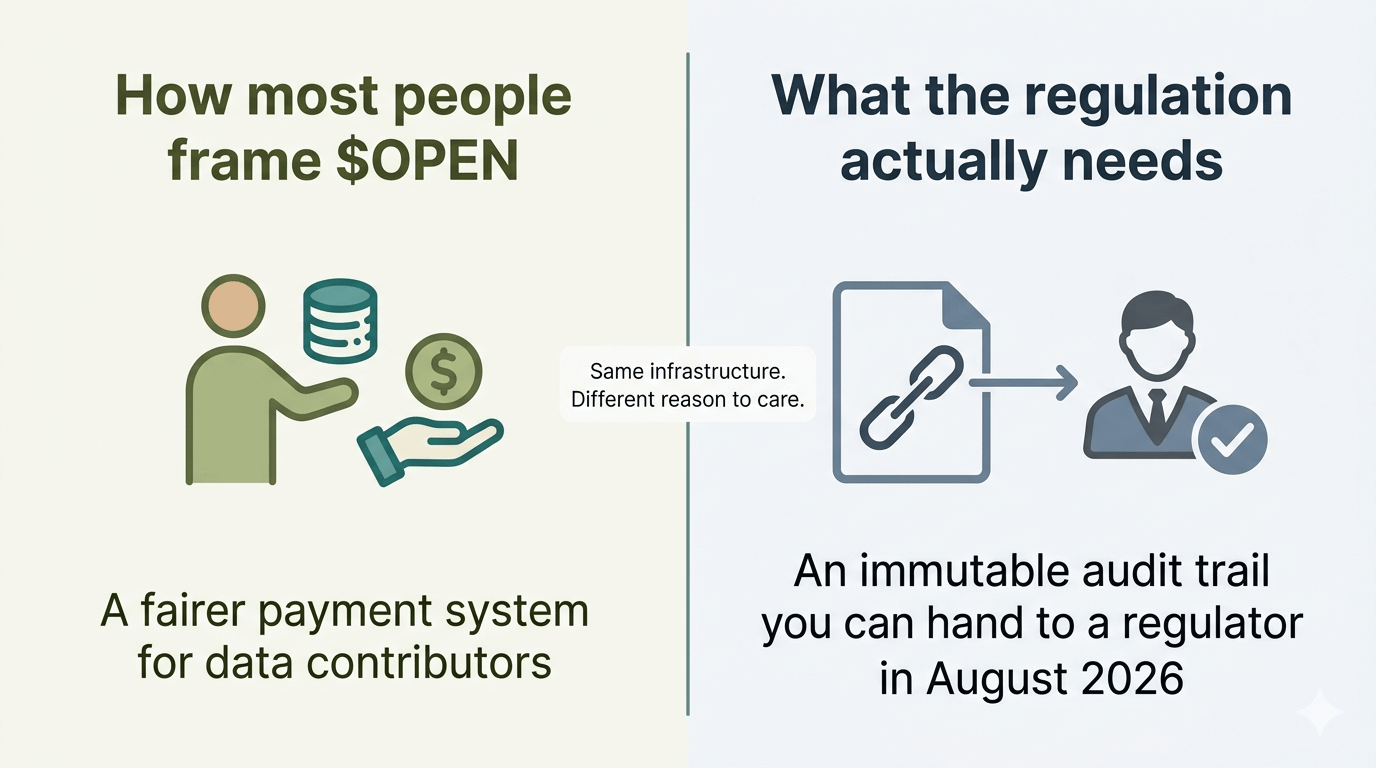
So here's the thing I keep sitting with. Everyone's been framing $OPEN and @OpenLedger as a contributor economy play — the story about paying data providers fairly, fixing AI's attribution problem, all of that. And that narrative is real. But I think it's almost accidentally underselling where the actual pressure is building. The EU AI Act doesn't care about paying contributors. It cares about documentation. It requires AI providers to maintain full records of training data origin, demonstrate bias controls, and hand over datasets to authorities on demand. And what OpenLedger actually built — Proof of Attribution, every data contribution logged immutably on-chain, lineage recorded at the protocol level — looks a lot less like a creator economy and a lot more like a compliance infrastructure.
I thought the project was solving for who gets paid. It might also be solving for who can prove what.
That distinction matters more than it sounds. Because a "fair payment system" is a nice-to-have that enterprises adopt slowly. But a "defensible audit trail that keeps you out of regulatory trouble" is something legal teams start paying attention to on a deadline. The EU enforcement date is three months away. The Story Protocol partnership OpenLedger signed in January 2026 specifically enables legally clean AI training with automatic rights holder payments — that's not a product decision made in isolation from what regulators were building toward.
But here's the part that doesn't sit right yet. The regulation compliance angle only works if enterprises actually build on OpenLedger's infrastructure, which means they have to trust a relatively new chain with production-level AI workloads. That's a big ask. Most enterprise AI teams aren't looking at crypto rails right now. They're looking at whatever their legal counsel approves, and that list rarely includes tokens. The compliance use case is genuinely compelling on paper. Whether it translates into actual enterprise adoption is a completely different question, and I don't think anyone can answer it yet honestly.
There's also the timing problem. If major AI labs get ahead of regulation by building their own internal provenance systems — and they have the resources to do exactly that — the window where OpenLedger's approach looks uniquely necessary gets a lot narrower.
Anyway. The deadline is August. I'll probably just watch what happens around then — whether the compliance framing starts showing up more in how the project talks about itself, or whether it stays buried under the contributor economy pitch.
Might be nothing. Might be the whole story.