
A few weeks ago, I had an interesting conversation with a friend who spends most of his time building AI tools. We were discussing where the real value in artificial intelligence comes from. At first, the answer seemed obvious: better models, bigger compute, faster infrastructure. But the longer we talked, the more the discussion drifted toward something less visible—the data layer.
That conversation stayed with me because it reminded me of a mistake I made years ago while trading. I once opened a short position on a company because I believed the product was overvalued. What I completely ignored was the infrastructure supporting the business. The product changed several times, but the underlying network kept generating value. The trade failed because I focused on the surface while the market quietly rewarded the foundation.
Lately, OpenLedger has been making me think about that lesson again.
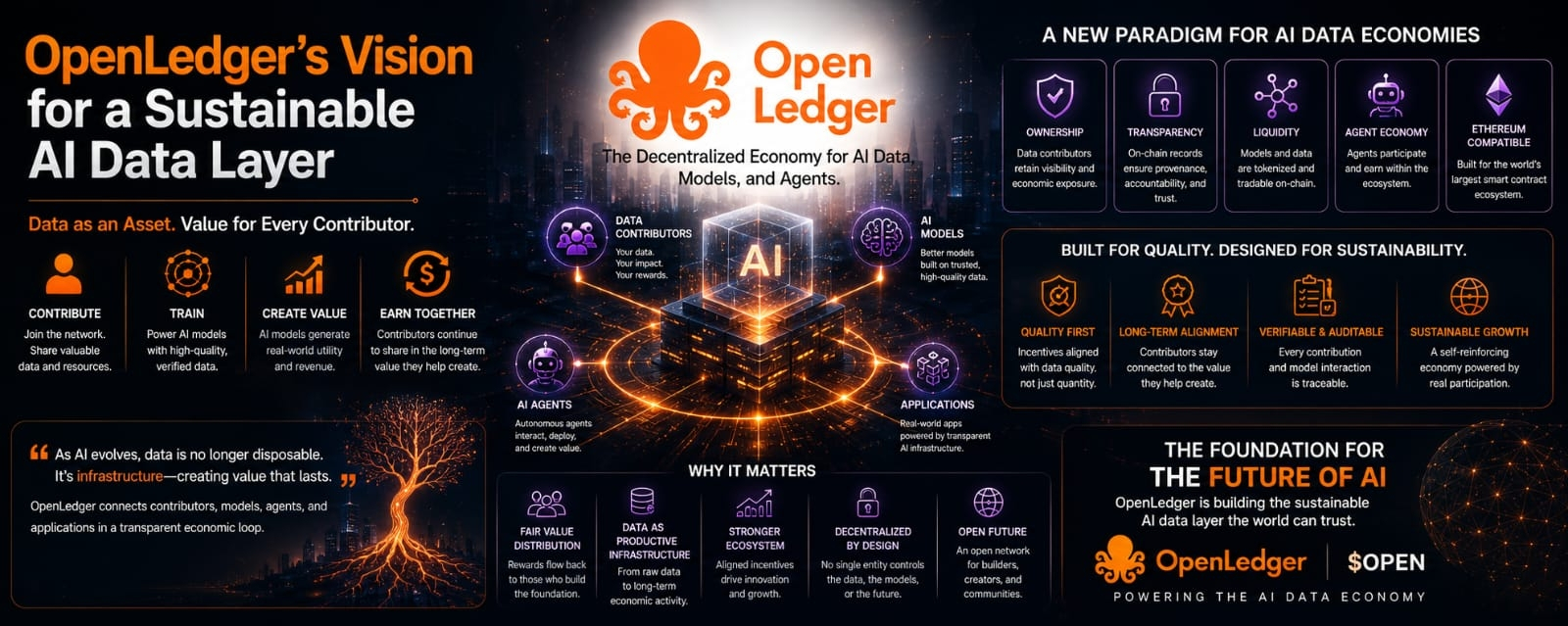
Most AI discussions still focus on models. Everyone wants to know which model is smarter, faster, or cheaper. Yet OpenLedger approaches the space from a different direction. Instead of treating data as something consumed and forgotten, it treats data as an asset that remains connected to the value it helps create.
That may sound like a small distinction, but I think it changes the entire framework.
Traditionally, data contributors provide information, models get trained, and the value largely flows elsewhere. The contributors fade into the background once the training process ends. OpenLedger challenges that structure by attempting to keep contributors inside the economic loop.
The idea is simple enough to understand through a real-world comparison.
Imagine a city where thousands of people help build roads. Once construction is complete, they never receive anything again despite the roads generating economic activity for decades. Now imagine a system where contributors maintain some exposure to the value created by those roads over time. Suddenly, participation looks very different.
That is essentially the question OpenLedger is asking about AI data.
If models continue generating value long after training, should the underlying data remain economically invisible?
The network's architecture appears designed around participation, contribution, and AI activity being connected rather than isolated. Data contributors are not positioned as one-time suppliers. Instead, they become participants in a broader ecosystem where value creation can potentially continue long after the original contribution.
What makes this particularly interesting is the monetization angle.
For years, many technology platforms benefited from user-generated data while contributors received little beyond access to the service itself. OpenLedger introduces a different possibility. Data becomes something closer to productive infrastructure rather than disposable fuel.
Of course, this is where the theory encounters reality.
One concern I keep returning to is quality control.
I have watched countless incentive systems attract large amounts of participation very quickly. The initial numbers always look impressive. Then the quality problem appears. Rewards encourage quantity, contributors optimize for volume, and maintaining standards becomes increasingly difficult.
OpenLedger attempts to address this challenge through contributor incentives and network participation mechanisms. Whether those systems remain effective at larger scales is still an important question.
In my experience, incentive design is often the difference between a sustainable network and a temporary trend.
Another aspect that deserves attention is ownership.
The AI industry has historically concentrated ownership around companies that control models and infrastructure. OpenLedger introduces a framework where model ownership and liquidity can exist on-chain rather than remaining behind closed corporate walls.
That changes how value potentially moves across the ecosystem.
Instead of contributors disappearing after training, data, models, and participants remain connected through an economic structure. The result is a network where visibility and accountability become more integrated into the lifecycle of AI development.
The agent economy adds another layer to this discussion.
As AI agents become increasingly capable, their ability to operate independently raises important economic questions. OpenLedger allows agents to participate directly within the network while remaining connected to the surrounding incentive structure.
From a fundamental perspective, this is significant.
An ecosystem where agents interact, deploy services, and create value while remaining tied to transparent economic mechanisms may be more sustainable than isolated systems operating behind closed interfaces.
I also think the project's compatibility with Ethereum deserves more attention than it often receives.
Adoption frequently depends less on technology and more on familiarity. Users already understand wallets, smart contracts, and on-chain participation. By building within an environment people recognize, OpenLedger reduces some of the friction that often slows new networks.
That said, I remain cautious.
One question continues to surface whenever I evaluate projects focused on ownership and decentralization: do users genuinely care about ownership, or do they primarily care about rewards?
Those are not always the same thing.
If incentives become less attractive, will contributors remain because they believe in data ownership? Or will participation decline as attention shifts elsewhere?
Markets have a habit of testing convictions very quickly.
There is also the unavoidable issue of speculation. AI remains one of the strongest narratives in technology, and narratives often move faster than infrastructure. Investors frequently price future expectations long before underlying systems prove themselves.
This creates a difficult environment for projects building foundational layers.
Infrastructure requires patience. Narratives reward speed.
That tension is one reason OpenLedger continues to stand out to me. It feels less focused on chasing headlines and more focused on establishing a framework where data, contributors, models, and agents remain economically connected.
Whether that vision ultimately succeeds will depend on execution, adoption, and the ability to maintain data quality at scale.
Still, the core idea feels increasingly relevant.
As AI continues evolving, data may no longer be viewed as a raw material that disappears after consumption. It may start being valued more like infrastructure—something that continues generating economic activity long after its initial creation.
OpenLedger is betting that this shift is coming.
The market may not fully understand that asset class yet. Many participants still find it easier to trade AI narratives than evaluate the systems powering them. But if the future of artificial intelligence depends on sustainable data economies, the projects building those foundations today may eventually become impossible to ignore.
$OPEN @OpenLedger #OpenLedger $PORTAL $STG #SolsticeInstitutionsCryptoInfra #SuiMainnetResumes