
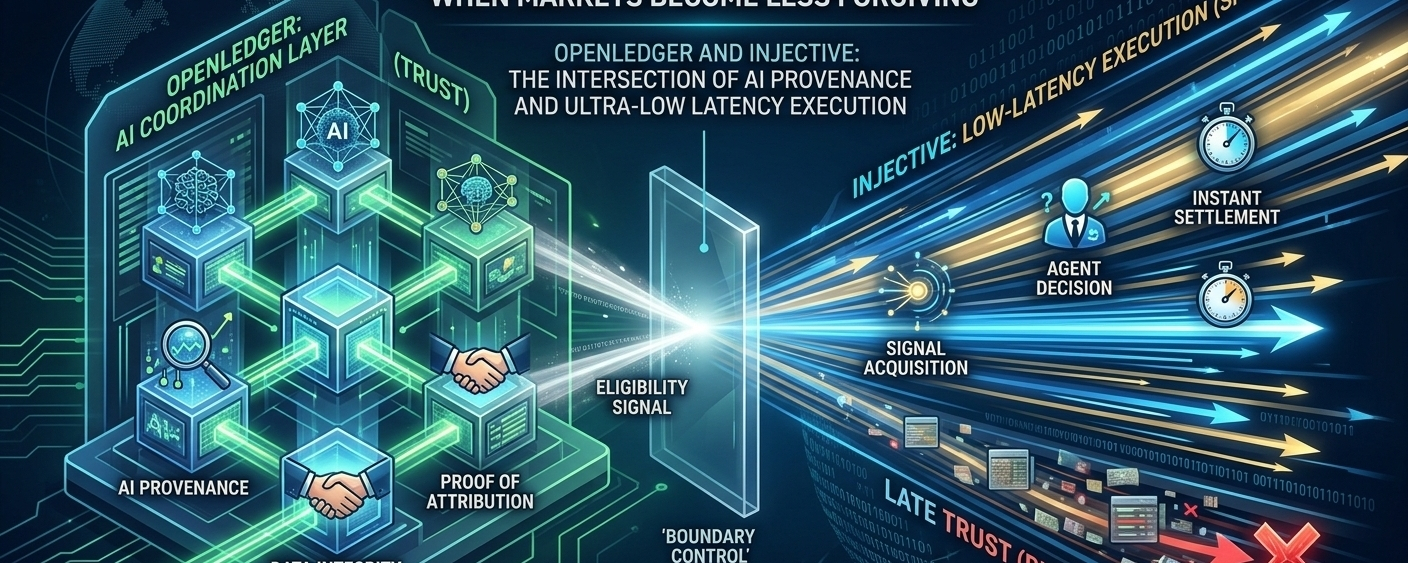
When analyzing the intersection of OpenLedger ($OPEN ) and Injective’s ultra-low latency architecture, it is easy to default to a simplistic conclusion: faster execution simply means more efficient AI markets. However, this surface-level view misses a critical structural tension. The true value of this pairing lies not just in velocity, but in how high-speed environments force us to rethink data validation. The Friction Between Speed and Verification
In legacy systems, checking AI provenance—verifying data origins, model integrity, and contributor inputs—is treated like post-transaction paperwork. A system reviews the history and determines trustworthiness long after the action has concluded.
In a compressed, high-frequency environment like Injective, however, markets do not pause for retrospective analysis. If the timeline between a market signal, a decision, and its final settlement is reduced to milliseconds, late validation becomes functionally useless. Trust is bound by timing.
From Attribution to Coordination
If an autonomous AI agent acts on flawed datasets or compromised models, the resulting error translates immediately into execution risk. Capital gets deployed, and exposure occurs before the system can flag the discrepancy.
This shifts the narrative for OpenLedger from a simple archival tracking tool to an active coordination layer. Rather than slowing down transactions with heavy overhead, OpenLedger’s architecture must serve as a lightweight boundary controller. Its role is to ensure that a model's history and data credibility can travel seamlessly alongside the execution speed, signaling whether a piece of data is eligible for immediate action before the market moves.
Ultimately, the integration isn't about flashy infrastructure. It is a fundamental design overhaul aimed at proving that trust can remain practical and protective when financial environments leave zero room for error.
Executive Summary
The Velocity Trap: The integration of OpenLedger and Injective goes beyond raw speed; it addresses the systemic vulnerability of executing automated decisions faster than they can be validated.
The Risk of "Late Trust": In low-latency environments, traditional post-facto verification is obsolete. If an AI model operates on corrupt data, financial exposure happens before retroactive audits can catch it.
OpenLedger as a Gatekeeper: Through Proof of Attribution, OpenLedger transforms from a passive data repository into an inline coordination layer. It determines a signal's eligibility for action in real-time.
The Ultimate Objective: The system's goal is to make cryptographic verification light enough to ride alongside high-speed execution, providing essential structural boundaries before unverified data triggers high-frequency mistakes.