
I've been watching the AI and blockchain space for a while now, and one thing keeps standing out to me: the most meaningful changes rarely arrive all at once. They don't usually appear as a breakthrough moment that everyone immediately recognizes. Instead, they emerge slowly, almost quietly, until one day you realize the conversation has shifted and the assumptions underneath it have changed.
Lately, I've found myself thinking about projects like OpenLedger.
Not because it makes the biggest claims, but because it seems to sit at the center of a question that the industry is still trying to answer. As AI becomes more capable, who captures the value it creates? And if data, models, and autonomous agents become increasingly important, what kind of infrastructure is needed to support them?
For years, data has been treated like fuel. People generate it constantly, companies collect it, models learn from it, and products are built on top of it. The value chain is familiar by now. What's less clear is whether that structure still makes sense in a future where AI systems are becoming more autonomous and increasingly woven into everyday digital activity.
OpenLedger appears to be built around that uncertainty.
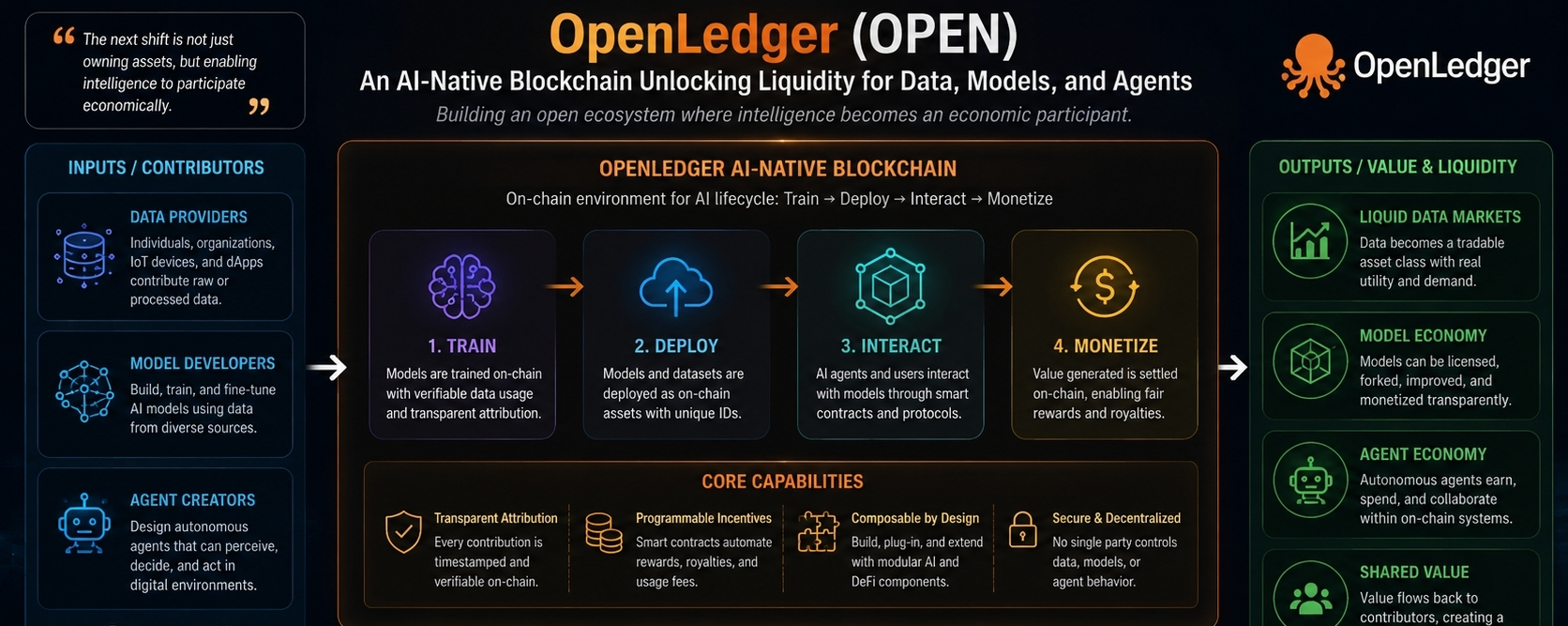
The project positions itself as an AI-native blockchain focused on creating liquidity around data, AI models, and agents. At a surface level, the idea feels straightforward. If data contributes to intelligence, perhaps data should have a clearer economic role. If models create value, perhaps their contribution should be measurable. If autonomous agents perform tasks and interact with digital environments, perhaps they should be able to participate in economic systems rather than exist outside of them.
But the longer I think about it, the less simple it feels.
Turning something into a market doesn't just create opportunities—it changes behavior. Sometimes that leads to healthier ecosystems. Other times it creates new incentives that gradually pull attention away from the thing that originally mattered.
That's where my curiosity about OpenLedger begins.
The network is designed so that model training, deployment, and agent interactions can happen within an on-chain environment. Instead of treating AI as something external that occasionally connects to blockchain infrastructure, it seems to imagine AI as an active participant inside the system itself.
That distinction feels important.
There's a difference between recording activity and building infrastructure where activity becomes part of the network's economic logic. In OpenLedger's vision, data, models, and agents aren't just tools. They're participants.
Its Ethereum-compatible architecture makes that vision easier to understand. Wallet connectivity, smart contracts, and integration with broader Layer-2 ecosystems allow it to fit naturally into an environment that developers already know. Rather than building an isolated island, the project appears to be positioning itself within a larger ecosystem that's already familiar with composability and shared infrastructure.
That approach makes sense.
Most successful networks don't start by asking people to abandon everything they already use. They usually grow by connecting themselves to existing habits and systems. Familiarity lowers friction.
Still, technology is only part of the story.
What I keep wondering about is the relationship between decentralization and automation.
Blockchain originally emerged from a desire to distribute trust. AI, in many ways, is about increasing efficiency through delegation. One pushes authority outward. The other often reduces the need for human involvement in individual decisions.
Bringing those ideas together is fascinating, but it also creates tension.
The more autonomous systems become, the more important questions of accountability seem to become. If agents can act, transact, and interact independently, where does responsibility sit? If data becomes a tradable asset, who ultimately benefits from its value? If models become economic participants, what prevents ecosystems from becoming dependent on a small number of highly influential actors?
I don't think there are easy answers.
In fact, one of the reasons OpenLedger interests me is because it exists in a space where many of those answers don't yet exist. The project is attempting to build infrastructure around things that are still evolving: AI models, autonomous agents, and new forms of digital ownership.
That's an ambitious place to build from.
At the same time, history has a way of reminding us that new infrastructure often looks obvious only in hindsight. While it's being built, the future remains uncertain. Some ideas become foundations. Others become experiments that help point the way for something else.
It's still too early to know where OpenLedger ultimately fits.
Maybe creating liquidity around data, models, and agents will strengthen digital economies and distribute value more fairly. Maybe it will introduce new layers of complexity and dependency that aren't fully visible yet. Both possibilities feel equally plausible from where we stand today.
For now, I see OpenLedger less as a finished answer and more as a reflection of a broader shift taking place across technology.
The conversation is slowly moving beyond simple ownership of assets and toward ownership of intelligence itself—who contributes to it, who benefits from it, and how its value moves through networks.
Whether OpenLedger becomes a major part of that future remains uncertain.
What feels certain is that the questions it's asking are becoming harder to ignore. And sometimes, the projects worth paying attention to aren't the ones making the loudest promises. They're the ones quietly exploring where the world might be heading before the rest of us have fully noticed the direction of the change.