
A few weeks ago, I was helping a friend compare two AI tools for a research project. Within twenty minutes, we had generated summaries, outlines, and even draft reports. Everything worked smoothly. The answers were fast, polished, and surprisingly useful.
Then my friend asked a question that caught me off guard.
"Where did all of this actually come from?"
Not which company built the model.
Not which chatbot interface we were using.
The answer itself.
For some reason, I couldn't stop thinking about that question afterward.
The AI industry moves incredibly fast. Every week there seems to be a new model, a new benchmark, a new announcement claiming better performance than the previous version. Most discussions revolve around speed, reasoning ability, context windows, or cost.
Those things matter.
But lately, I've been paying more attention to something happening underneath the surface.
The path behind the output.
When we buy a product in the physical world, there is usually a supply chain behind it. Raw materials are sourced somewhere. Manufacturing happens somewhere else. Logistics connect the pieces together. Every stage contributes value before the final product reaches a customer.
Yet AI often feels different.
You ask a question.
An answer appears.
Everything that made that answer possible becomes invisible.
The datasets disappear.
The contributors disappear.
The infrastructure disappears.
Years of work collapse into a few paragraphs on a screen.
The more I thought about it, the more unusual that seemed.
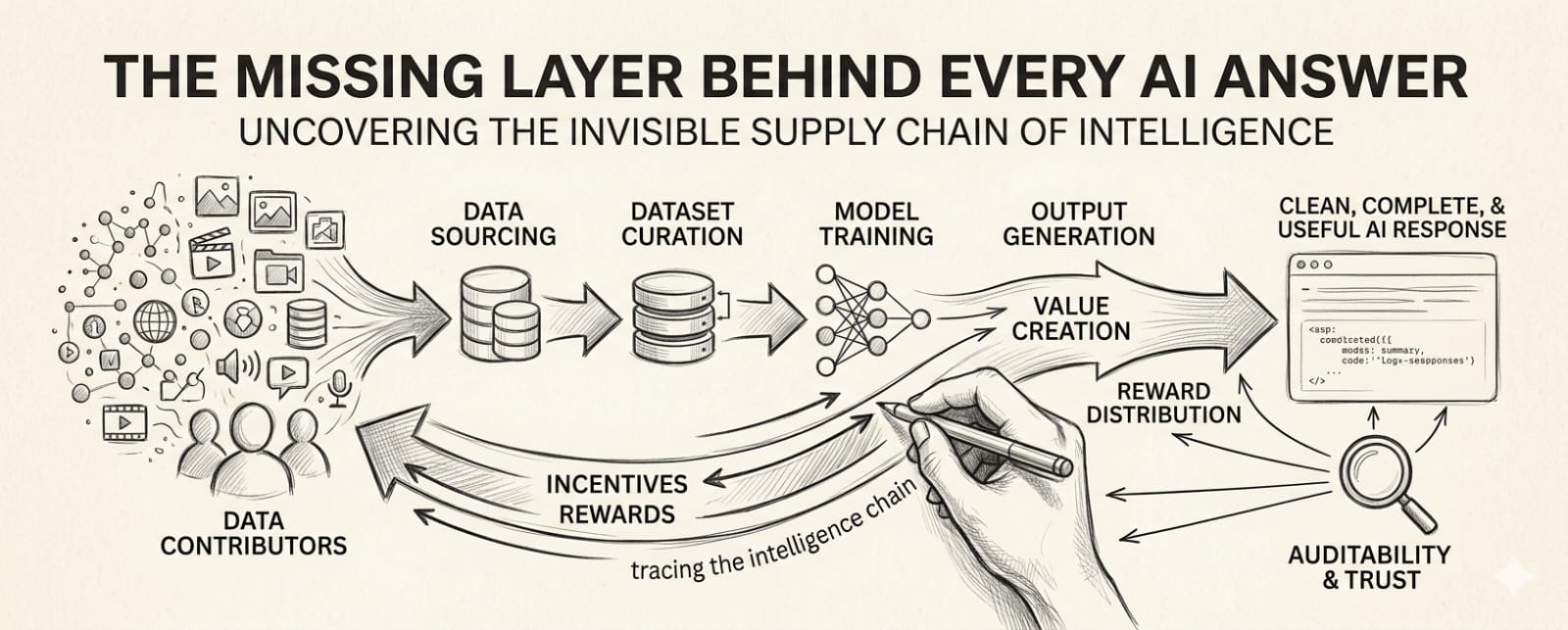
Recently, projects like OpenLedger have been exploring this exact area. Instead of focusing entirely on creating smarter models, the idea appears to be centered on creating visibility around how intelligence is produced and how value flows through the system.
At a high level, the concept sounds straightforward.
People contribute data.
Datasets help train models.
Models generate outputs.
Outputs create value.
Rewards move back through the chain.
Simple idea.
Complicated reality.
I've seen enough technology cycles to know that diagrams often look cleaner than real-world implementation.
The moment actual incentives enter the picture, complexity follows.
Data contributors want fair compensation.
Developers want flexibility.
Users want convenience.
Governance participants want influence.
Everyone enters the system with different priorities.
That doesn't make the idea less important.
If anything, it makes it more interesting.
One thing I keep noticing is that AI conversations often focus on the destination while ignoring the journey.
People evaluate answers based on usefulness.
Did the code work?
Did the summary save time?
Did the image generate correctly?
Those are reasonable questions.
But as AI becomes increasingly integrated into business operations, research workflows, legal processes, and economic activity, another question starts becoming relevant.
Can we trace where the intelligence came from?
I sometimes think about this through a simple analogy.
Imagine receiving a package with no shipping information attached.
The package arrives.
It works perfectly.
At first, you probably don't care where it originated.
But if something breaks, suddenly origin matters.
Who manufactured it?
Who supplied the components?
Who is responsible?
Accountability often becomes important only after problems appear.
AI may follow a similar pattern.
Right now, convenience dominates user behavior.
Most people prefer fast answers over detailed attribution.
History suggests this is normal.
The internet itself evolved the same way.
People rarely think about network infrastructure until websites stop loading.
People rarely think about payment rails until transactions fail.
People rarely think about cloud architecture until systems go offline.
Invisible systems stay invisible until they become necessary.
That is where I find OpenLedger's approach interesting.
Not because it guarantees success.
Not because decentralized AI automatically solves every problem.
And certainly not because every infrastructure narrative eventually wins.
I've watched enough markets to know that great ideas and successful adoption are not always the same thing.
What catches my attention is the attempt to create something closer to an accounting system for intelligence.
A framework where AI outputs are not isolated events but final products connected to a broader chain of contributions.
In theory, that creates several advantages.
First, contributors gain clearer attribution.
Second, reward distribution becomes more transparent.
Third, organizations gain stronger auditability around how outputs were generated.
And finally, trust becomes easier to establish because the underlying process is less opaque.
Of course, trade-offs exist.
Greater transparency often introduces greater complexity.
More tracking requires more infrastructure.
More attribution requires more coordination.
More accountability requires more governance.
There is no free lunch.
That is why skepticism remains healthy.
Whenever I evaluate projects operating in emerging sectors, I try to separate compelling narratives from practical execution.
The narrative here is easy to understand.
The execution challenge is much harder.
Can attribution systems scale efficiently?
Will contributors actually participate?
Will users value transparency enough to justify additional complexity?
Those questions still need answers.
For investors, builders, and researchers, that may be the most important takeaway.
Pay attention to behavior rather than promises.
Watch whether ecosystems attract contributors.
Watch whether usage grows.
Watch whether economic incentives remain sustainable over time.
Infrastructure stories often develop quietly before becoming obvious.
Or they disappear entirely.
Both outcomes are possible.
That uncertainty is what keeps me interested.
Not excitement.
Not hype.
Curiosity.
Because the more AI becomes embedded into everyday life, the harder it becomes to ignore the invisible layers underneath it.
Today, most people only see the answer.
Tomorrow, they may want to see the entire path that produced it.
The data.
The models.
The contributors.
The incentives.
The ownership.
The full supply chain behind intelligence itself.
Whether that becomes a standard feature of AI remains uncertain.
But it feels like a question worth asking now rather than waiting until everyone else starts asking it later.

#StablecoinsMayExtendUSMonetaryInfluence