
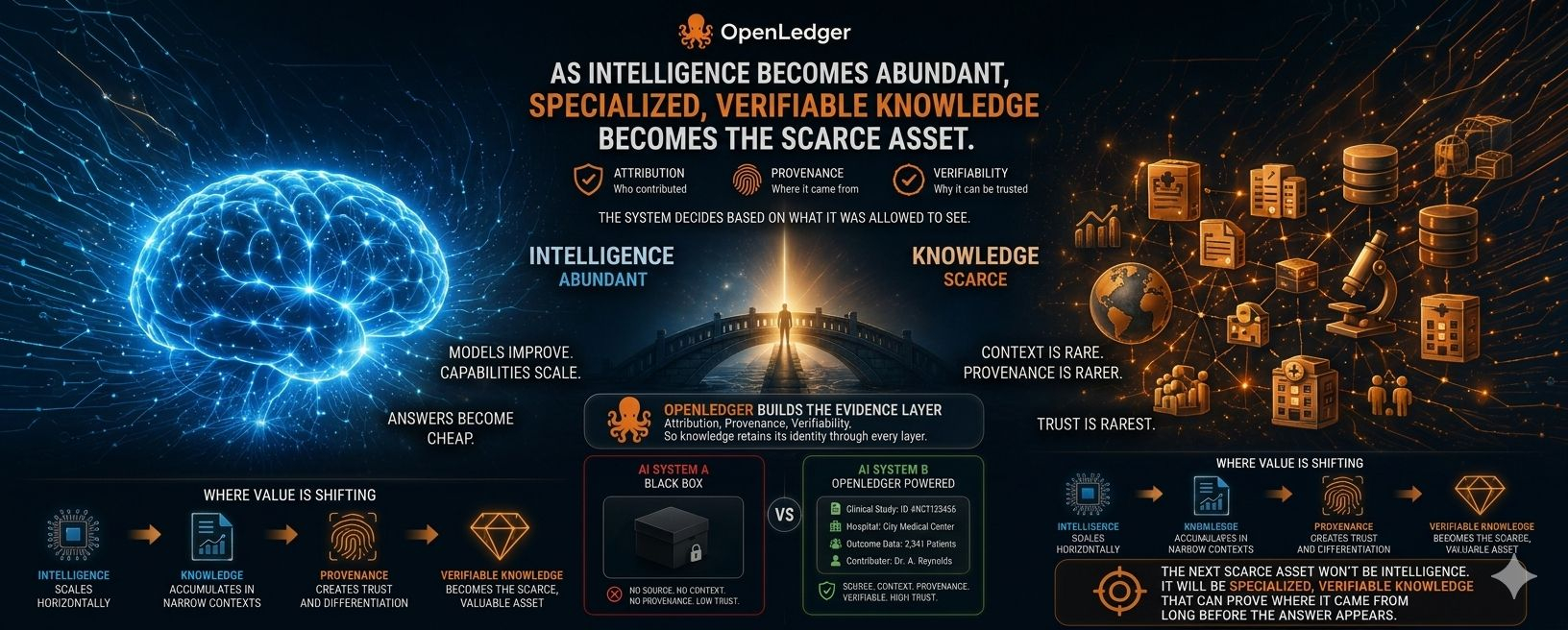
OpenLedger ($OPEN) May Make Specialized Knowledge More Valuable Than Intelligence Itself
Everyone assumes AI will make specialized knowledge less valuable.
I'm starting to think the opposite may happen.
And OpenLedger may be one of the first systems designed around that possibility.
For a long time, I viewed OpenLedger primarily as an attempt to improve incentives within AI systems—better attribution, stronger ownership, and fairer distribution of value. Those elements still matter, but lately I've become more interested in a deeper implication hidden underneath them.
I used to assume that as AI became more capable, expertise would become less valuable. After all, if intelligence becomes abundant, why would specialized knowledge command a premium?
The more I think about it, the less convinced I am.
What OpenLedger keeps pulling me toward is the idea that intelligence and knowledge are not the same thing. In fact, as intelligence becomes increasingly abundant, specialized knowledge may become even more valuable.
Not because intelligence becomes scarce.
Because context does.
Most AI conversations focus on capability. Better models. Better reasoning. Better outputs. Beneath those discussions sits a common assumption that intelligence is the primary bottleneck.
But what if it isn't?
What if the real bottleneck is understanding where knowledge originated, why it matters, and whether it can be trusted enough to influence decisions?
One idea from OpenLedger keeps resurfacing in my mind.
"The system decides based on what it was allowed to see."
A model can generate an answer. That part is rapidly becoming a commodity. But every answer is the final visible state of a massive compression process.
The training data disappears.
The selection process disappears.
The source quality disappears.
The answer survives.
The path does not.
Perhaps that's the layer OpenLedger is really targeting not the intelligence layer, but the evidence layer beneath it.
Imagine two medical AI systems.
Both recommend the same treatment.
One simply provides the recommendation.
The other can trace that recommendation back to specific clinical studies, hospitals, patient outcomes, and contributors who supplied the underlying data.
The answer is identical.
The trust is not.
A few years ago, I would have chosen the more intelligent model without hesitation.
Today, I'm not so sure.
Because intelligence without legibility creates a different kind of problem.
A system may know something.
But can it demonstrate why that knowledge deserves to influence a decision?
Those are not the same question.
And the gap between them may become increasingly expensive.
This is where the economics of knowledge begin to change.
General intelligence scales horizontally. It spreads across domains and becomes widely accessible.
Specialized knowledge behaves differently.
It accumulates inside narrow contexts—supply chains, medical edge cases, industrial processes, regional markets, and scientific datasets.
Small pockets of expertise that seem insignificant until a critical decision depends on them.
The internet rewarded information distribution.
AI appears poised to reward information synthesis.
But OpenLedger raises another possibility:
What if attribution systems eventually reward information origin?
Not all information.
Verifiable information.
Knowledge that retains its provenance even after passing through multiple layers of compression.
That possibility changes where value sits inside the ecosystem.
The valuable asset is no longer intelligence alone.
The valuable asset becomes knowledge that can preserve its identity throughout the journey.
I see similar dynamics emerging in creator economies.
Thousands of people can discuss the same topic.
Thousands can generate similar summaries.
Surface level intelligence becomes abundant.
Yet certain voices continue to command attention because they possess unique observations, datasets, experiences or perspectives that others cannot easily replicate.
Specialized context survives where generalized intelligence becomes interchangeable.
That's an uncomfortable conclusion.
For years, we've described AI as a force that would commoditize expertise.
Perhaps some forms of expertise will be commoditized.
But perhaps verified context becomes more valuable precisely because intelligence becomes abundant.
As models improve, scarcity doesn't disappear.
It shifts.
Toward provenance.
Toward evidence.
Toward attestation.
Toward understanding what entered the system before the answer emerged.
At first glance, these seem like infrastructure questions.
Almost boring questions.
Until you realize they determine who receives recognition, which knowledge survives, and which contributors remain visible in an increasingly AI-driven economy.
That's where my original assumption begins to break apart.
I assumed intelligence and knowledge would gradually become the same thing.
Now I'm not so sure.
The more I examine the boundary between attribution and output, the more they appear to diverge.
One system generates answers.
Another determines which knowledge survives long enough to matter.
Those functions sound similar.
But perhaps they are fundamentally different.
If intelligence becomes infinite, value doesn't disappear.
Value migrates.
And if OpenLedger is right, the next scarce asset won't be intelligence itself.
It will be specialized, verifiable knowledge that can still prove where it came from long before the answer ever appears.