
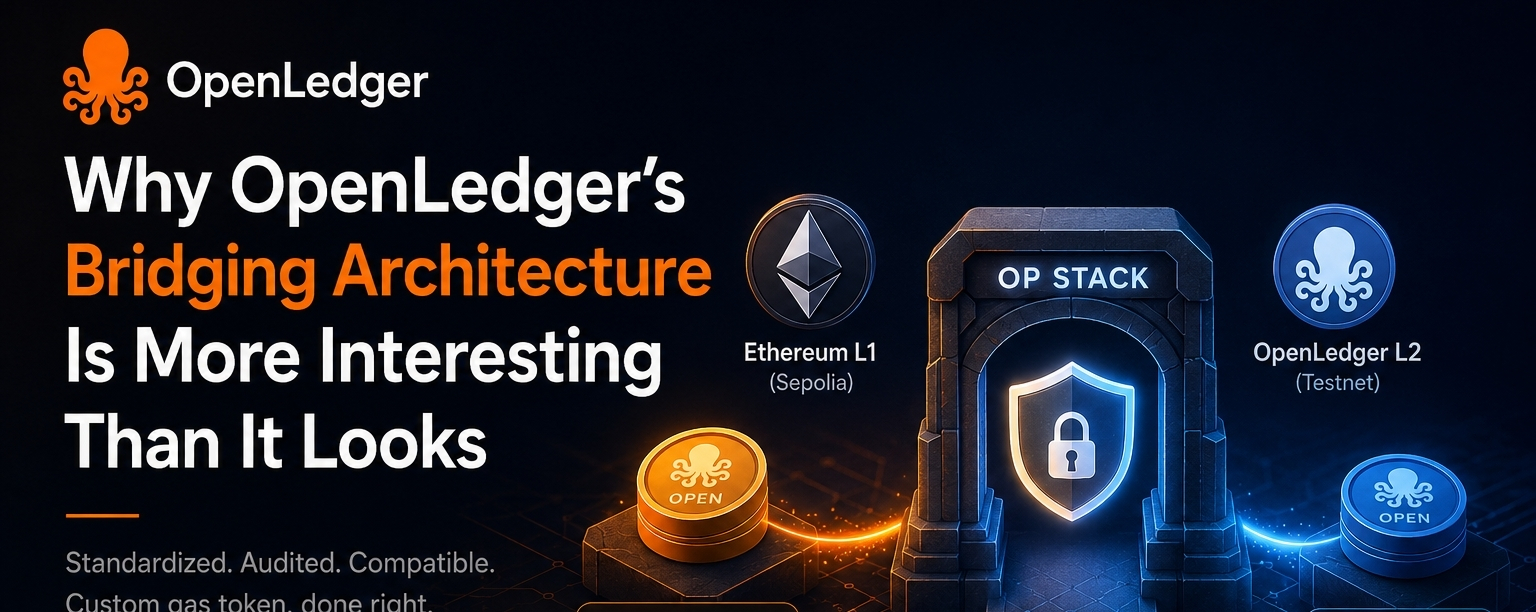
Most projects announce a bridge and move on. OpenLedger did something different and it's worth pausing to understand why.
When a new Layer 2 launches, the bridge is rarely the headline. It sits quietly in the background while token prices, airdrop speculation, and roadmap promises take center stage. But for anyone who has actually lost funds to a poorly designed bridge or watched a protocol collapse because its cross-chain infrastructure wasn't built with rigor the bridge is everything. It is the first and last line of defense between your assets and a very expensive mistake.
OpenLedger's approach here deserves a closer look.
Not Custom. Intentionally.
The first thing to understand about OpenLedger's bridge is that it wasn't built from scratch. The team deliberately chose the OP Stack Standard Bridge, deployed through AltLayer a Rollup-as-a-Service provider with a track record in the ecosystem. The core components OptimismPortal, L1StandardBridge, L2StandardBridge, and CrossDomainMessenger are the same canonical contracts used by Base, Mode, Zora, and others across the OP Stack family.
This is not laziness. This is a deliberate engineering philosophy.
When you build a custom bridge, you inherit every bug you introduce. When you use battle-tested infrastructure that has been audited multiple times by firms like OpenZeppelin and Trail of Bits, you inherit the security work of an entire ecosystem. There is genuine wisdom in not reinventing the wheel when the wheel is already round.
For users, this translates into something tangible: the same wallet you use on Base works on OpenLedger. MetaMask, Ledger hardware wallets, Hardhat development environments, viem all compatible, no friction, no surprises.
The Custom Gas Token Problem Solved Cleanly
Here is where it gets technically interesting.
OpenLedger uses OPEN, an ERC-20 token on Ethereum L1, as its native gas token on L2. This is not the default configuration. Standard OP Stack deployments use ETH as the gas token. OpenLedger needed something different and the way they handled it matters.
Rather than modifying the core bridge architecture (which would have introduced new attack surfaces and broken compatibility), OpenLedger leverages the existing OptimismPortal contract to handle OPEN token deposits. On testnet, OPEN tokens are locked in the OptimismPortal contract on Sepolia. Once the deposit finalizes, OPEN is minted natively on L2.
The withdrawal path works in reverse: OPEN is burned on L2, then unlocked on L1.
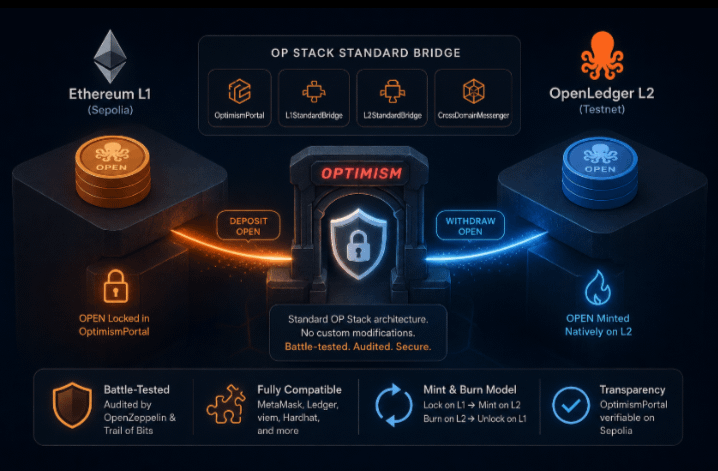
This is the standard OP Stack mint-and-burn model just applied to a custom ERC-20 rather than ETH. The elegance is that no custom modifications were made to the underlying bridge architecture. The security guarantees remain intact. The compatibility remains intact. The only thing that changed is what token flows through the pipe.
It is a meaningful design choice. Custom gas tokens are notoriously tricky to implement without introducing vulnerabilities. OpenLedger threaded that needle by working within the system rather than around it.
What This Signals About the Project
Reading between the lines, OpenLedger's bridging decisions reflect a team that understands where to take risks and where not to.
Building a novel AI-focused data layer on a blockchain? That is a space that arguably justifies new thinking and novel architecture. But the bridge the piece that holds user funds during transit is not the place to experiment. The conservative, compatibility-first approach here suggests a team that understands operational risk, not just product vision.
That kind of judgment is underrated in crypto. A lot of projects fail not because the core idea was wrong, but because one component was built without the appropriate level of care.
The Bottom Line
OpenLedger's bridge is not exciting in the way that a new token mechanism or a novel consensus algorithm might be. It is exciting in the way that a wellengineered foundation is exciting quietly, structurally, and only obviously important when you consider what happens without it.
Standardized. Audited. Compatible. Custom gas token implemented cleanly within existing constraints.
For a network positioning itself at the intersection of AI and decentralized data infrastructure, getting the fundamentals right is not optional. It is the prerequisite for everything else.
The testnet OptimismPortal contract is live and verifiable on Sepolia. For those who want to look under the hood rather than take anyone's word for it that transparency is, itself, part of the point.
