
when i first looked at openledger, i honestly treated it like background noise.
another ai narrative wrapped in blockchain language. another system trying to convince the market that decentralization and artificial intelligence belong together. and maybe that reaction says more about the state of crypto than the project itself because after enough cycles, you start developing this instinct where every new idea feels suspiciously familiar. everybody starts using the same words. everybody promises infrastructure for the future. eventually the language becomes so polished that it stops feeling real.
that’s where i placed openledger in my head at first.
just another attempt to package intelligence into a tokenized economy.
but the strange thing is, the more i kept reading about it, the less comfortable that assumption became.
because underneath all the ai terminology, i started noticing that the project wasn’t really obsessed with intelligence itself. it seemed obsessed with something much quieter. something most people barely talk about when they discuss ai.
ownership.
attribution.
economic memory.
and i think that realization changed the entire way i looked at it.
especially now, while the project keeps evolving almost daily around decentralized contribution systems, validator coordination, agent infrastructure, and mechanisms designed to track value creation between data providers, models, and autonomous agents. the updates themselves feel less like marketing announcements and more like pieces of a larger machine slowly assembling itself in public.
that’s the part i keep coming back to.
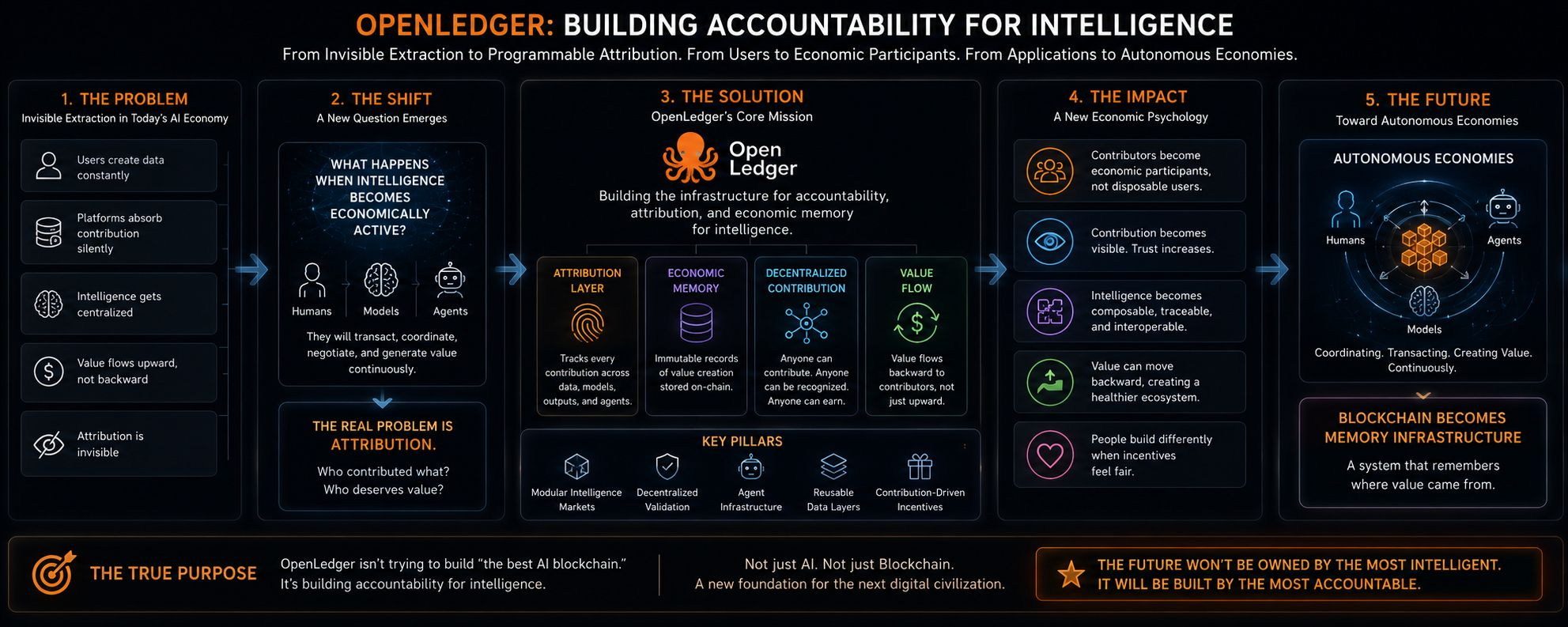
because maybe openledger isn’t trying to become “the best ai blockchain.”
maybe it’s trying to solve a much stranger problem.
what happens when intelligence itself becomes economically active?
not human intelligence alone.
machine intelligence too.
i keep thinking about that because most conversations around ai still sound temporary. people talk about tools. assistants. productivity. faster workflows. but beneath all of that, there’s this much bigger structural shift quietly approaching where agents may eventually transact, coordinate, negotiate, and generate value continuously without human intervention every second.
and if that future actually unfolds, then the real problem isn’t intelligence.
the real problem is attribution.
who trained the models.
who provided the data.
who refined the outputs.
who contributed signal instead of noise.
who deserves value once autonomous systems begin operating at scale.
the longer i sit with that thought, the more unsettling it becomes.
because right now, most of the internet functions through invisible extraction. people create data constantly without understanding how much value their behavior generates elsewhere. platforms absorb contribution silently. intelligence gets centralized because contribution becomes impossible to track cleanly.
but openledger feels like it’s trying to reverse that flow.
and honestly, i’m starting to think that changes everything.
because if attribution becomes programmable, then participation itself changes. contributors stop behaving like disposable users and start behaving like economic participants. data stops feeling passive. models stop feeling isolated. intelligence becomes something composable, traceable, and economically linked back to the people or systems that helped create it.
that creates a completely different psychological environment.
and psychology matters more than technology most of the time.
people build differently when incentives feel fair.
communities behave differently when contribution becomes visible.
systems evolve differently when value can move backward instead of only upward.
i think that’s the hidden layer inside openledger that most people still aren’t fully seeing because the market keeps reducing everything into token speculation. everybody wants to know which ai project will pump hardest. meanwhile almost nobody is asking what kind of infrastructure autonomous economies actually require underneath the surface.
those are two completely different conversations.
one is about hype.
the other is about civilization-scale coordination.
and maybe that sounds dramatic, but i genuinely think we’re approaching a moment where economic systems themselves start changing shape because intelligence is no longer staying contained inside humans alone.
that realization has been sitting with me heavily lately.
especially when i watch how openledger keeps positioning itself around modular intelligence markets, decentralized validation systems, reusable data layers, and contribution-driven incentives instead of just pure narrative expansion. the structure feels intentional. almost patient. like the project understands that the next digital economy may not revolve around applications anymore, but around coordination between humans, models, and autonomous agents simultaneously.
and honestly, i don’t think the market fully understands what that means yet.
because once agents begin interacting economically at scale, blockchain stops being just financial infrastructure.
it becomes memory infrastructure.
a system that remembers where value came from.
and maybe that’s the entire point.
maybe openledger isn’t trying to build artificial intelligence at all.
maybe it’s trying to build accountability for intelligence.
the longer i think about that, the harder it becomes to reduce this project into another trend cycle.
personally, i still think there are huge unanswered questions. scalability. adoption. whether decentralized contribution systems can actually compete against centralized ai giants. whether people will truly care about attribution once convenience becomes dominant. all of those tensions are real.
but even with those uncertainties, i can’t ignore the direction.
because for the first time in a while, a project made me stop thinking about ai as software and start thinking about it as an economy.
and once i saw it that way, i couldn’t unsee it anymore.