
I’ve been watching AI and blockchain drift toward each other for a while now.
Not in the dramatic way people often describe technological change, where everything suddenly transforms overnight. It has felt slower than that. More gradual. Almost like two separate conversations that kept happening in different rooms until, at some point, someone opened the door between them.
Lately, I find myself paying attention to projects that sit in that shared space.
Not because I’m convinced they represent the future, but because they seem to be asking questions that nobody really knows how to answer yet.
OpenLedger is one of those projects.
The first time I came across it, what stayed with me wasn't a specific feature or technical claim. It was the larger idea underneath it all. The notion that data, AI models, and even autonomous agents might eventually become participants in their own economic system.
That thought lingered longer than I expected.
For years, data has mostly lived in the background. People generate it, companies collect it, models learn from it, and value emerges somewhere in the process. Most of the time, the path between contribution and reward feels invisible. We know value is being created, but it's often difficult to see where it begins or where it ends.
OpenLedger seems to be looking directly at that problem.
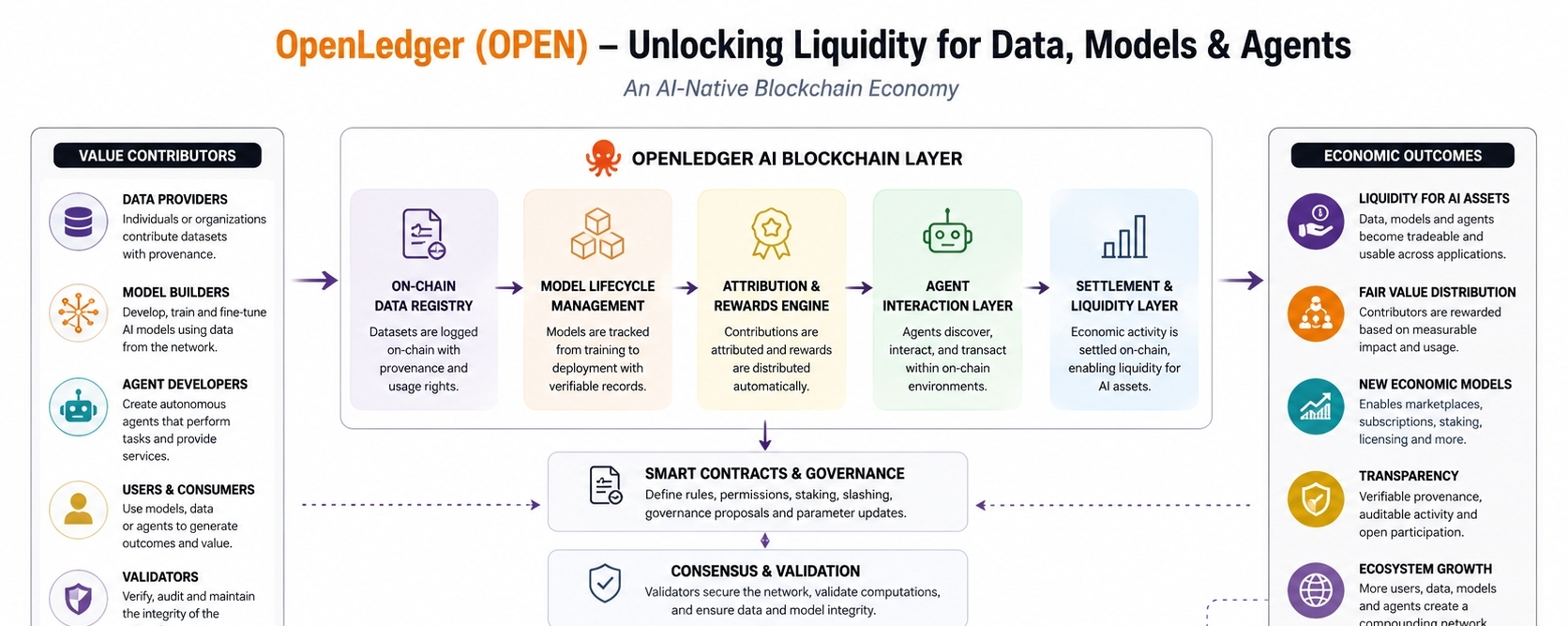
The project is built around the idea that data, models, and AI-driven agents should be able to generate, track, and capture value more openly. Instead of existing outside the blockchain, many of these activities are intended to happen within the network itself. Training models, deploying them, interacting with them, and recording those interactions become part of the chain's environment.
At least, that's the vision as I understand it.
The network is Ethereum-compatible, which feels like a practical decision more than an ideological one. There is already a large ecosystem built around Ethereum, along with wallets, smart contracts, and Layer-2 networks that people know how to use. Starting from familiar foundations often makes more sense than trying to reinvent everything from scratch.
Still, the technical side isn't what I keep returning to.
What interests me is the underlying assumption.
The assumption that value can be organized differently.
That maybe the relationship between data creators, model builders, users, and autonomous systems doesn't have to follow the patterns that have dominated the internet for the last decade.
It's an attractive idea.
But I can't tell whether it's attractive because it's realistic or because people have become frustrated with the alternatives.
There's a difference.
When I look at AI today, I see enormous concentration. Larger models require larger resources. Larger resources tend to gather around larger organizations. The cycle feeds itself. More capability often leads to more centralization.
Blockchain, at least in theory, emerged as a response to that kind of concentration. It promised distribution, transparency, and systems that could function without relying entirely on trusted intermediaries.
What happens when those two forces meet?
I'm not sure anyone knows.
OpenLedger appears to be exploring that intersection. It imagines a world where intelligent systems can participate directly in economic activity, where autonomous agents interact with services, where data contributions can be recognized, and where incentives are embedded into the infrastructure itself.
Some days that sounds incredibly logical.
Other days it sounds like the beginning of a completely new set of problems.
Because every time we create a market around something, that thing changes.
The internet created markets around attention.
Social platforms created markets around influence.
Advertising systems created markets around behavior.
Now there is growing interest in creating markets around data, intelligence, and machine-generated work.
Maybe that's a natural evolution.
Or maybe we're simply extending the same economic patterns into a new technological era.
I honestly don't know.
The idea of unlocking liquidity around data and AI agents is particularly interesting to me because it sounds empowering on the surface. Resources that were previously trapped become useful. Contributors can potentially receive compensation. Participation becomes easier to measure.
But liquidity has a way of reshaping incentives.
Once something becomes monetizable, people start optimizing for it.
Sometimes that's productive.
Sometimes it creates distortions nobody anticipated.
The challenge is that both outcomes often look similar at the beginning.
I also find myself wondering about autonomous agents.
There is growing confidence in the idea that agents will become increasingly capable of making decisions, coordinating tasks, and creating economic value with minimal human involvement. OpenLedger seems designed with that possibility in mind.
Yet I can't shake a certain discomfort around the idea.
Not because I think autonomous systems are inherently dangerous.
More because I wonder what happens when economic activity gradually becomes less human.
Not absent of humans, necessarily.
Just further removed from them.
A system can be decentralized and still feel distant.
A network can be transparent and still become difficult for ordinary people to understand.
Those possibilities seem worth thinking about.
Maybe OpenLedger helps create a more open framework for AI development. Maybe it gives contributors clearer ownership and stronger incentives. Maybe it becomes part of a broader movement toward more transparent AI economies.
Or maybe reality turns out to be messier than the theory.
Technology usually does.
What keeps me interested is not certainty but uncertainty. The project sits in a place where some of the most important questions about AI remain unresolved.
Who should benefit from intelligence?
How should value move through systems built on data?
Can decentralization genuinely balance the growing power of automation?
And perhaps most importantly, can we build economic systems around AI without recreating the same dependencies we were trying to escape in the first place?
I keep wondering about that.
The more I watch AI and blockchain evolve, the less convinced I become that either technology alone holds the answer. What matters is the structure that forms around them, the incentives they create, and the people—or increasingly, the agents—that participate within them.
OpenLedger feels like one attempt to explore that territory.
Whether it ultimately reveals a better path forward or simply another version of familiar dynamics is something I’m still trying to figure out.
For now, I’m content to keep watching.