
Europe's landmark crypto regulatory framework was designed to bring order to a chaotic market. But according to one of the industry's most prominent custody executives, it may have inadvertently built a structural fault line directly into the stablecoin ecosystem.
Mike Belshe, CEO of BitGo, went public this week with a pointed critique of the Markets in Crypto Assets framework, arguing that MiCA's reserve requirements don't protect stablecoin users — they expose them to the exact systemic risks that crypto was designed to sidestep.
The Reserve Requirement Problem
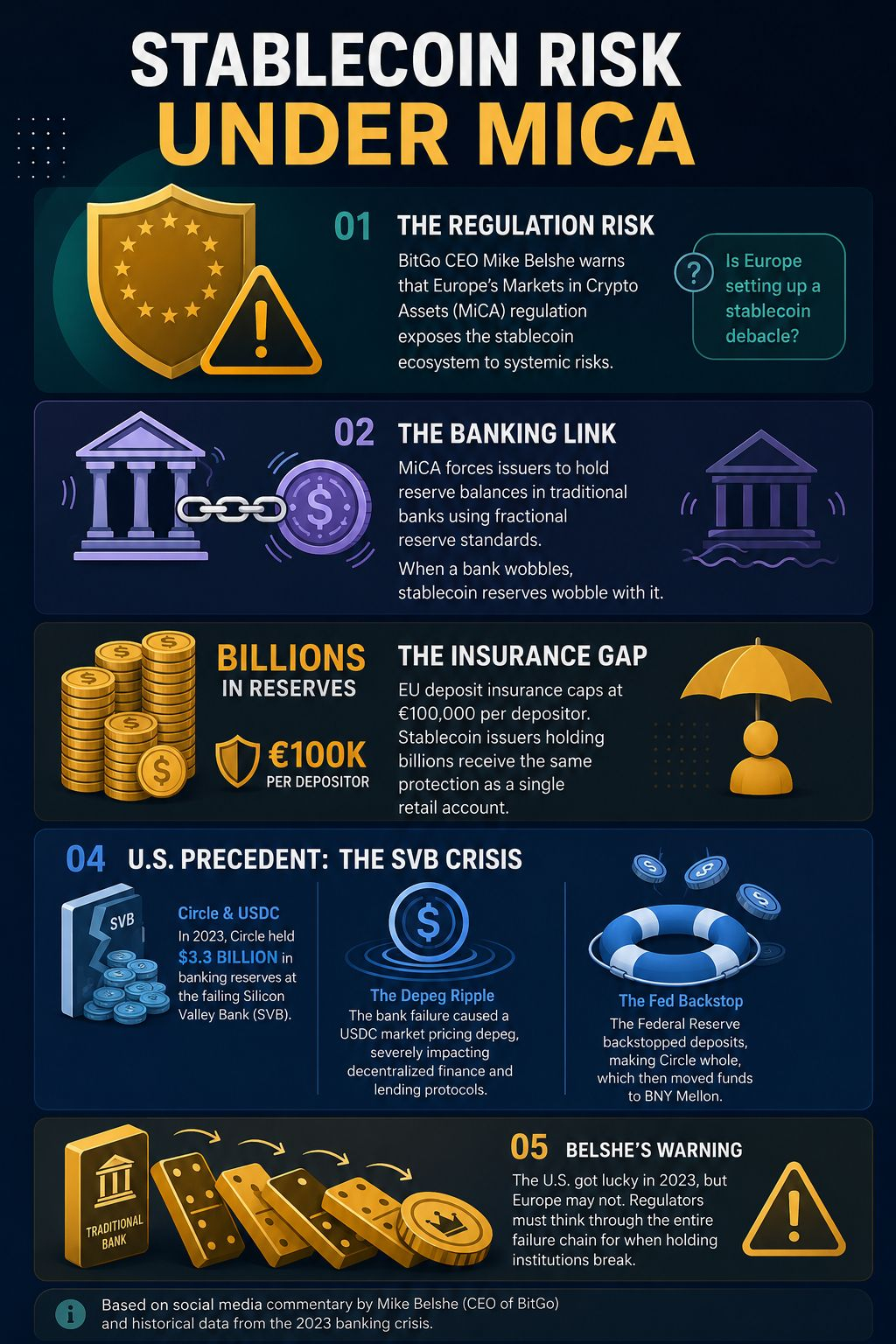
At the heart of Belshe's concern is a specific MiCA provision that requires stablecoin issuers to hold a portion of their reserves in licensed European banks — institutions that operate on fractional reserve principles. In plain terms, those banks don't hold every euro deposited with them. They lend most of it out.
That creates a dependency that Belshe argues has no place in a system built on the premise of transparency and full backing. "That creates a direct link between crypto markets and traditional banking stress," he wrote on social media. "When a bank wobbles, stablecoin reserves wobble with it."
The deposit insurance gap compounds the problem. EU deposit protection caps at €100,000 per depositor — the same ceiling that applies to a retail savings account. A stablecoin issuer holding billions in reserve balances at a European bank sits behind that same ceiling. As Belshe put it, that's not a rounding error. It's a structural gap.
The SVB Precedent Europe Should Study
Belshe's warning isn't theoretical. The U.S. lived through a version of this scenario in March 2023, when the collapse of Silicon Valley Bank sent shockwaves through the stablecoin market. Circle, the issuer of USDC, had $3.3 billion of its reserve backing sitting inside SVB at the time of the bank's failure. The result was a USDC depeg that cascaded through decentralized finance, hitting lending protocols and rattling confidence across the broader market.
The crisis was ultimately contained — the Federal Reserve stepped in, backstopped deposits, and made customers whole, including Circle, which subsequently moved its reserves to BNY Mellon. But Belshe's point is that the outcome depended entirely on a discretionary intervention that may not be repeated, and may not be available to European issuers operating under a different regulatory and monetary system.
"The U.S. got lucky in 2023," he said. "Europe may not."
Regulation That Doesn't Think Through the Failure Chain
What Belshe is really calling for is a regulatory framework that stress-tests the full sequence of events — not just who holds the reserves under normal conditions, but what the exposure looks like when the institution holding them runs into trouble.
That kind of second-order thinking is often missing from financial regulation, which tends to be written in stable environments and tested in unstable ones. MiCA has genuine strengths, and the EU deserves credit for attempting a comprehensive framework when most jurisdictions were still arguing about definitions. But a rule that ties stablecoin solvency to the health of fractional reserve banks — without meaningful insurance coverage for the scale involved — leaves a gap that a future banking stress event could easily exploit.
The stablecoin market has grown too large and too embedded in broader crypto infrastructure for that risk to be dismissed. If a major European stablecoin were to depeg under circumstances MiCA's reserve rules helped create, the fallout wouldn't stay contained to Europe for long.