
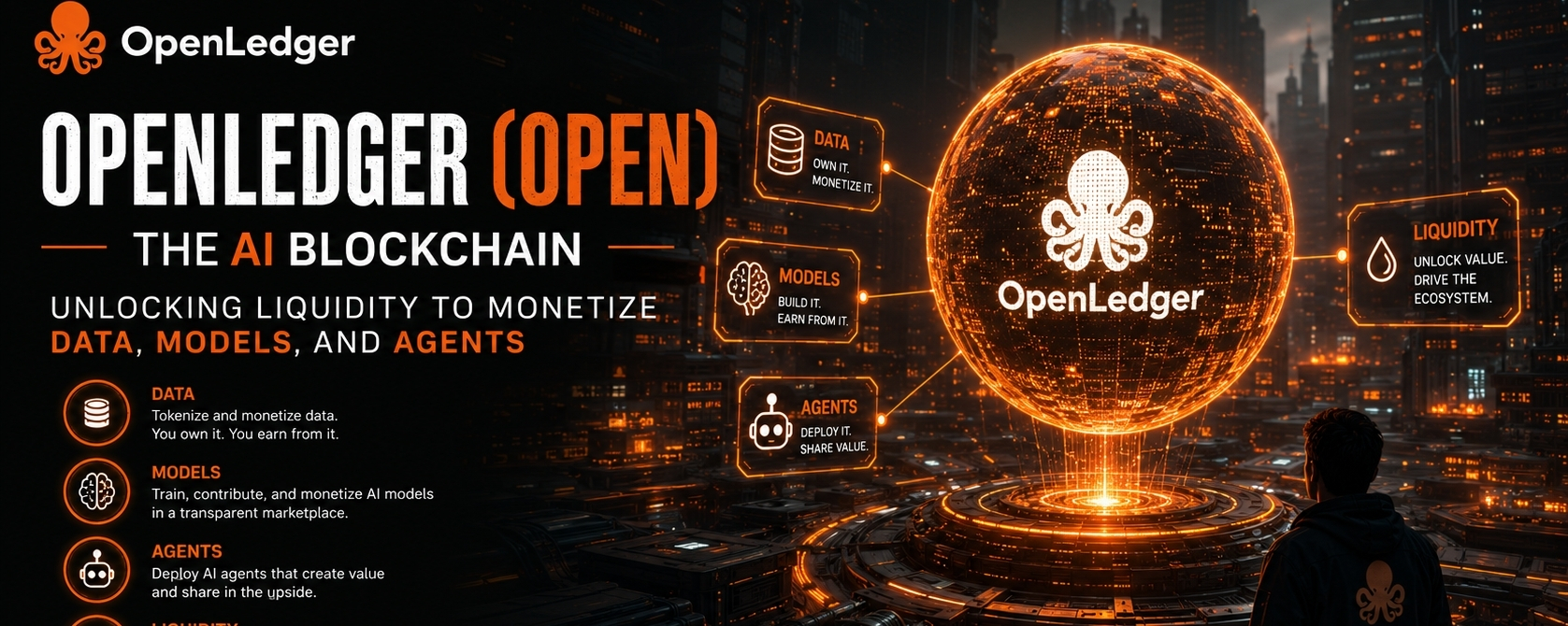
I keep coming back to OpenLedger, not because I understand it completely, but because I don't.
That feeling has become strangely familiar in this space.
The first time I started paying attention, it looked like another moment in a market full of moments. New narratives arrive almost every week. They appear suddenly, gather attention, collect belief, and for a while they seem impossible to ignore. Then the noise shifts somewhere else. It usually does.
So I find myself waiting.
Not waiting for announcements or partnerships or metrics that people post online. I think I've learned to pay less attention to those things. What interests me more is what remains after everyone has already reacted. What survives after excitement becomes routine.
OpenLedger sits in that part of my mind.
I watch people talk about AI, data, models, agents. I watch the language change depending on the mood of the market. Some days the conversations feel visionary. Other days they feel transactional. The same ideas somehow sound completely different depending on whether people think there is money nearby.
I've seen this before.
Not in exactly the same form, but close enough.
The cycle repeats itself across Web3. First comes curiosity. Then confidence. Then numbers. Then expectations. Then comparison. Eventually belief starts competing with calculation.
At that stage, everything changes.
People rarely leave all at once. Instead, their behavior shifts gradually. Conversations become shorter. Questions become different. Attention becomes more selective. The same individuals who once explored possibilities begin measuring outcomes. The language becomes less emotional and more efficient.
I notice that happening everywhere.
What makes OpenLedger interesting to observe is that it exists in a space where value itself feels uncertain. Not uncertain because nobody can describe it, but uncertain because the boundaries keep moving.
Data becomes an asset.
Models become an asset.
Agents become an asset.
At least that's the direction everything seems to be moving.
But watching something emerge is different from reading about it after the fact. When you're inside the process, nothing feels settled. Every assumption still has room to fail. Every narrative still has room to change shape.
That's where I find myself.
Watching.
Trying not to decide too quickly.
The strange thing about Web3 is how quickly people become certain about things that haven't had time to reveal themselves. A few successful weeks can create confidence that feels permanent. A few difficult months can create doubt that feels equally permanent.
Neither usually lasts.
Time tends to expose things more honestly than excitement ever can.
When I look at OpenLedger, I find myself thinking less about technology and more about behavior.
How do people act when rewards are obvious?
How do they act when rewards become less obvious?
How long does participation continue after incentives stop doing most of the work?
Those questions interest me because they often reveal the real structure underneath everything else.
A system can attract activity.
A world attracts presence.
The difference isn't always visible in the beginning.
In the early stages, both can look identical.
People arrive. Numbers grow. Conversations expand. New participants enter faster than old participants leave.
Everything looks healthy.
But eventually the atmosphere changes.
The easy attention disappears.
The audience becomes smaller.
People stop performing excitement for each other.
That's when I start paying closer attention.
Because a system can continue functioning without being loved.
A world is different.
A world creates reasons to stay that aren't entirely rational.
Not because participants are loyal, but because they feel connected to something larger than the immediate reward.
I don't know yet where OpenLedger sits on that spectrum.
Maybe nobody does.
What I see right now feels unfinished.
Pieces moving.
Expectations forming.
Assumptions being tested in public.
Some people seem convinced they've already seen the future. Others seem convinced they've already identified the flaws. Both groups might be wrong.
Most emerging projects look obvious only after enough time has passed.
While they're happening, they're usually confusing.
That's the part people forget.
History looks clean when viewed backward.
The present rarely does.
So I continue watching the smaller details.
The conversations that happen when nobody is celebrating.
The participants who remain when attention shifts elsewhere.
The moments where enthusiasm becomes routine.
Those moments often tell a more honest story than any launch ever could.
And with OpenLedger, I find myself returning to the same feeling over and over again.
Not certainty.
Not skepticism.
Something in between.
The sense that there may be something meaningful forming here, but also the awareness that Web3 has produced this feeling many times before.
Sometimes it became something real.
Sometimes it didn't.
For now, I keep looking at what happens after the headlines move on.
I keep watching how people behave when nobody is telling them where to look.
And somewhere in that quiet space, beyond the announcements and the predictions and the confidence that seems to appear so easily online, OpenLedger is still taking shape.
Or maybe it's revealing a shape that was always there.
I'm not sure yet.
So I keep watching.
