
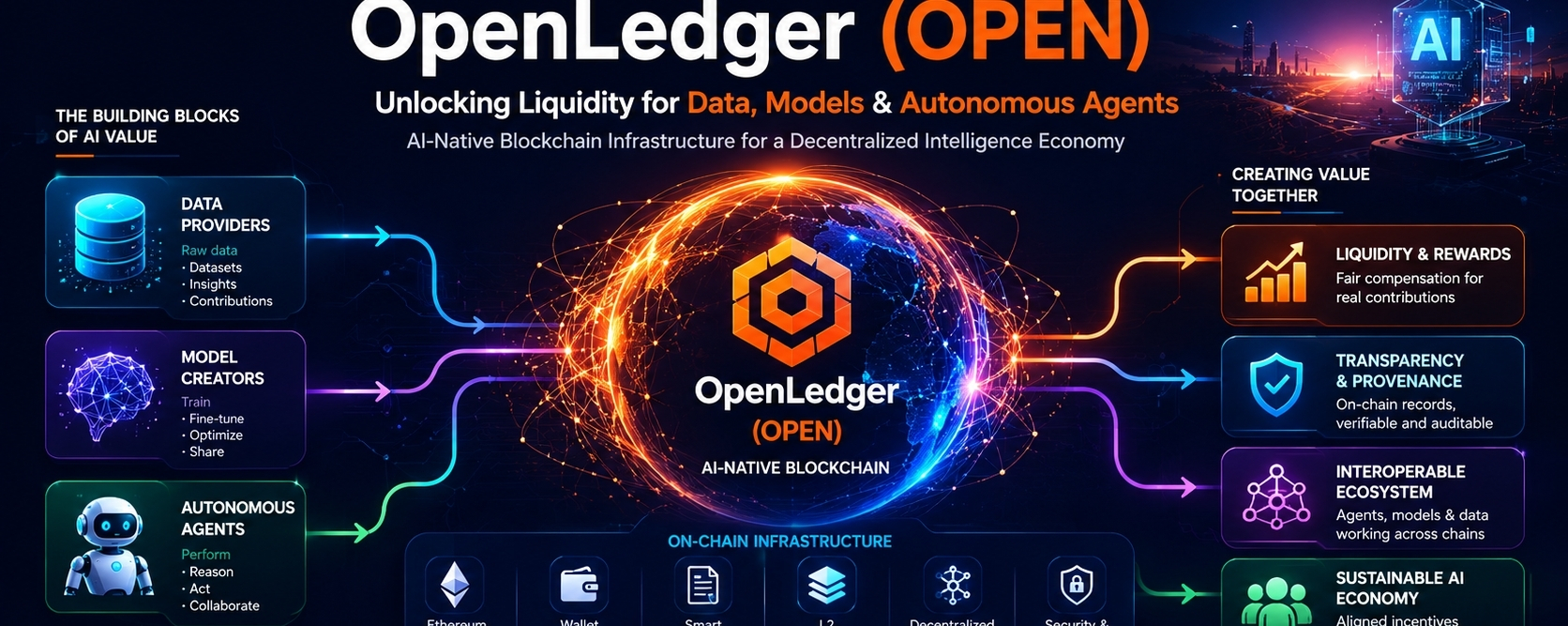
I've been watching the AI space for a while now, and lately I keep noticing how the conversation has shifted. A few years ago, people were mostly talking about what AI could do. Now, more often than not, the discussion seems to revolve around who owns the data, who benefits from the models, and where all the value ends up once these systems become part of everyday life.
The more I think about it, the more complicated it feels.
Every major technology wave starts with excitement. New possibilities appear, old assumptions get challenged, and for a while it seems like everything is moving faster than anyone can fully understand. AI feels like it's in that phase right now. At the same time, blockchain continues searching for applications that extend beyond speculation and into something that feels genuinely useful.
That's partly why OpenLedger caught my attention.
Not because it claims to have all the answers, but because it seems to be exploring a question that many people are only beginning to ask. If data is valuable, if AI models are valuable, and if autonomous agents are becoming increasingly capable, then how should that value be recognized and distributed?
OpenLedger appears to be built around that idea. Rather than treating AI as something happening outside the blockchain, it tries to create an environment where data, models, and agents can interact directly within an on-chain economy. Training, deployment, and agent activity aren't viewed as separate processes sitting in the background. They're part of the system itself.
What makes this interesting is that the infrastructure feels familiar. It's Ethereum-compatible, works with existing wallets, supports smart contracts, and connects with broader Layer-2 ecosystems. That might sound like a technical detail, but I think it matters. Most successful technologies don't win because they're completely different. They win because they make new ideas easier to access through tools people already understand.
Still, I find myself approaching these kinds of projects with a certain amount of caution.
The idea of creating liquidity around data and AI sounds reasonable on paper. After all, data fuels models, models power applications, and agents can perform useful work. Connecting incentives to those contributions seems logical.
But I also wonder what happens when everything becomes financialized.
Technology often starts by solving a problem and ends up creating entirely new behaviors. Once something can be measured, rewarded, and traded, people naturally begin optimizing for those rewards. Sometimes that leads to innovation. Sometimes it creates incentives that nobody anticipated at the beginning.
That's where a lot of my questions about OpenLedger come from.
The project seems to sit between two powerful trends. One is decentralization, which aims to reduce dependence on centralized control. The other is automation, which aims to reduce dependence on human effort. Both ideas are appealing in their own way. Both promise efficiency. Yet neither automatically guarantees better outcomes.
I keep wondering what happens when autonomous agents become active economic participants. If agents can generate value, make decisions, and interact with one another at scale, where does human judgment fit into the picture? Does it remain at the center, or does it slowly move to the edges while machines handle more of the activity themselves?
Maybe that's not a problem.
Maybe it's simply the next stage of digital systems evolving.
But it's difficult to know.
What I find most interesting about OpenLedger isn't necessarily the technology itself. It's what the project represents. It reflects a growing belief that intelligence, data, and automation may eventually become assets that move through economic networks just as naturally as tokens do today.
Whether that creates stronger ecosystems or introduces new forms of dependency is still an open question.
For now, OpenLedger feels less like a finished solution and more like an experiment unfolding in public. An experiment trying to understand how AI and blockchain might coexist, not as separate technologies, but as parts of the same economic framework.
Maybe it works. Maybe it doesn't.
Either way, I think the questions it raises are more important than the answers people are rushing to provide. Because beneath all the technical discussions, the real challenge isn't building smarter systems. It's understanding how those systems create value, who benefits from that value, and whether the structures we build today will still make sense once the technology becomes far more capable than it is now.
That's the part I'm still thinking about.