
When DeepSeek shook the AI market in early 2025, the conversation quickly became about model performance, training costs, and whether the AI race had fundamentally changed.
What caught my attention was something else.
If AI models keep getting cheaper, faster, and more accessible, what remains scarce?
Because scarcity is where value usually lives.
That question led me back to OpenLedger and the role of OPEN.
At first, I struggled to understand the project.
Maybe because I've become skeptical of anything that combines AI, blockchain, and a token into a single narrative. Crypto has seen plenty of projects promise to reinvent entire industries by putting a token in the middle. Most of them eventually discovered that adding incentives is easier than creating real value.
But the more I looked into OpenLedger, the more I felt it wasn't really competing with OpenAI, Anthropic, or even other AI-focused crypto networks.
OpenLedger seems to be chasing a different problem.
Trust.
More specifically, trust in data.
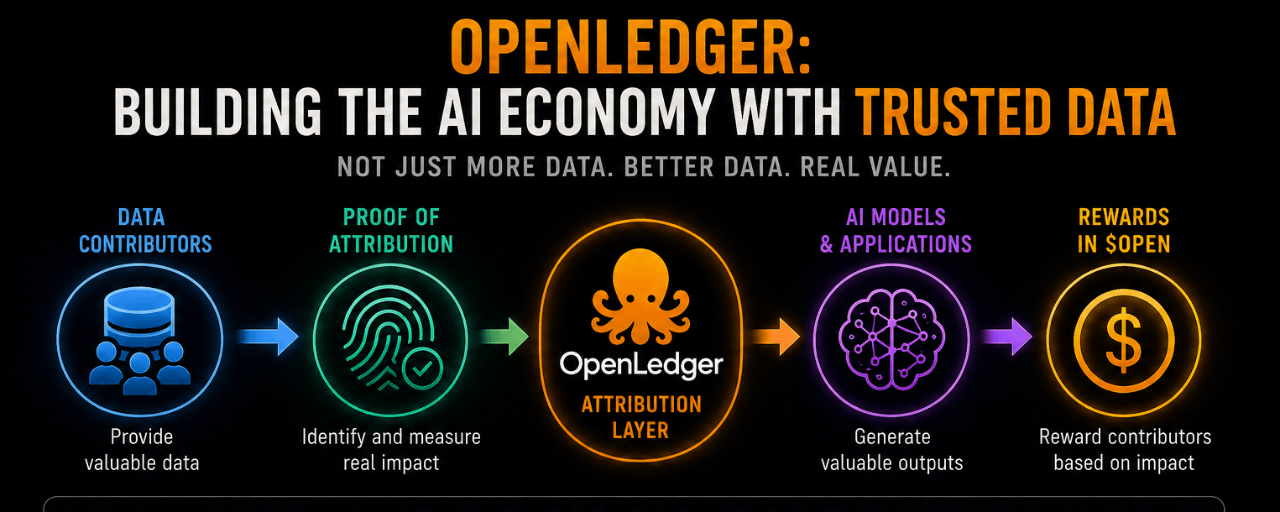
If Ethereum turned blockspace into an asset and Solana monetized speed, OpenLedger is attempting to make data measurable, attributable, and economically valuable.
That's a much harder challenge than it sounds.
Everyone agrees that data matters.
The problem is that not all data matters equally.
A single high-quality medical dataset may contribute more value to an AI model than millions of low-quality social media posts. Yet most systems today struggle to distinguish between the two in a meaningful economic way.
This is where OpenLedger's attribution layer becomes important.
The idea is simple to explain but incredibly difficult to execute.
Imagine an AI model trained on millions of different data points. When that model generates value, who deserves credit?
Who contributed the most?
Who should be rewarded?
OpenLedger wants to answer those questions through attribution mechanisms and distribute rewards through OPEN accordingly.
In theory, it's one of the most interesting ideas in the AI infrastructure space.
In practice, it's also where the biggest risk exists.
Think of AI as a soup made from millions of ingredients.
When someone tastes the final product and says it's excellent, how do you determine which ingredient was responsible for the flavor?
Which contributor should receive the reward?
If attribution works, the network can encourage high-quality data creation.
If attribution fails, incentives become distorted.
And once incentives become distorted, user behavior changes.
We've already seen this happen across crypto.
DeFi optimized liquidity mining.
GameFi optimized reward farming.
Move-to-Earn optimized step farming.
Participants naturally learn how to maximize incentives.
That's not a flaw in human behavior.
It's how incentives work.
Which leads to what I think is OpenLedger's biggest challenge.
Not AI quality.
Not tokenomics.
Data quality.
The internet already produces more data than anyone can realistically process. The world doesn't suffer from a lack of information.
It suffers from a lack of reliable information.
If OpenLedger cannot consistently identify and reward valuable datasets more than low-quality ones, the network could gradually evolve into what I'd call a "Data Farming Economy."
A system where participants optimize for generating reward-eligible data rather than useful data.
The numbers might still look impressive.
More datasets.
More contributors.
More AI activity.
More OPEN flowing through the ecosystem.
But activity alone isn't the same as value.
A library with ten million books isn't useful if nobody knows which books are worth reading.
That's why I think the long-term success of OpenLedger depends on something surprisingly simple:
Can quality outperform quantity?
Can a dataset that meaningfully improves model performance earn more value than thousands of datasets that merely increase volume?
If the answer is yes, OpenLedger could become an important layer of the emerging AI economy.
If the answer is no, it risks becoming another incentive-driven crypto experiment dressed in AI branding.
And that's what makes the project so interesting to watch.
Because OpenLedger isn't really competing against Ethereum, Solana, or even OpenAI.
In many ways, it's competing against human nature itself.
People will always optimize for rewards before they optimize for ideals.
The future of OPEN may ultimately depend on whether the network can make those two goals point in the same direction.
A small difference on paper.
But potentially the difference between building a real AI economy and building another temporary narrative.