

I noticed something recently while scrolling through old articles online.
The same ideas kept appearing again and again. Sometimes they were rewritten as posts, sometimes turned into summaries, and sometimes repeated by entirely different accounts. The information survived, but figuring out where it originally came from felt surprisingly difficult.
That thought stayed with me while reading about OpenLedger.
Most conversations around AI focus on capability. Bigger models, faster systems, and more powerful outputs dominate the discussion. But as AI-generated content becomes increasingly common, another question starts becoming more important.
How do we preserve the connection between a contribution and the value it creates?
The internet became incredibly efficient at distributing information. What it never solved particularly well was attribution. Knowledge travels everywhere, yet the trail behind that knowledge often fades over time.
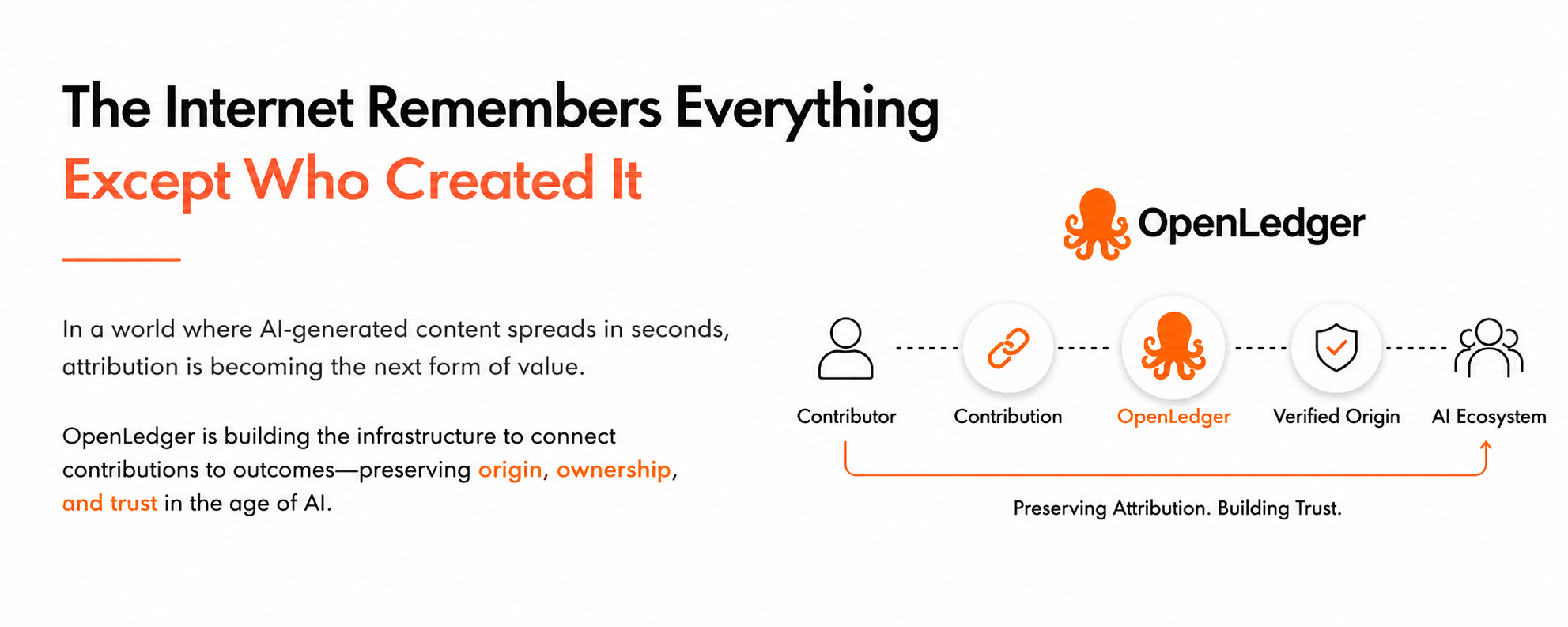
That is what makes OpenLedger interesting to me. Rather than focusing only on creating intelligence, the project also explores how contributions can remain connected to outcomes. In an ecosystem where data, expertise, and feedback help shape AI systems, preserving that connection becomes increasingly valuable.
The reason this matters extends beyond AI itself. History shows that when things are easily available people start caring about real things. This has happened before with art. People want to know that a piece of art is genuine. We see this with collectibles too. People want to own the deal. The same thing is happening with media and digital things. People want to know they are getting the version.
As synthetic content expands, similar questions naturally emerge.
Where did this come from? Who contributed to it? Can we be sure where it came from?
For me OpenLedger is a change in the way we think about digital value. OpenLedger is really, about looking at value in a new way. The next phase of AI may not be defined solely by creating more intelligence. It may also be defined by building systems that preserve attribution, ownership, and trust as information moves through increasingly complex digital environments.
Source: OpenLedger Docs. Not financial advice. DYOR.