
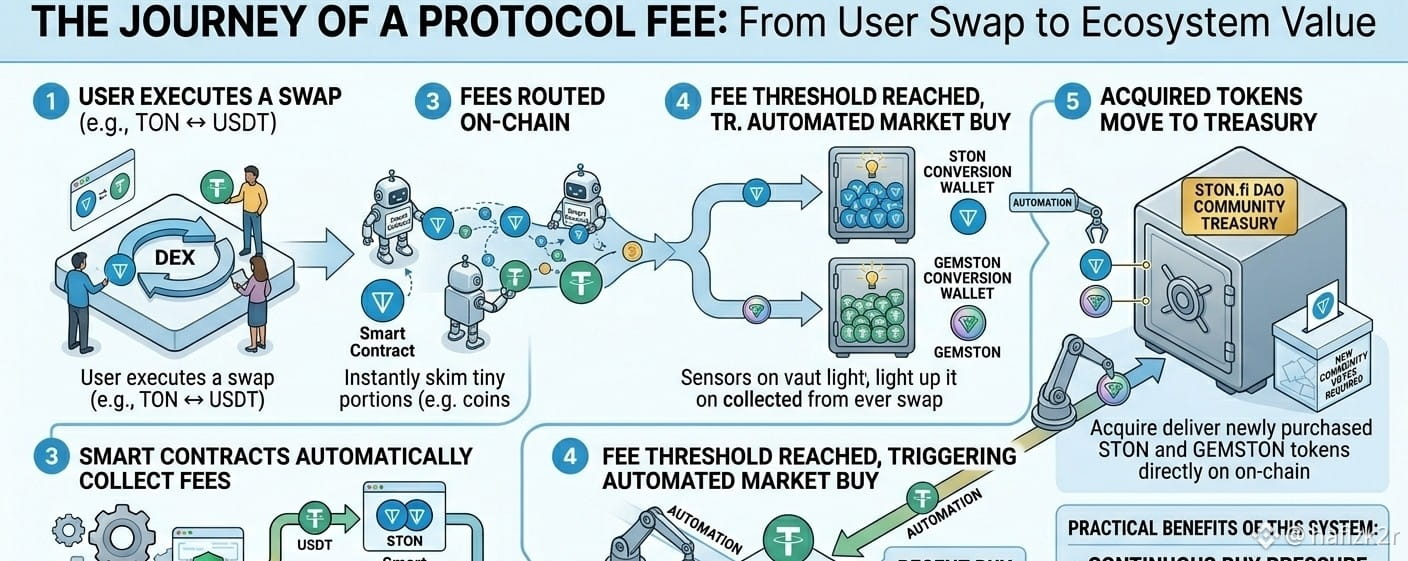
Every time you make a trade on a decentralized exchange like STON.fi, the magic happens instantly behind the scenes. You click "Swap," and your tokens change form. But during that process, a tiny fraction of the trade is collected as a protocol fee.
While traditional financial institutions hide their fees in corporate earnings, STON.fi handles its fees entirely on public smart contracts. Based on official data from the STON.fi ledger, here is a step-by-step look at exactly how those fees work in practice.
Step 1: Automatic Collection at the Swap
The process begins the exact second a user executes a swap on the STON.fi platform. The smart contract automatically deducts a small protocol fee from the trade. Initially, these fees are gathered in standard ecosystem tokens like TON and USDT, though the system is designed to support other tokens as infrastructure expands.
Step 2: Routing to Dedicated Wallets
Instead of going into a single, unorganized pool, the collected fees are immediately routed on-chain to two highly specific destination addresses:
The STON Conversion Wallet: Dedicated entirely to accumulation for STON token conversions.
The GEMSTON Conversion Wallet: Dedicated entirely to accumulation for GEMSTON token conversions.
These wallets act as temporary on-chain staging areas, holding the accumulated TON and USDT fees in plain public view.
Step 3: Triggering the Open Market Buyback
Fees do not just sit in these staging wallets forever. The smart contracts are programmed with a specific rule: when a certain fee threshold is reached, an automated market buy is triggered.
Without any human intervention, the wallets automatically execute swaps right back on STON.fi. They use the accumulated fee tokens (like USDT) to purchase STON and GEMSTON at the prevailing market price. For example, recent ledger transactions show regular automated market buys ranging from roughly $68 to $255 USDT per swap.
Step 4: Securing the Community Treasury
Once the open-market swaps are complete, the newly acquired STON and GEMSTON tokens are instantly forwarded to a separate, secure on-chain treasury address.
According to a community mandate passed by the STON.fi DAO, up to 50% of all collected protocol fees are dedicated to this treasury buyback loop. The other 50% is reserved to fund ongoing development, platform operations, and core infrastructure.
Why This Matter: The Practical Benefits
By letting smart contracts handle protocol fees instead of central managers, the ecosystem gains three major practical advantages:
Continuous Buy Pressure: The protocol is constantly acting as a natural buyer of its own ecosystem tokens (STON and GEMSTON) directly from the open market.
Predictable Automation: Because the Ston Foundation doesn't control the smart contracts or time the market based on token prices, the buybacks happen naturally and predictably based purely on trading volume.
Immutable Trust: Every single fee converted is visible on the public blockchain. To date, this practical loop has successfully processed over 3,100 conversions, resulting in $337,000+ worth of value funneled back into the project's ecosystem.
Ultimately, every swap made on the platform plays a direct role in funding operations and building a community-controlled treasury all entirely handled by code.
For more info, check the blog 👇
https://transparency.ston.foundation/
STON.fi