
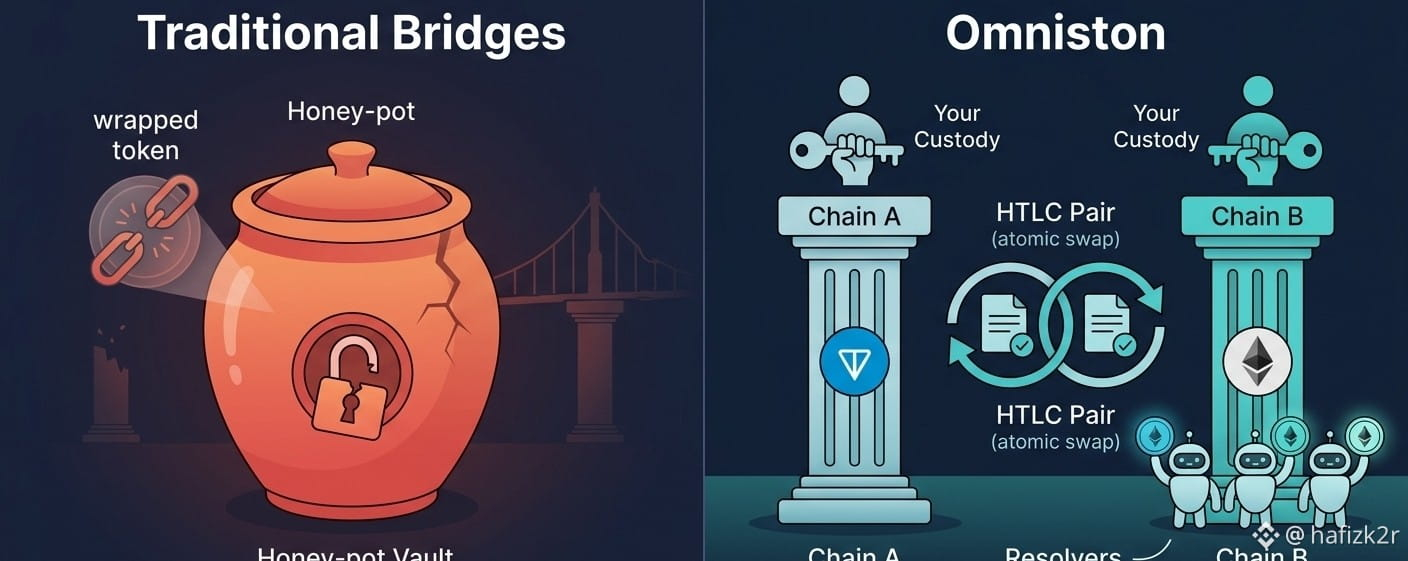
Moving crypto from one blockchain to another has historically been one of the riskiest activities in decentralized finance (DeFi). Most conventional cross-chain solutions rely on a familiar recipe: you lock your crypto in a massive central vault on Chain A, and the bridge mints a fake "wrapped" version of that token for you on Chain B.
The problem? Those central vaults become multi-million-dollar honeypots that constantly attract hackers.
Omniston, a cross-chain execution layer developed by STON.fi Dev, completely flips this script. It doesn't use a vault, it doesn't mint wrapped tokens, and it never forces you to give up custody of your assets. Instead, it replaces the "honeypot" with a marketplace driven by a powerful dynamic duo: Resolvers and HTLCs.
The New Architecture: Resolvers + HTLCs
To understand how Omniston eliminates bridge risk, you only need to understand two concepts:
1. The Resolver (The Market Maker)
Instead of a giant, passive pool of funds, Omniston uses a competitive network of independent, professional liquidity providers called Resolvers. When you request a cross-chain swap, Omniston broadcasts your request. Resolvers compete to give you the best price quote using their own funds on the destination chain.
2. The HTLC Pair (The Spine of the Swap)
Once you accept a quote, the transaction is locked down by a pair of Hashed Timelock Contracts (HTLCs), one on your starting chain and one on your destination chain. These contracts are cryptographically linked together by a single secret passcode.
What Actually Changes in Practice?
By pairing competing Resolvers with smart-contract HTLCs, Omniston radically changes how cross-chain swaps feel and function in three ways:
True "All-or-Nothing" Safety: Traditional bridges can leave you stranded if one side of the bridge stalls, leaving you with lost funds or unbacked wrapped tokens. With Omniston’s HTLC pair, either both sides get their tokens, or nobody does. If a resolver fails or a blockchain freezes, the smart contract automatically refunds your original crypto as soon as the timer expires. There is zero path where you lose your money.
Native-to-Native Swaps: You start with native tokens on one chain (like TON) and end up with native tokens on another chain (like an EVM chain). You never have to hold vulnerable "wrapped" assets that rely on a bridge remaining solvent.
No Central Point of Failure: Because Resolvers bring their own capital to the table on demand, there is no massive, centralized pool of billions of dollars sitting around waiting to get exploited. The risk is decentralized across the entire network.
Summary
Conventional bridges act like traditional third-party couriers. You hand over your money and hope it makes it to the other side safely. Omniston operates like a secure, automated digital escrow. By replacing risky custody vaults with a fast marketplace of Resolvers and the mathematical certainty of HTLCs, it ensures cross-chain swapping is finally safe, direct, and completely under your control.
Check the official blog at https://blog.ston.fi/omniston-explained-how-cross-chain-swaps-on-ton-work-without-a-bridge/