
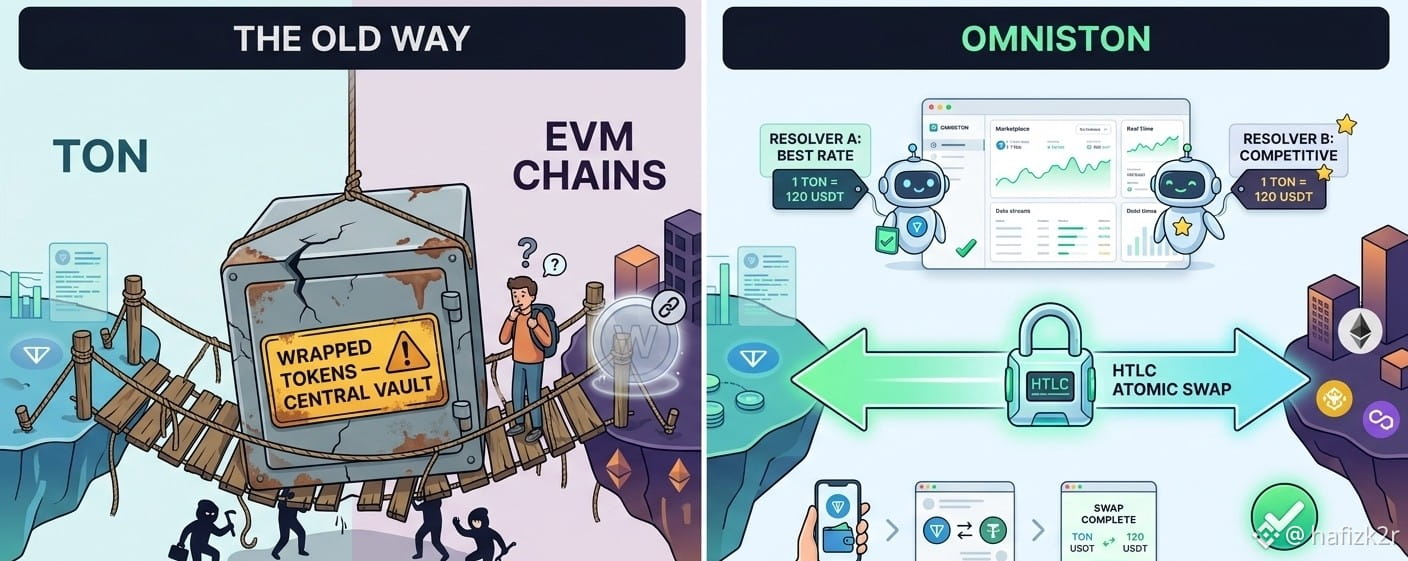
If you have spent any time in crypto recently, you know that the space is divided into different "blockchain islands." On one side, you have popular EVM chains like Base, BNB Chain, and Polygon, which all speak the same core Ethereum language. On the other side, you have TON (The Open Network), a fast-growing ecosystem closely tied to Telegram that operates on completely different rules.
Because TON and EVM chains don't speak the same language, moving your tokens between them has traditionally been messy, confusing, and risky.
Enter Omniston, the underlying engine powering cross-chain swaps on STON.fi. Omniston bridges the massive structural gap between TON and the EVM world without using a conventional bridge. Here is how it changes the game.
Why the TON-to-EVM Jump is Usually Messy
When connecting standard EVM chains together (like moving stablecoins from Polygon to Base), developers can easily adapt the same smart contracts. But TON uses its own distinct virtual machine.
In a traditional cross-chain setup, you are forced to use a wrapped-token bridge. This means locking your native tokens in a giant central vault on one chain to receive a wrapped synthetic version on the other side.
Not only do these central vaults attract hackers, but the return trip can be highly asymmetric. If you try to bridge back to TON, your funds might arrive as an unbacked wrapped token, forcing you to execute an extra swap on a native DEX before your crypto is actually usable again.
Aa
Enter Omniston: The Marketplace Model
Omniston completely removes the need for wrapped assets and central vaults, introducing a symmetric, native-to-native trading loop. Instead of an vulnerable vault, Omniston creates a highly competitive open marketplace:
The Request: You select your asset pair, for example, swapping native USDT on the BNB Chain for native Toncoin (or a local TON token called a jetton) on TON.
The Competition: Omniston broadcasts a Request for Quote (RFQ) to a network of independent liquidity providers called Resolvers. These Resolvers actively compete against each other to give you the absolute best market price.
The Cryptographic Lock: Once you accept a quote, Omniston coordinates the swap using a matching pair of Hashed Timelock Contracts (HTLCs).
Your source funds lock safely into an HTLC on the starting chain, while the winning Resolver locks their own native funds into a matching HTLC on the destination chain. Both contracts share a single, un-hackable cryptographic key.
The Power of "All-or-Nothing" Settlement
What makes the Omniston architecture perfect for beginners is its strict all-or-nothing guarantee.
With a regular bridge, a network stall or a drop in liquidity can leave your funds stuck in limbo or locked on a broken bridge contract. With Omniston’s paired HTLC system, a cross-chain swap is treated as a single atomic event: either both sides get their assets automatically, or the entire transaction safely unwinds. If a Resolver fails to deliver your tokens on the destination chain within a specific time window, the smart contract automatically triggers a countdown timer. Once expired, your original funds are released back into your wallet. There is absolutely no middle state where your money can vanish into a black hole.
Tailored for the Multichain Future
Whether you are seeking out the ultra-low fees of Base, the deep liquidity of BNB Chain, or the highly economical micro-transactions of Polygon, Omniston serves as the invisible connective tissue back to the TON ecosystem.
By utilizing mathematics and open competition instead of risky custodial vaults, it ensures that moving your value between completely different blockchain worlds is as simple, fast, and secure as a single