

Access Binance OTC desk on the VIP Portal
Overall Market
 Data source: TradingView
Key Takeaways
The Fed reinforced the higher-for-longer narrative, with the latest dot plot implying a more hawkish policy path than markets previously expected.
Global liquidity remains under pressure, as elevated U.S. yields, a firm dollar, and another Bank of Japan rate hike all point to tighter financial conditions.
Geopolitical risk has eased at the margin, with markets expecting Strait of Hormuz shipping to normalize over the next 30–60 days, but that has not been enough to revive crypto demand.
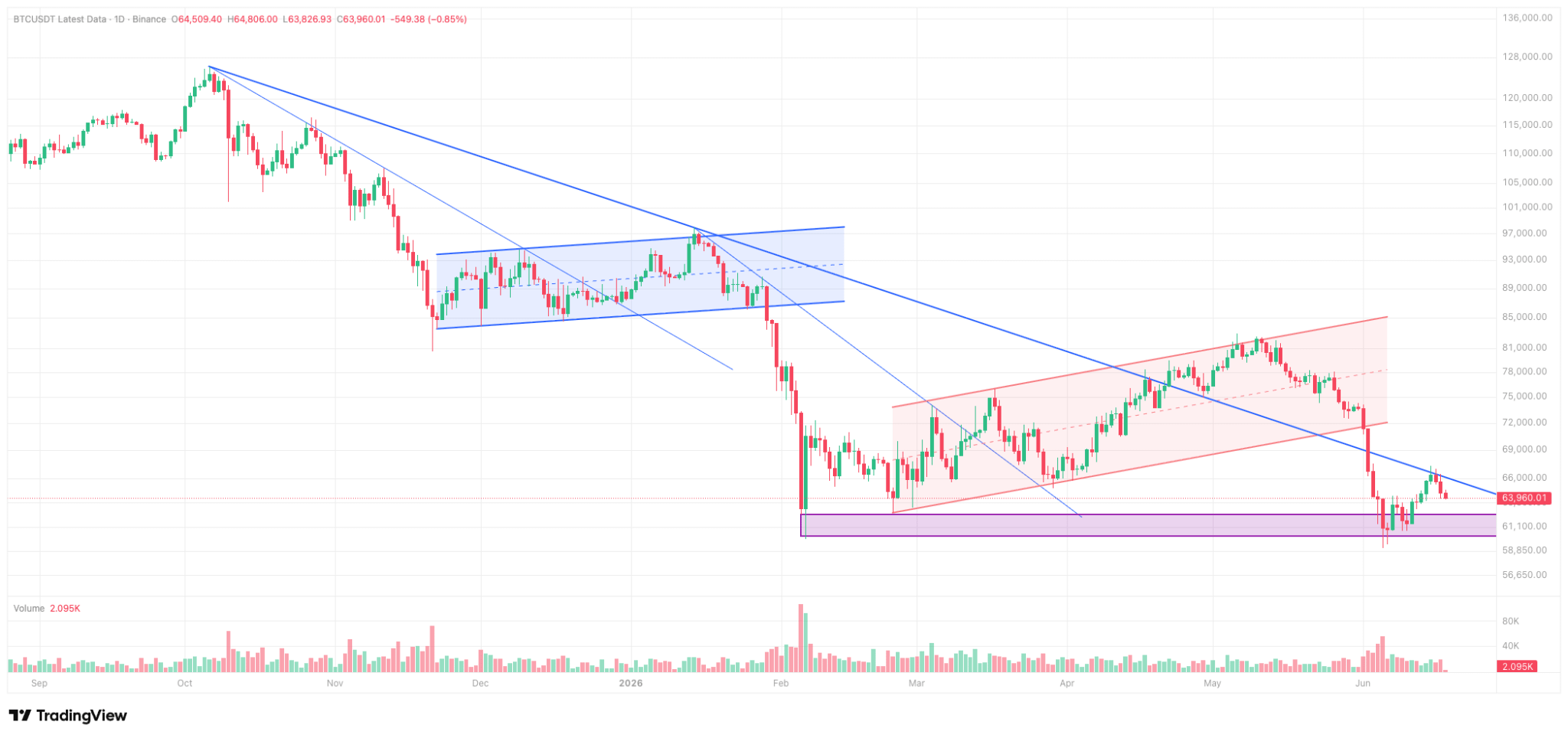
Bitcoin price action remains weak, with BTC failing to reclaim the $67,000–68,000 zone after testing the $59,000 area.
Technical structure remains bearish below $68,000–70,000, while a daily close below $60,000 would increase the risk of a move toward the high-$50,000s.
Positioning and sentiment remain defensive, with put buying, call selling, extreme fear, and USDT trading slightly below parity all pointing to weak confidence.
The market is still dealing with the same core issue: liquidity is not improving. The latest FOMC meeting reinforced a higher-for-longer rate regime, the BOJ added to the global tightening backdrop, and Bitcoin has not found enough spot demand to reclaim key technical levels. Geopolitical risk has eased somewhat, but for now, that alone is not enough to bring capital meaningfully back into crypto.
Macro: The Fed Keeps Liquidity Tight
The latest FOMC meeting confirmed that the Fed is not ready to shift dovish. Policymakers acknowledged that growth remains resilient and the labor market is still relatively stable, but inflation continues to be described as elevated. That leaves the Fed with limited room to ease in the near term.
The key market takeaway was the updated dot plot. If markets were previously expecting one rate cut by the end of 2026, the Fed’s latest projections now imply a meaningfully tighter path, with the median end-2026 rate forecast moving from 3.4% to 3.8%. That is roughly a 40 basis point hawkish shift.
This is not supportive for global liquidity. Bitcoin tends to perform best when real yields are falling, the dollar is weakening, and central banks are moving toward easier policy. That is not today’s setup. Treasury yields remain elevated, the dollar is firm, and the Fed is not giving markets a clear easing signal. Without a fresh liquidity catalyst, it is difficult for BTC to sustain strong upside momentum.
Global Liquidity: BOJ Adds to the Tightening Bias
The Bank of Japan also added to the tightening backdrop this week with another rate hike. Markets have remained relatively calm, likely because the move was broadly expected, and we have not seen a disorderly unwind in carry trades.
Still, the direction matters. Japan has been a major source of cheap global funding for years. Even gradual normalization can reduce liquidity at the margin. Our desk does not expect a meaningful expansion in global liquidity over the coming months. The more likely outcome is that conditions stay tight, or even contract modestly.
Geopolitics: Tail Risk Eases, but Crypto Does Not Respond
On geopolitics, the reported improvement in the U.S.-Iran situation has helped reduce some tail risk. Following the MOU signed by President Trump, markets now expect oil shipping through the Strait of Hormuz to gradually normalize over the next 30–60 days. If this plays out, lower oil prices could help reduce inflation pressure at the margin.
However, the market reaction was telling. Risk sentiment improved briefly, but the move did not last. That suggests U.S.-Iran tension is no longer the dominant driver. Investors remain more focused on U.S. equities, AI, semiconductor supply constraints, and the broader rate environment.
For crypto, the message is simple: easing geopolitical risk helps, but it is not enough. The asset class still needs a stronger crypto-specific catalyst to attract fresh inflows.
Bitcoin: Weak Demand and Bearish Technicals
Bitcoin price action remains soft. After testing the $59,000 area, BTC has failed to reclaim the $67,000–68,000 zone. From the desk, we also do not see meaningful spot buying flow at current levels. Without stronger purchase demand, it is difficult to argue that a durable rebound is underway.
The daily chart also remains cautious. BTC peaked near $126,000 in October 2025 and has been making lower highs since then, forming a clear descending channel. After briefly recovering into a rising channel between roughly $65,000 and $85,000, price has now broken below that structure and is again testing the $60,000–62,000 horizontal support band.
As long as BTC remains below the descending trendline from the October highs, currently around $66,000–67,000, the technical structure remains bearish. A daily close below $60,000 would be a significant breakdown and could open the door toward the high-$50,000s. For a meaningful recovery, BTC needs to reclaim $67,000–68,000 with conviction and sustained volume.
Positioning and Sentiment: Still Defensive
Options activity points to a cautious institutional tone. Implied volatility has moved somewhat higher, but flows are not being driven by upside speculation. Instead, our desk is seeing more put buying and call selling, suggesting investors are focused on downside protection rather than chasing a breakout.
Sentiment is also weak. The Crypto Fear and Greed Index remains in extreme fear territory. From a long-term perspective, that can create a better accumulation zone for patient holders, but it does not mean the market has to rebound immediately. Extreme fear can persist if liquidity remains tight and demand stays weak.
USDT is another signal to watch. Tether is trading slightly below one dollar, around 10 bps under parity. This is not a major depeg, but it does reflect weak confidence. Until USDT returns to parity, and ideally trades at a slight premium, it may be difficult for market sentiment to improve meaningfully.
Bottom Line
The setup remains challenging. The Fed is still hawkish, the BOJ is tightening, and global liquidity is not improving. Geopolitical risk has eased, but that has not generated sustained demand for Bitcoin. Capital continues to rotate toward U.S. equities, AI, and semiconductor-related themes.
Given extreme fear, current levels may be suitable for gradual long-term accumulation. But this process could take time. In the near term, Bitcoin may still face pressure until liquidity improves, BTC reclaims key technical levels, and a stronger crypto-specific narrative emerges.
Why trade OTC?
Binance offers our clients various ways to access OTC trading, including chat communication channels and the Binance OTC platform (https://www.binance.com/en/otc) for manual price quotations and execution services.
Email: trading@binance.com for more information.
Join our Telegram Channel @BinanceOTCTrading (https://t.me/+0mkJQnbQiOdlZjk0) to stay up to date with the markets!
You can also reach out to us on Telegram (@Binance_OTC_Desk) to connect directly with our experienced traders for your OTC trading needs. We look forward to assisting you and providing exceptional service for all your OTC transactions.