Abstract / Theoretical Exposition
The speculative hypothesis that Bitcoin (BTC) could appreciate to a staggering valuation of $100 million per unit, while seemingly hyperbolic, invites rigorous scrutiny when examined through the dual lenses of geopolitical risk management and historical wealth-preservation strategies. This proposition rests on a recurrent behavioral pattern observed among ultra-high-net-worth individuals (UHNWIs) and institutional capital allocators during periods of impending systemic instability.
Historical Precedent and the Art Market as a Safe-Haven Proxy
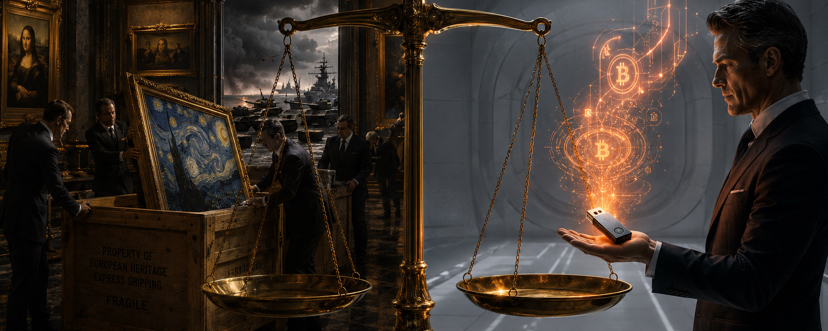
A well-documented, albeit anecdotal, correlation exists between major global conflicts and pronounced spikes in the transaction volumes of blue-chip fine art. In the antebellum phase—the precarious interval preceding large-scale armed conflicts—sophisticated investors systematically liquidate conventional asset classes, including equities, sovereign bonds, and illiquid real estate holdings. Their capital is subsequently reallocated toward tangible, physically redeemable stores of value that exhibit aesthetic intrinsic worth, most notably masterpieces of fine art and rare collectibles.
Empirical observations of art market cyclicality reveal a striking temporal pattern: record-breaking, high-profile art auctions frequently serve as harbingers of imminent geopolitical ruptures. The rationale is rooted in the fungible, universally recognized, and comparatively portable nature of these artifacts. Following the cessation of hostilities, a secondary phenomenon emerges: these very artworks rapidly re-enter the public auction sphere. This occurs as the original purchasers—or their beneficiaries—seek to restore liquidity, re-engage in productive capital deployment within post-conflict reconstruction economies, or adjust their portfolios to reflect the newly stabilized risk-free rate.
The Logistical and Custodial Constraints of Physical Assets
Nevertheless, while fine art has historically fulfilled this protective function, it is encumbered by profound logistical inefficiencies and custodial vulnerabilities. The physical transportation of a significant private collection across international borders demands an intricate infrastructure: specialized climate-controlled shipping containers, comprehensive insurance policies against damage or theft, armed security details, and complex customs clearances. In essence, the preservation of wealth through physical art necessitates the mobilization of extensive material resources—metaphorically, the logistical burden of an entire fleet of trucks.
The Digital Paradigm Shift: Bitcoin as a Superior Successor
In stark contrast, Bitcoin presents a revolutionary alternative that effectively eliminates these physical constraints. As a purely digital, cryptographically secured bearer asset, it epitomizes the theoretical maximum of "portability premium." The entirety of a multi-billion dollar sovereign wealth fund can be compressed into a twelve- or twenty-four-word mnemonic seed phrase, which is effortlessly stored within a single hardware-based cold storage device. This compact digital artifact possesses zero physical mass, is entirely agnostic to national boundaries, and can be transported across any jurisdiction instantaneously, without the conspicuous visibility or physical deterioration that plagues tangible art shipments.
Synthesis and Forward-Looking Implications
Consequently, if the historical precedent of capital flight into tangible assets holds true for future systemic crises, Bitcoin's inherent technological superiority—specifically its infinite divisibility, instantaneous global settlement capabilities, and unparalleled concealability—logically positions it as the evolutionary successor to the Van Gogh or the Picasso within the strategic wartime portfolio. The functional substitution effect, driven by the elimination of physical carrying costs and custodial risks, provides a theoretical underpinning for an astronomically bullish long-term valuation trajectory. In this framework, the $100 million price target is not merely speculative exuberance, but rather a rational extrapolation of Bitcoin's ascendancy as the ultimate, frictionless hedge against geopolitical entropy.