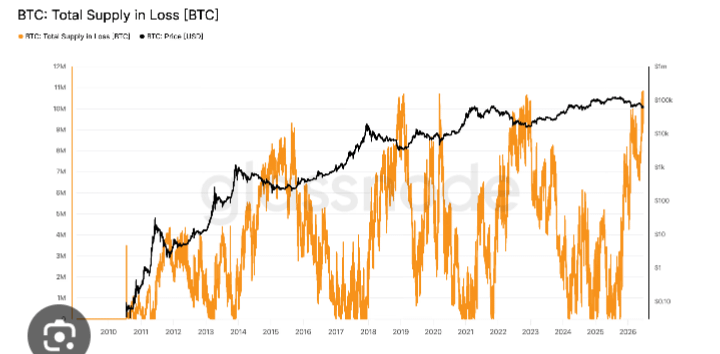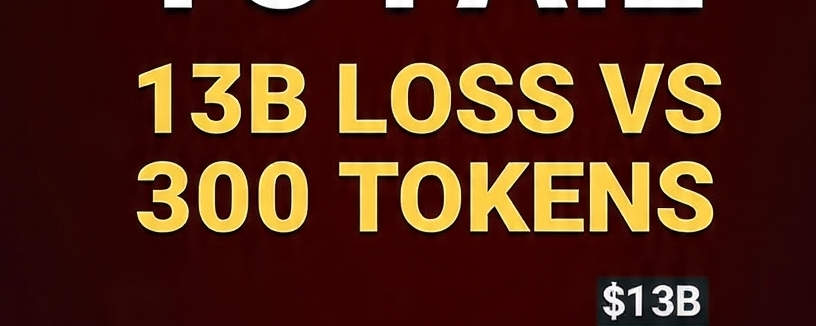
Michael Saylor’s Strategy just took a $13 billion paper hit on Bitcoin.
Let that sink in.
Strategy’s unrealized $BTC BTC loss alone is bigger than the entire market cap of 300+ “prominent” altcoins combined. One company. One position. $13B underwater.
This is why people call Bitcoin “too big to fail” now. When the biggest corporate holder bleeds, it moves the whole market.
1. The Number: $13 Billion Paper Loss
*What it means*: Strategy bought BTC at higher prices. With BTC at $58K, their average cost vs current price = ∼$13B unrealized loss on paper.
*Key word: Paper*. They haven’t sold. No realized loss unless they dump. Saylor’s thesis: “Never sell Bitcoin.”
*Context*: Strategy holds ∼226,000 BTC. At $58K, that stack is worth ∼$13.1B. Their cost basis is ∼$35B. Do the math.
2. $13B > Hundreds Of Tokens: The Humbling
*For perspective*:
1. *$13B > Market cap of XRP* right now. XRP is a top 7 coin.
2. *$13B > DOGE + SHIB + TON combined* at current prices.
3. *$13B > ∼300 altcoins* outside the top 20. Entire ecosystems.
One corporate treasury’s unrealized loss > most of crypto.
*Translation*: Bitcoin isn’t a “small cap experiment” anymore. Corporate Bitcoin treasuries are now systemically important.
3. Why This Is “Too Big To Fail” Territory
*Reason 1: Contagion risk*
If Strategy was forced to sell, 226K BTC hitting market = BTC to $40K fast. Every alt would -30% in a week. Exchanges, miners, ETF issuers, other companies all get hit.
*Reason 2: Narrative risk*
Strategy IS the corporate Bitcoin narrative. If they capitulate, every other company with BTC on balance sheet gets questioned. MicroStrategy = Tesla of BTC treasuries.
*Reason 3: Stock + Debt link*
Strategy issued debt/convertibles to buy BTC. Stock MSTR trades like leveraged BTC. If MSTR crashes, debt covenants, shareholders, lenders all get nervous. It’s now a feedback loop.
4. The Bull Case: Why Saylor Doesn’t Blink
*1. Timeframe*: Strategy’s cost basis averages 2020-2024 buys. They’re not trading. They’re stacking for 2030+.
*2. Cash flow*: Software business funds operations. They don’t need to sell BTC to pay bills.
*3. Precedent*: Saylor rode BTC from $60K → $16K in 2022 and bought more. He’s been $13B underwater before.
*Quote energy*: “Bitcoin is digital property. You don’t sell property in a dip.”
5. The Bear Case: What If $58K Breaks?
If BTC goes $50K → $45K, that $13B becomes $18B-$20B paper loss.
*Pressure points*:
1. *Shareholders*: MSTR stock would get destroyed. Activist pressure builds.
2. *Debt markets*: If BTC stays low for years, refinancing gets hard.
3. *Psychology*: “Too big to fail” becomes “too big to ignore.” Regulators watch closer.
Strategy won’t sell at $58K. But at $35K? That’s untested.
6. What This Means For Bitcoin + Alts
*For BTC*: Strategy is a price floor buyer of last resort. Every dip, they buy more. That’s why $58K held. They have a bid.
*For alts*: You’re trading against a $35B BTC buyer who doesn’t care about your token. Liquidity goes to BTC first. That’s why ETH, XRP, DOGE underperform when BTC has corporate bid.
*For the market*: We’re past “crypto is small.” A single company’s P&L is bigger than entire sectors. That’s institutionalization. With institutionalization comes less volatility long-term, but scarier drawdowns short-term.
Bottom Line In Your Words
*$13B paper loss* sounds scary. But Strategy isn’t selling. They can’t, and they won’t.
*“Too big to fail”* means: If Strategy dies, Bitcoin dies. So Bitcoin won’t be allowed to die. Markets, ETFs, other corps, and Saylor himself won’t let it.
*The takeaway*: Hundreds of tokens are smaller than one company’s BTC loss. That tells you who won the treasury war. Bitcoin did.
Alts pump on narratives. BTC pumps on balance sheets. Strategy’s $13B hole is proof of that.
_Not financial advice. $13B paper loss can become $20B if BTC falls. MSTR is leveraged BTC exposure. Don’t ape your rent money. DYOR on corporate BTC risk and your own tolerance.