


BNB Chain processed $2 trillion in Dex volume during 2025. To put that in perspective, that's roughly equivalent to the entire GDP of Italy flowing through a single blockchain network in twelve months. The number alone tells a story of extraordinary adoption, but the mechanics behind it reveal something deeper about how BNB Chain evolved from a trading-focused layer one into a comprehensive Web3 infrastructure.
The numbers for 2025 paint a picture of sustained momentum across every metric that matters. Total value locked in DeFi protocols climbed from $5.3 billion in Q1 to $7.8 billion by Q3, representing a 30.7% quarterly growth rate that accelerated throughout the year. Daily transactions surged from 4.9 million in early 2025 to 13.3 million by Q3, with peaks touching 14.2 million in mid-December. Daily active addresses followed a similar trajectory, expanding from 1.2 million to 2.3 million, with the network recording a single-day peak of 5 million active users.
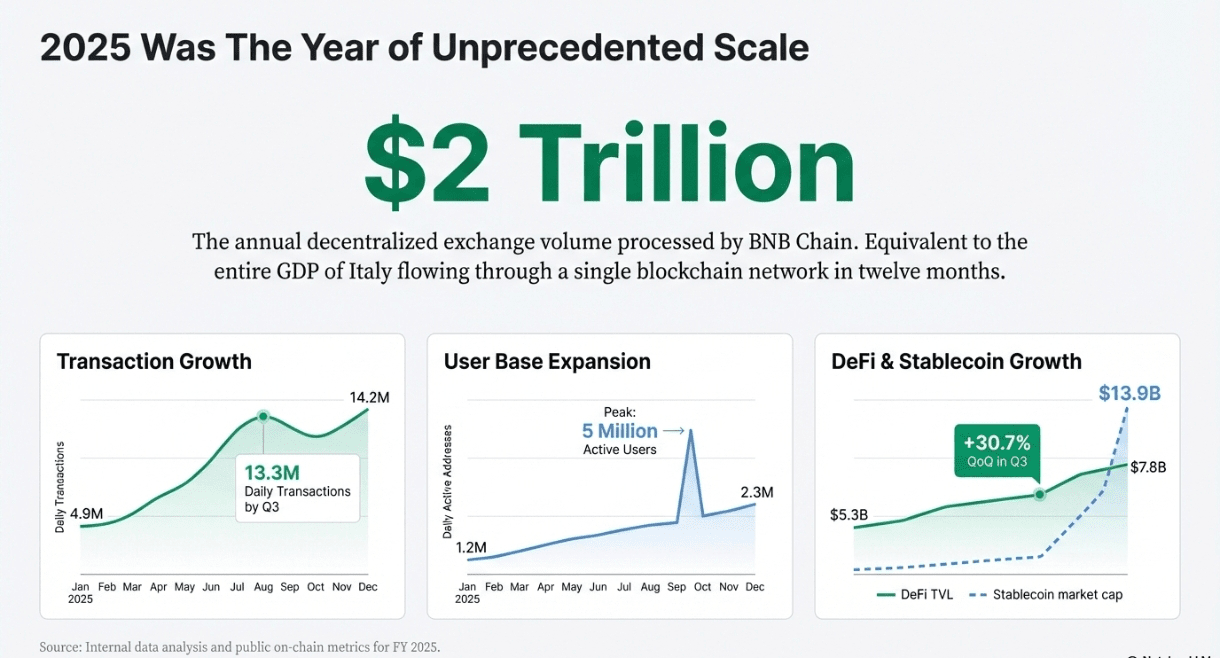
The stablecoin economy on BNB Chain doubled in size, reaching $13.9 billion by Q3, establishing the network as the third-largest chain by stablecoin market capitalization. This growth came despite, or perhaps because of, aggressive fee reductions. The Maxwell hard fork in June cut block times to 0.75 seconds and reduced minimum gas prices to 0.05 Gwei, bringing transaction costs down to approximately $0.005. The chain collected $44 million in fees during Q3, maintaining profitability while becoming one of the cheapest high-throughput networks in production.
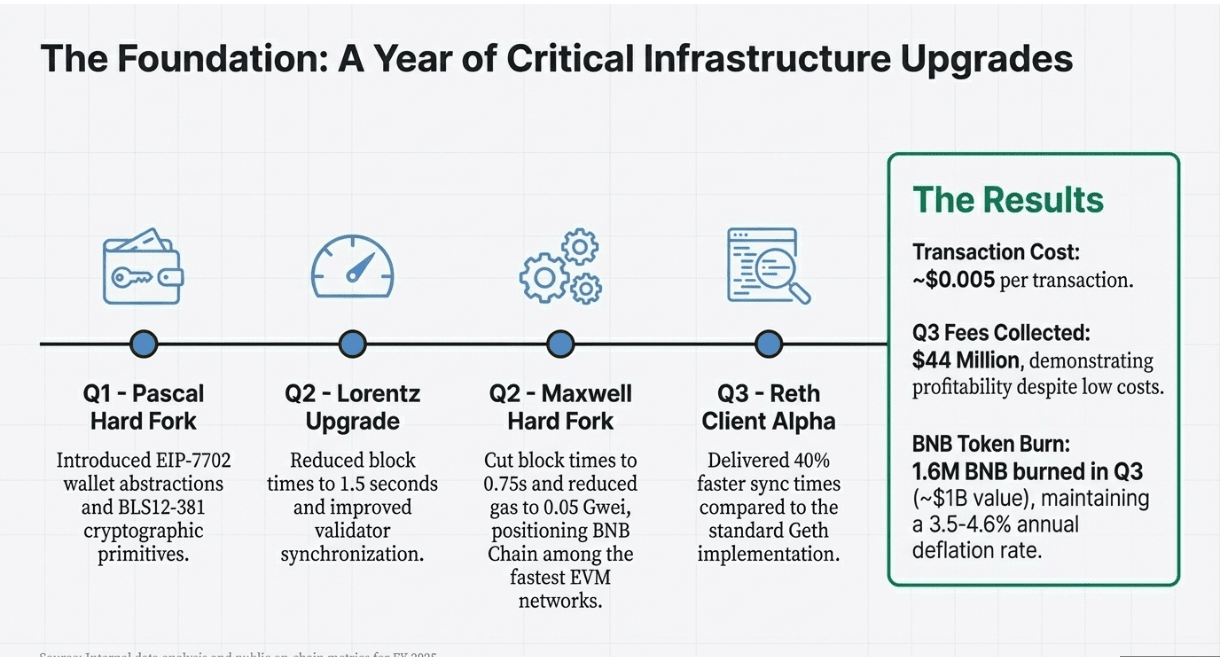
Infrastructure improvements drove much of this performance. The Pascal hard fork in Q1 introduced EIP-7702 wallet abstractions and BLS12-381 cryptographic primitives. The Lorentz upgrade in April reduced block times to 1.5 seconds and improved validator synchronization. Maxwell followed in June with the 0.75-second block time that positioned BNB Chain among the fastest EVM-compatible networks. By September, the Reth client alpha delivered 40% faster sync times compared to the standard Geth implementation.
Developer activity expanded modestly but steadily. The network supported 1,295 active developers by December 2025, up 6% year-over-year, with 281 full-time developers representing an 8% annual increase. The MVB accelerator program completed its eleventh season, having incubated over 200 projects since inception. In October, BNB Chain launched a $1 billion Builder Fund backed by YZi Labs, targeting projects in DeFi, artificial intelligence, real-world assets, and decentralized science.
BNB Chain's market positioning strengthened throughout the year. The network ranked fourth globally by DeFi TVL and climbed to second place by daily DEX volume during Q3. By the end of Q3, BNB's market capitalization reached $140.4 billion, placing it as the fifth-largest crypto asset. The quarterly burn mechanism destroyed 1.6 million BNB tokens valued at approximately $1 billion, maintaining a 3.5-4.6% annual deflation rate that reduced circulating supply to 139.3 million tokens.
II. DeFi Sector Performance
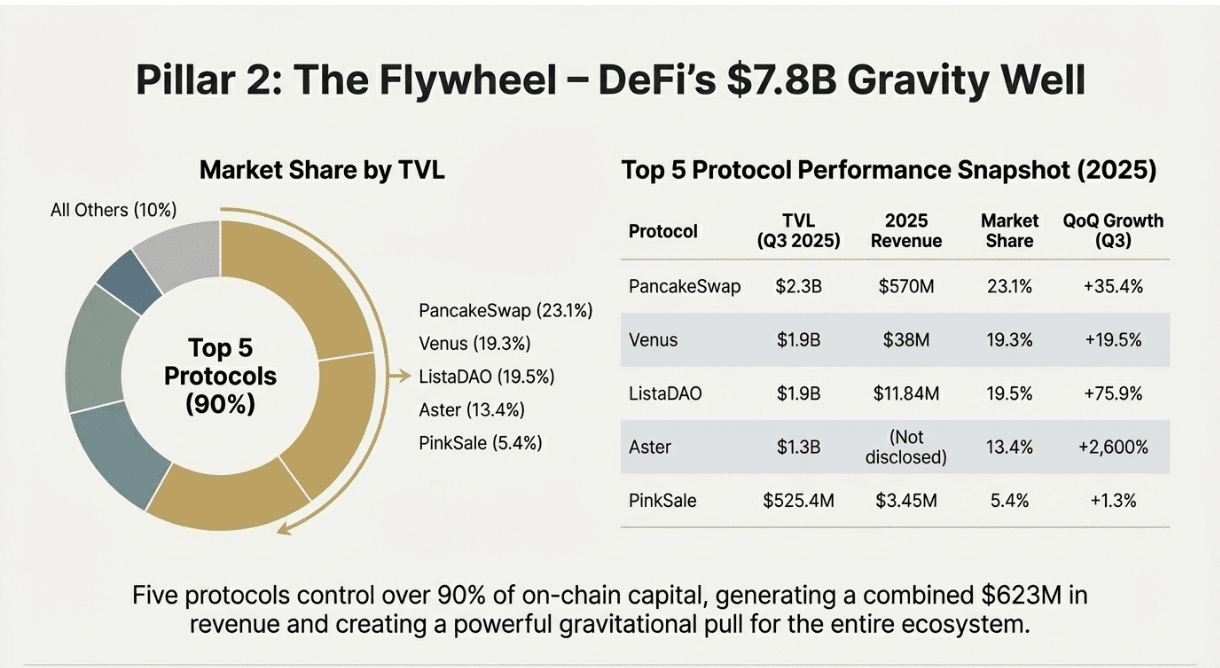
BNB Chain's DeFi ecosystem generated $7.8 billion in total value locked by Q3 2025, driven by five protocols that collectively controlled over 90% of on-chain capital. The sector's growth trajectory accelerated quarter-over-quarter, from 14% in Q2 to 30.7% in Q3, powered by innovations in automated market making, perpetual trading, and liquid staking derivatives.
❍ PancakeSwap: The Dominant Force
PancakeSwap commanded $2.3 billion in TVL on BNB Chain as of Q3 2025, representing 23.1% of the entire ecosystem. The protocol processed $1.55 billion in 24-hour trading volume during peak periods, capturing approximately 72% of all DEX activity on the network. Revenue performance showed remarkable strength, with the protocol generating $570 million in gross fees throughout 2025, breaking down to $108.79 million in Q1, $190.52 million in Q2, $178.61 million in Q3, and $92.06 million in Q4.
Daily active addresses for PancakeSwap reached 88,464 during late 2024 benchmarks, with transaction counts hitting 571,269 per day. The protocol's contribution to BNB Chain's overall 13.3 million daily transactions in Q3 demonstrates its central role in network activity. TVL growth rates of 10.6% in Q2 and 35.4% in Q3 reflected the impact of Version 4 launches and cross-chain expansion.
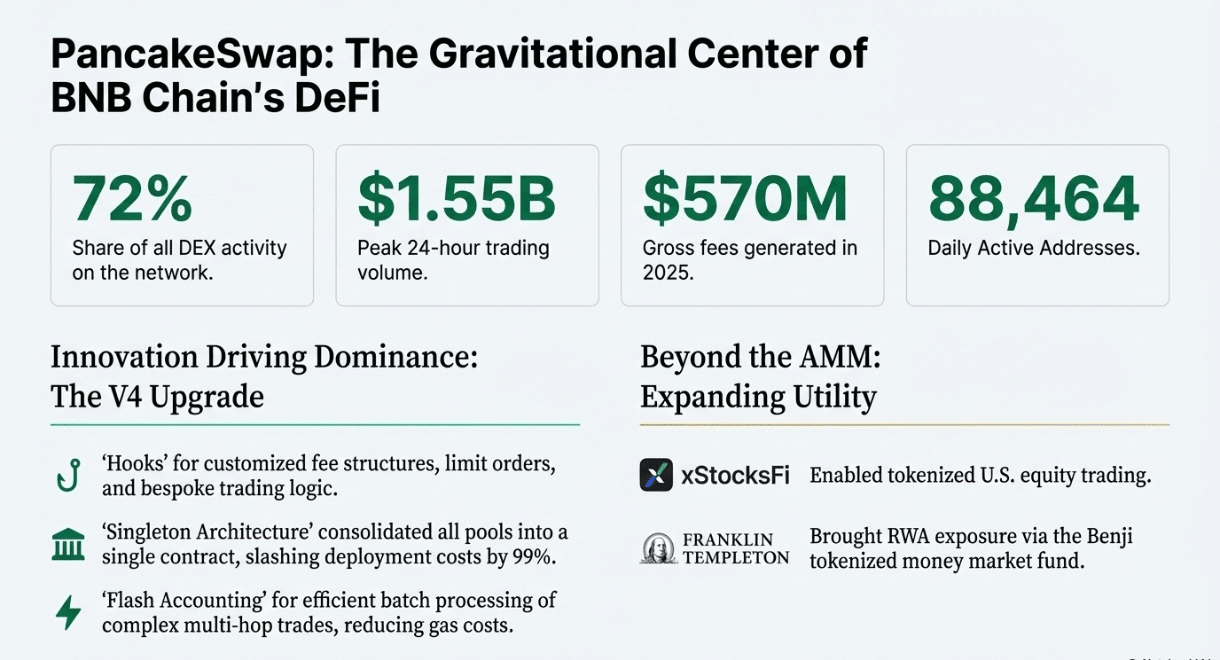
The V4 upgrade introduced hooks for customized fee structures and trading logic, singleton architecture that reduced deployment costs by 99%, and flash accounting for batch transaction processing. Strategic partnerships expanded PancakeSwap's utility beyond pure trading. The xStocksFi integration in July 2025 enabled tokenized U.S. equity trading directly through the DEX interface. A September partnership with Franklin Templeton brought real-world asset exposure via the Benji tokenized money market fund.
PancakeSwap's liquidity provision offered 15.35% average APY across 224 active pools. The CAKE tokenomics revision implemented in 2025 reduced daily emissions to 14,500 tokens while enhancing burn mechanisms through protocol revenue. Cross-chain veCAKE expansion allowed governance token holders to participate in voting regardless of which network held their tokens, supporting the protocol's multichain ambitions.
❍ Venus Protocol: Lending Market Leader
Venus Protocol maintained $1.9 billion in TVL throughout 2025, capturing 19.3% of BNB Chain's DeFi capital. The algorithmic money market facilitated $692.6 million in active borrows by year-end, positioning it as the largest lending platform on the network. Protocol revenue totaled approximately $38 million for 2025, with quarterly figures of $15.58 million in Q1, $8.18 million in Q2, $8.05 million in Q3, and $6.29 million in Q4.
The platform's TVL grew 19.5% quarter-over-quarter in Q3, supported by increased demand for leveraged positions and yield farming strategies. Venus supported approximately 50,000 daily active addresses based on lending sector trends, contributing meaningfully to the chain's 2.3 million daily active users in Q3. Dynamic interest rates adjusted automatically based on utilization ratios, with borrow rates typically ranging from 5-10% for volatile assets and 1-5% for stablecoins.
Venus's synthetic stablecoin VAI provided capital-efficient liquidity for borrowers seeking leverage without liquidation risks from volatile collateral price movements. The protocol integrated USDe in August 2025, adding Ethena's synthetic dollar as both collateral and borrowing option. Enhanced liquidation mechanisms reduced systemic risk during market volatility periods, with improved oracle feeds providing more accurate price data for collateral valuation.
vToken mechanics allowed lenders to earn yields while maintaining liquidity through tradable receipt tokens. The platform's algorithmic approach to interest rates meant that high utilization periods generated proportionally higher yields for suppliers, creating natural supply-demand equilibrium. Venus's integration with PancakeSwap enabled seamless liquidity flows between lending positions and trading strategies.
❍ ListaDAO: Liquid Staking Innovator
ListaDAO captured $1.9 billion in TVL by Q3 2025, representing 19.5% of the DeFi ecosystem and marking explosive 75.9% quarter-over-quarter growth. The protocol's liquid staking and collateralized debt position (CDP) model attracted 1.1 million BNB in staked assets valued at $1.1 billion, with slisBNB commanding 97% market share among liquid staking derivatives. Protocol revenue reached $11.84 million for 2025, distributed as $2.07 million in Q1, $1.23 million in Q2, $2.71 million in Q3, and $5.83 million in Q4.
The protocol supported 729,100 BNB in liquid staking by Q2, demonstrating consistent growth in adoption throughout the year. ListaDAO's integration with Aster in September 2025 provided stablecoin settlement infrastructure for perpetual trading, creating synergies between liquid staking yields and derivatives markets. The lisUSD stablecoin offered borrowers the ability to extract liquidity from staked BNB positions without sacrificing staking rewards.
slisBNB tokens accrued staking rewards automatically while remaining fully liquid for use in DeFi protocols. This dual-utility model attracted capital from users seeking both staking yields and additional DeFi opportunities. The CDP mechanism allowed users to mint lisUSD against slisBNB collateral at overcollateralization ratios that protected the system from cascading liquidations during market downturns.
ListaDAO's open-source framework enabled third-party developers to build on top of its liquid staking infrastructure. The protocol's focus on BNB-native staking positioned it as essential infrastructure for the network's proof-of-stake security model, with staked BNB contributing to validator operations while remaining productive capital within DeFi.
❍ Aster: Perpetuals Powerhouse
Aster emerged as a major force in Q3 2025 following its September 17 token generation event, reaching $1.3 billion in total TVL with $1.088 billion on BNB Chain specifically. The perpetual exchange processed $8.191 billion in daily trading volume at peak periods, supporting $2.392 billion in open interest across trading pairs. Cumulative perpetual volume for 2025 reached $794.515 billion, with October alone accounting for $218.712 billion.
The platform's TVL surged 2,600% quarter-over-quarter in Q3, driven by the ASTER token airdrop of 704 million tokens and aggressive liquidity incentives. Trading fees from high-frequency perpetual positions generated an estimated $500,000 to $800,000 daily during peak periods. Aster's contribution to BNB Chain's 13.3 million daily transactions in Q3 came primarily from derivatives trading activity.
Aster's dual-mode interface separated Simple Mode for one-click trading with MEV protection from Pro Mode offering advanced charting and order types. The platform supported up to 100x leverage on major crypto pairs, attracting both retail traders seeking high-risk exposures and sophisticated market makers providing liquidity. Backing from YZi Labs, the same entity supporting PancakeSwap and the $1 billion Builder Fund, provided capital and strategic resources for rapid scaling.
The USDF stablecoin grew 464.6% quarter-over-quarter to $360.3 million in Q3, serving as the settlement currency for perpetual positions. This vertical integration reduced dependency on external stablecoin providers while capturing additional protocol value. Aster's MEV-free trading environment addressed a persistent pain point in on-chain derivatives, using private transaction ordering to prevent front-running and sandwich attacks.
❍ PinkSale: Launchpad Infrastructure
PinkSale maintained $525.4 million in TVL throughout 2025, representing 5.4% of the DeFi ecosystem. The decentralized launchpad facilitated token creation and initial sales for over 20,000 projects, helping them raise more than $1 billion in cumulative funding. Protocol revenue totaled $3.45 million for 2025, with $1.6 million in Q1, $710,000 in Q2, $630,000 in Q3, and $410,000 in Q4.
The platform attracted millions of monthly investors through its no-code token creation interface, eliminating technical barriers for project launches. Strict KYC requirements for project teams addressed security concerns, reducing scam risks that plague decentralized launchpads. PinkSale's integration with BNB Chain's incentive programs positioned it as a preferred launchpad for projects seeking ecosystem support and visibility.
The top five DeFi protocols generated a combined $623 million in protocol revenue during 2025, demonstrating sustainable business models beyond token emissions. PancakeSwap's dominance across trading volume and revenue metrics reflected its first-mover advantage and continuous innovation. Venus and ListaDAO's comparable TVL figures showed competitive positioning in lending versus liquid staking, with ListaDAO's explosive growth suggesting shifting capital preferences. Aster's rapid ascent post-TGE indicated strong product-market fit in perpetual trading, while PinkSale's stability provided essential infrastructure for ecosystem expansion.
III. DEX Ecosystem
BNB Chain processed $16.16 billion in weekly DEX volume during late 2025, distributed across five major exchanges that served different market segments and trading strategies. The sector generated $3.7 million in weekly fees, with total daily volume reaching $2.09 billion during peak periods. DEX activity contributed significantly to the network's 13.3 million daily transactions in Q3, with combined swap operations exceeding 70 million weekly across all platforms.
❍ PancakeSwap: Market Dominance
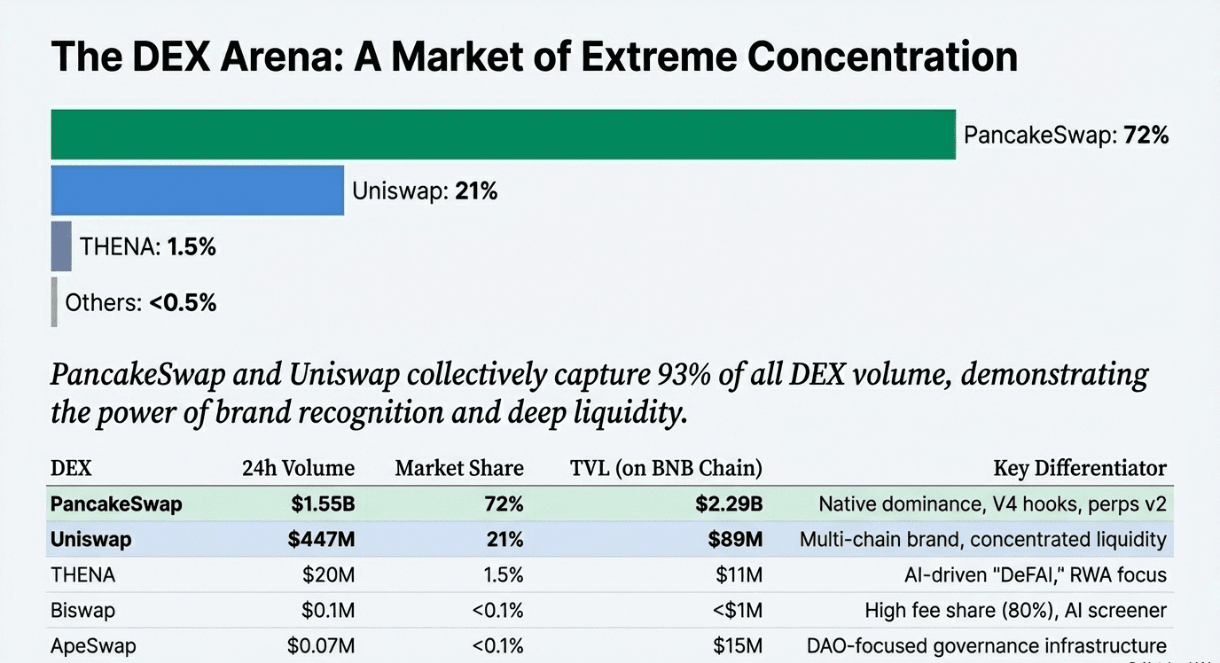
PancakeSwap maintained overwhelming market leadership with $1.55 billion in daily trading volume, representing 72% of all DEX activity on BNB Chain. The protocol's cumulative volume reached $1.935 trillion by late 2024, with 2025 activity pushing total lifetime volume past $3 trillion. TVL of $2.46 billion concentrated 93% on BNB Chain at $2.29 billion, with the remaining 7% distributed across other supported networks.
Daily active addresses of 88,000 generated over 571,000 transactions, indicating high-frequency trading activity and multiple daily interactions per user. The platform supported 224 liquidity pools offering 15.35% average APY, attracting both passive liquidity providers and active yield farmers. Fee structures averaged 0.25% per swap, lower than traditional AMMs while maintaining profitability through volume scale.
PancakeSwap V4 introduced revolutionary architecture with hook-based customization allowing developers to implement custom fee structures, limit orders, and price stability mechanisms. The singleton design consolidated all pools into a single contract, reducing deployment costs by 99% and enabling more capital-efficient liquidity management. Flash accounting enabled batch processing of complex multi-hop trades, improving execution speed and reducing gas costs.
The perpetual trading v2 launch on BNB Chain brought derivatives directly into the PancakeSwap ecosystem, competing with standalone platforms like Aster. Crosschain veCAKE expansion allowed governance participation across all supported networks, creating unified liquidity incentives regardless of capital location. CAKE Tokenomics 3.0 reduced daily emissions to 14,500 tokens while implementing enhanced burn mechanisms tied to protocol revenue, creating deflationary pressure on the token supply.
❍ Uniswap: Multi-Chain Presence
Uniswap's BNB Chain deployment processed $447 million in daily volume, split between V3 at $253 million and V4 at $194 million, capturing 21% market share. Cumulative volume on BSC reached $114.6 billion by late 2024, with 2025 adding substantial incremental trading. TVL on BSC stood at $89 million, representing a small fraction of Uniswap's global $5.3 billion total value locked across all chains.
The protocol supported 199-201 trading pairs on BSC with dynamic fees ranging from 0.01% to 1% based on pool volatility and liquidity depth. Weekly swap counts reached approximately 28 million globally, with BNB Chain activity representing an estimated 20% of total user base based on volume distribution. Transaction costs on BSC averaged $0.01, roughly 100 times cheaper than Ethereum mainnet, driving adoption among cost-sensitive traders.
Uniswap V3's concentrated liquidity model allowed liquidity providers to specify price ranges, improving capital efficiency compared to full-range liquidity provision. V4's hook system enabled custom logic for pools, including time-weighted average price oracles, dynamic fees, and limit order functionality. Wormhole bridge integration facilitated cross-chain liquidity flows, allowing users to move assets between BNB Chain and other supported networks seamlessly.
The protocol's BNB Chain presence served primarily as a low-cost alternative for traders priced out of Ethereum mainnet while maintaining Uniswap's trusted brand and battle-tested smart contracts. Integration with major wallets like MetaMask and Trust Wallet provided easy access for retail users, while the permissionless listing model enabled long-tail token trading without centralized gatekeeping.
❍ THENA: Innovation Focus
THENA generated approximately $20 million in daily volume with 321,000 weekly swaps, capturing less than 2% market share but punching above its weight in innovation. Cumulative volume reached $38.5 billion by late 2024, demonstrating consistent if modest trading activity. TVL of $11 million produced $15 million in annual revenue across 2024, translating to extraordinary capital efficiency with revenue exceeding TVL.
The V3,3 modular architecture supported real-world asset tokenization and composable pool structures, positioning THENA for institutional adoption. Revenue distribution across 2024 showed $4.1 million in Q1, $3.1 million in Q2, $2.5 million in Q3, and $5.6 million in Q4, with the Q4 surge suggesting successful product launches or market capture. Nine active pools offered 0% average APY on base yields, with returns generated through veTHE token locking and emissions rather than trading fees.
THENA's integration with Venus Protocol created a DeFAI superapp combining lending, trading, and automated strategy execution. AI agents built on THENA's infrastructure automated yield optimization, rebalancing portfolios based on market conditions without manual intervention. ARENA V2 added GameFi elements, rewarding traders with NFTs and special privileges based on trading volume and loyalty.
THE Card provided fiat on-ramp functionality, allowing users to purchase crypto with credit cards directly through the DEX interface. The options market launch enabled more sophisticated hedging strategies, attracting professional traders seeking derivatives exposure. Community-driven governance through veTHE token locking aligned incentives between protocol developers and long-term liquidity providers.
❍ Biswap: Multichain Expansion
Biswap processed approximately $100,000 in daily volume with 122,000 weekly swaps, representing less than 0.1% of BNB Chain DEX market share. Despite minimal scale, the protocol supported 2.7 million cumulative users across its lifetime. 2024 revenue totaled $250,000, with Q4 accounting for $230,000, suggesting recent product launches or promotional activities driving temporary volume spikes.
The platform operated across four EVM chains (BNB, Ethereum, Arbitrum, Base) with an 80% fee distribution to liquidity providers, among the highest in the industry. V3 launchpad offered revenue sharing for early project supporters, creating additional yield beyond standard LP fees. A comprehensive platform redesign in 2025 improved user experience and reduced friction in the trading interface.
Points farming incentivized regular platform usage, with accumulated points redeemable for governance rights or fee discounts. AI token screener helped users identify trending tokens and potential opportunities, addressing information asymmetry in long-tail markets. Copy trading terminal allowed retail users to replicate professional traders' strategies automatically, democratizing access to sophisticated trading approaches.
Community governance controlled farming allocations and fee structures, giving users direct input on protocol direction. The cross-EVM trading terminal enabled single-interface access to liquidity across all supported chains, simplifying multichain position management. Despite strong feature sets, Biswap's minimal volume indicated challenges in user acquisition and liquidity bootstrapping.
❍ ApeSwap: DAO Infrastructure
ApeSwap generated approximately $70,000 in daily volume with 113,000 weekly swaps, representing less than 0.1% of BNB Chain DEX activity. Cumulative volume reached $16.36 billion by late 2024, indicating historical relevance despite current low activity. TVL of $15 million, mostly concentrated on BSC, produced $1 million in annual revenue distributed as $470,000 in Q1, $190,000 in Q2, $140,000 in Q3, and $220,000 in Q4.
The DAO-focused architecture differentiated ApeSwap from purely technical AMMs, emphasizing community governance and decentralized decision-making. Multichain support across BNB, Arbitrum, Ethereum, and Polygon provided access to diverse liquidity pools and trading pairs. Cumulative revenue distribution to token holders reached $870,000, demonstrating commitment to value accrual for governance participants.
The DEX landscape on BNB Chain showed extreme concentration, with PancakeSwap commanding nearly three-quarters of all trading activity. Uniswap's strong second-place position reflected brand recognition and Ethereum trader migration seeking lower fees. THENA, Biswap, and ApeSwap collectively controlled less than 2% of market share, indicating the difficulty of competing against entrenched market leaders even with innovative features.
IV. Meme Coin Phenomenon
BNB Chain's meme sector experienced explosive growth in 2025, catalyzed by the Four.meme launchpad that facilitated 600+ token launches following a viral October tweet from CZ. The sector generated over $20 billion in cumulative trading volume across the year, with peaks coinciding with broader crypto market rallies and social media virality cycles.
❍ MemeCore:
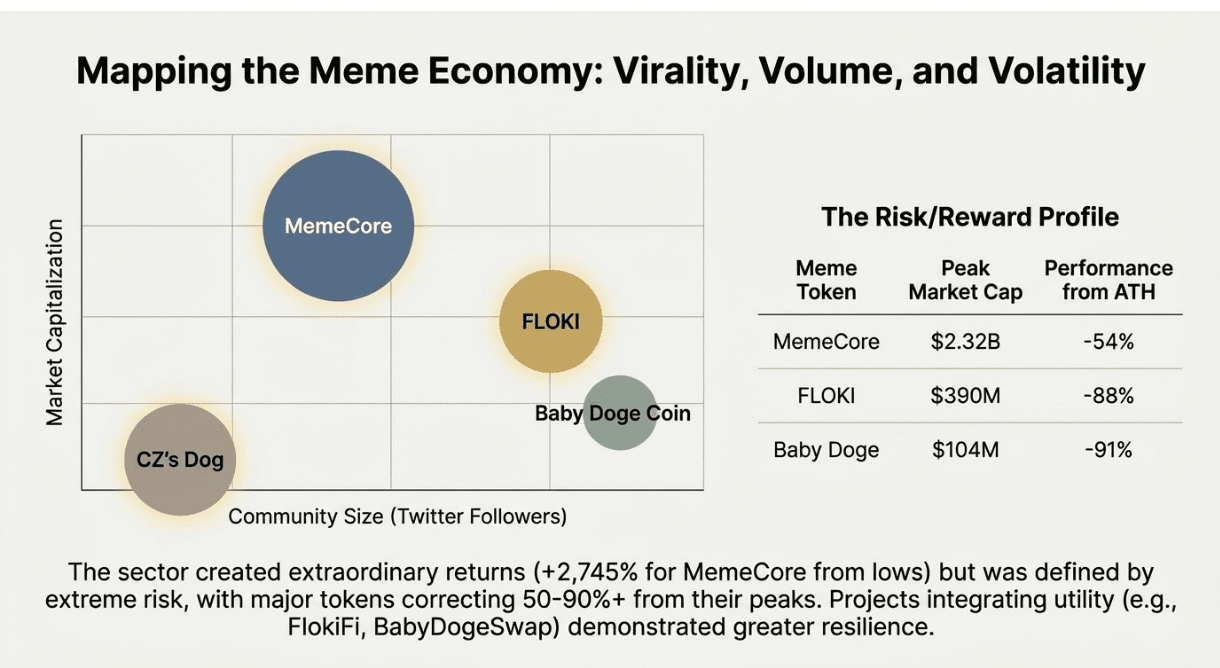
MemeCore dominated the sector with $2.32 billion market capitalization and $1.35 price per token as of late 2025. Trading volume of $11.1 million daily indicated sustained interest beyond initial launch hype. The project's Twitter following of 323,000 users represented strong community engagement, critical for meme token longevity.
Price performance showed dramatic volatility typical of meme assets, with an all-time high of $2.96 in September 2025 representing a 54% decline from peak to current levels. The 2025 performance of +2,745% from all-time lows demonstrated extraordinary returns for early participants despite the subsequent correction. Fully diluted valuation of $7.17 billion with only 32% circulation created significant unlock risk as vesting schedules released additional tokens.
MemeCore positioned itself as layer-one meme infrastructure rather than pure speculation, though concrete technical deliverables remained sparse. Binance Alpha spot and perpetual listings in July 2025 provided legitimacy and liquidity access for retail traders. Strategic funding from Waterdrip Capital and AC Capital between March and July 2025 suggested institutional backing, though funding amounts remained undisclosed.
The viral economy rewards mechanism incentivized content creation and social sharing, paying users in MEMECORE tokens for trending posts and community engagement. Mainnet launch implied for July 2025 aimed to transition from pure meme narrative to functional blockchain infrastructure, though execution risks remained high given the team's meme-focused origins.
❍ FLOKI:
FLOKI maintained $390 million market capitalization with $0.0000405 price per token, supported by 707,000 Twitter followers representing one of the largest meme token communities. The multi-chain deployment across BSC, Ethereum, and other networks provided broad accessibility but potentially fragmented liquidity. DWF Labs' strategic $1.25 million investment in December 2023 signaled professional market making support.
GameFi integration through Valhalla game added utility beyond meme speculation, creating play-to-earn mechanics and NFT ecosystems. FlokiFi DeFi protocols including lending and staking provided yield opportunities for token holders, differentiating FLOKI from purely speculative memes. The project's metaverse ambitions targeted long-term value creation through virtual real estate and digital experiences.
All-time high of $0.000346 in June 2024 represented significant downside from peak, with current prices down approximately 88% from historical highs. Recent 24-hour performance of negative 1.11% indicated sideways trading patterns rather than explosive growth. The project's evolution from Elon Musk-inspired meme to multi-faceted ecosystem demonstrated the sector's potential for serious product development.
❍ Baby Doge Coin:
Baby Doge Coin achieved $104 million market capitalization despite extremely low per-token prices due to massive 420 quadrillion total supply. Daily volume of $4.8 million supported active trading, while 2.75 million Twitter followers represented the largest social media presence among BNB Chain memes. The BSC contract at 0xc748673057861a797275cd8a068abb95a902e8de had operated since 2021, demonstrating longevity unusual in meme markets.
Deflationary tokenomics with automatic burns on each transaction aimed to reduce supply over time, though the massive initial supply meant meaningful scarcity required years of consistent volume. Charitable donations to animal rescue organizations aligned with the project's dog-themed branding, creating positive social impact narratives. BabyDogeSwap DEX, NFT marketplaces, and AI tools expanded utility beyond simple speculation.
All-time high in December 2024 represented a 91% decline to current levels, indicating severe correction from recent peak. Seven-day performance of negative 9% suggested continued downward pressure. OKX exchange listings from 2021 through 2025 provided liquidity access, though the project competed with numerous dog-themed alternatives. MissionPawsible game launch added play-to-earn mechanics similar to FLOKI's strategy.
The reflection mechanism distributed a percentage of each transaction to existing holders, rewarding long-term holding over active trading. Transaction taxes of approximately 10% (buy and sell combined) created friction for traders while funding the reflection pool and charity wallet. Scam clones proliferated due to the project's popularity, requiring careful contract address verification for new buyers.
❍ Cheems:
Cheems commanded $193 million market capitalization at $0.00000095 per token, supported by 102,000 Twitter followers. The project's migration from Solana to BNB Chain in 2025 represented a strategic bet on BSC's lower fees and larger user base. Self-styled as "lord of memes," Cheems benefited from the broader Doge meme family recognition while maintaining distinct branding.
Community burn events aimed to reduce supply and create scarcity narratives, though effectiveness depended on burn magnitude relative to total supply. DAO governance plans and NFT launches added utility layers, though implementation details remained limited. PancakeSwap liquidity provision enabled easy trading access for BSC users.
High volatility characterized trading patterns, with multi-percentage daily swings common during viral social media cycles. Anonymous team composition created uncertainty around long-term development commitment and potential rug pull risks. Competition from Four.meme launched tokens threatened market share as newer memes attracted speculative capital.
❍ CZ's Dog (BROCCOLI):
CZ's Dog launched on Four.meme with $11.7 million market capitalization at $0.012 per token, generating $10.5 million daily volume that exceeded market cap. The extreme volume-to-market-cap ratio indicated potential wash trading or imminent dump risks typical of newly launched memes. Twitter following of 6,800 users represented early-stage community building.
The project capitalized on Binance founder CZ's cultural influence and his October 2025 tweet that catalyzed $20 billion in BNB Chain meme trading volume. Four.meme deployment provided easy launch mechanics and initial liquidity, though the platform's 600+ launches created severe competition for attention. PancakeSwap integration enabled immediate trading access.
Trending status in late December 2025 Twitter lists suggested short-term social media momentum but questionable sustainability. Zero utility beyond meme speculation created total dependency on narrative strength and community enthusiasm. Centralization concerns tied to Binance associations raised questions about token distribution and potential insider advantages.
The meme sector on BNB Chain showed extreme risk-reward dynamics, with massive returns for early participants offset by 50-90% corrections from all-time highs. Projects attempting utility integration (FLOKI, Baby Doge) demonstrated better community retention than pure speculation plays. The Four.meme platform lowered barriers to meme token creation, potentially saturating the market and fragmenting liquidity across hundreds of low-quality projects.
V. Lending and Liquid Staking Infrastructure
BNB Chain's lending markets and liquid staking protocols controlled $3.2 billion in combined TVL by late 2025, providing essential financial primitives for leveraged trading, yield generation, and capital efficiency. The sector enabled users to maintain BNB staking rewards while accessing liquidity for DeFi participation, creating synergies between network security and economic activity.
❍ Venus Protocol: Established Leader
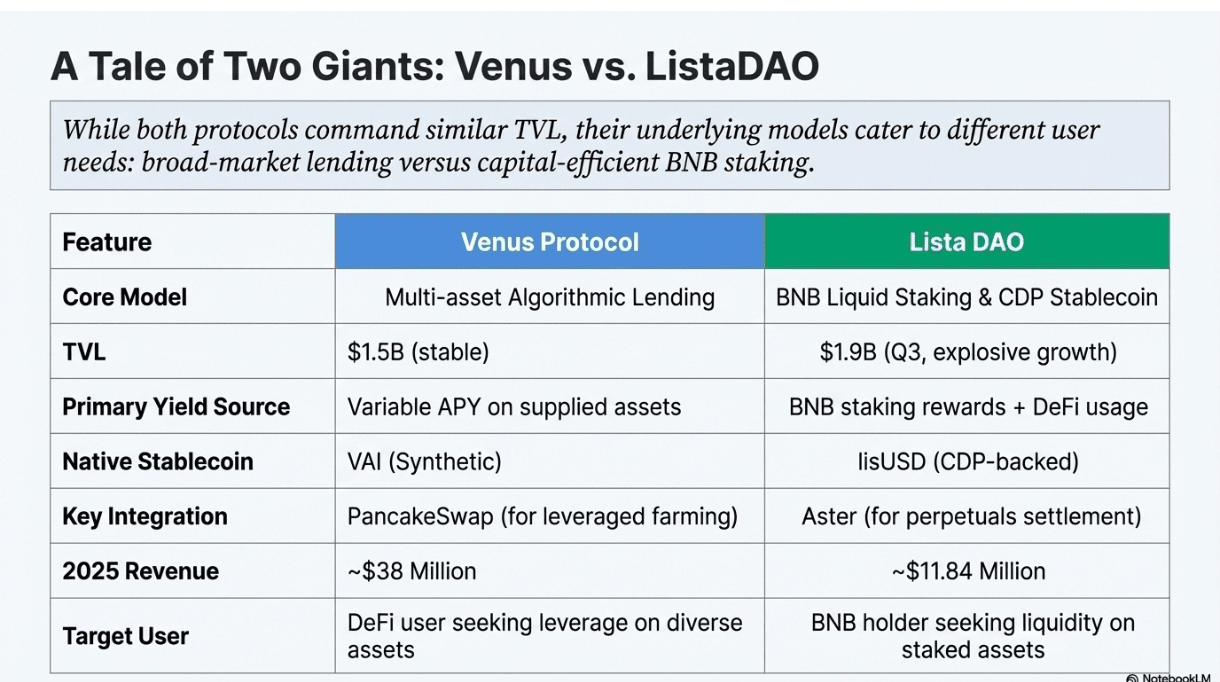
Venus Protocol maintained $1.5 billion TVL with $692 million in active borrows, representing the largest lending platform on BNB Chain. Variable APY rates ranged from 1-5% for stablecoins to higher percentages for volatile assets, adjusting algorithmically based on utilization ratios. Supply APY reached 4% for BNB deposits with borrow rates of 5-10% depending on market conditions and collateral ratios.
Protocol integration with PancakeSwap enabled seamless liquidity management, allowing users to leverage lending positions for yield farming strategies. Native stablecoin VAI provided synthetic dollar exposure without reliance on external issuers, though maintaining its peg required careful collateral management. USDe integration in August 2025 added Ethena's synthetic dollar as a borrowing option, expanding available leverage strategies.
The platform's algorithmic interest rate model created natural equilibrium between supply and demand. High utilization periods triggered higher borrow rates, incentivizing new supply until rates normalized. Lower utilization reduced rates to stimulate borrowing demand. This mechanism operated automatically without governance intervention, though the protocol could adjust model parameters through voting.
vToken mechanics represented deposits as tradable assets, enabling complex strategies like using vBNB as collateral in external protocols while earning Venus supply yields. Liquidation mechanisms protected protocol solvency during market volatility, automatically closing undercollateralized positions and distributing seized collateral to liquidators. Oracle improvements in 2025 reduced price manipulation risks and improved liquidation accuracy.
❍ Lista DAO: Liquid Staking CDP
Lista DAO's $701.54 million TVL on BSC facilitated $460.63 million in borrowing through its CDP stablecoin model. Supply APY of approximately 4% for BNB deposits combined with 6% borrow rates for lisUSD created arbitrage opportunities for sophisticated users. Q4 2025 revenue of $974,889 demonstrated sustainable fee generation from lending and liquidation activities.
The slisBNB liquid staking derivative represented staked BNB that continued earning staking rewards while remaining liquid for DeFi use. This dual-utility model attracted capital from users seeking both staking yields and additional DeFi opportunities. Integration with BNB Chain's proof-of-stake consensus meant Lista directly supported network security while enabling capital efficiency.
lisUSD stablecoin allowed borrowers to extract liquidity from BNB holdings without selling, maintaining long-term price exposure while accessing working capital. Overcollateralization ratios protected the system from liquidation cascades during market downturns. The CDP model differed from Venus's algorithmic approach by focusing specifically on BNB collateral and stablecoin issuance rather than multi-asset lending markets.
Integration with Aster perpetual DEX in September 2025 created settlement infrastructure, allowing perpetual traders to use lisUSD for margin without moving assets between protocols. This vertical integration reduced capital fragmentation and improved user experience. The open-source framework enabled third-party developers to build specialized products on top of Lista's infrastructure.
❍ Stader: Modular Staking
Stader participated in BNB Chain's $1.662 billion total liquid staking TVL through its BNBx product offering one-click staking with 3-5% APY. Auto-compounding mechanisms reinvested staking rewards automatically, eliminating manual claim requirements and improving capital efficiency. Total funding of $39.99 million provided resources for multi-chain expansion and product development.
The modular staking architecture supported customizable staking strategies, allowing users to choose validators, risk parameters, and reward distribution methods. Security-focused design prioritized validator selection and redundancy, reducing slashing risks compared to single-validator approaches. DeFi integrations enabled BNBx holders to use their staked positions as collateral in lending markets or liquidity pools.
Stader's multi-chain presence across Ethereum, Polygon, and other networks created network effects, with liquidity and brand recognition on one chain supporting adoption on others. The platform's focus on institutional-grade infrastructure attracted larger capital allocations from professional investors and DAOs seeking reliable staking solutions.
❍ Ankr: Infrastructure Provider
Ankr offered ankrBNB liquid staking derivative with 0.46% base APY, positioning as a lower-yield but highly secure option. The platform had 1,285 BNB staked through its service, representing modest but stable adoption. Total funding of $32.93 million supported Ankr's broader infrastructure business including RPC nodes, APIs, and developer tools.
Ankr's institutional focus differentiated it from retail-oriented competitors, with enterprise-grade SLAs and compliance frameworks. Lower base yields were offset by opportunities for DeFi boosts through lending and liquidity provision. The platform's extensive integrations across lending protocols and DEXs provided multiple yield enhancement pathways for ankrBNB holders.
The broader infrastructure business created synergies with liquid staking, as Ankr's RPC services and developer tools attracted projects building on BNB Chain. This ecosystem approach positioned Ankr as comprehensive infrastructure provider rather than pure liquid staking play. Cross-chain capabilities enabled users to move staked positions between networks based on yield opportunities.
❍ Beacon ETH (wbETH):
Beacon ETH's wrapped staking derivative on BSC brought Ethereum staking yields to BNB Chain users through wbETH. The product held 3,264,490 wbETH with a global market capitalization of $10.68 billion, representing significant cross-chain capital. Approximately 3% APY for wrapped Ethereum staking provided exposure to ETH yields while maintaining BSC's lower transaction costs.
Binance ecosystem integration enabled seamless bridging between Ethereum and BNB Chain, with wbETH serving as collateral in BSC lending markets and liquidity pools. The cross-chain model differed fundamentally from native BNB staking, targeting users seeking Ethereum exposure within the BNB Chain ecosystem. This created diversification opportunities for portfolios concentrated in BNB-native assets.
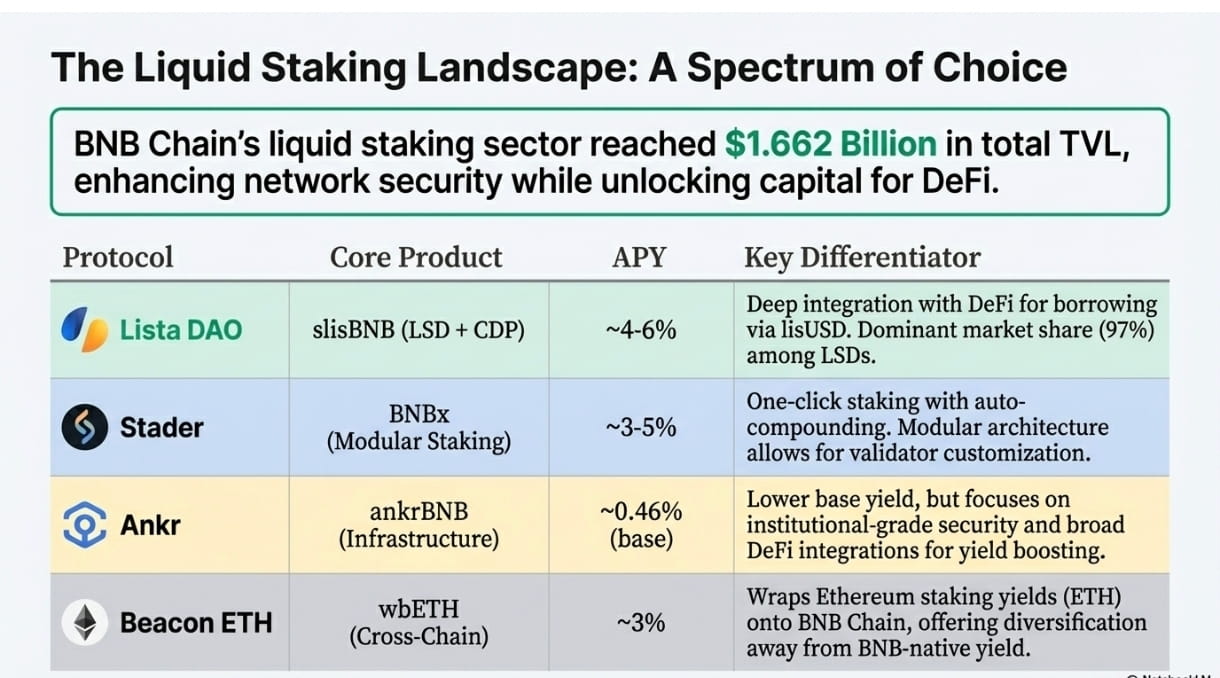
The lending and liquid staking sectors demonstrated the maturation of BNB Chain's financial infrastructure. Venus's dominance in lending reflected first-mover advantage and battle-tested smart contracts. Lista's rapid growth showed strong demand for capital-efficient staking derivatives. The variety of liquid staking options (Stader's modularity, Ankr's infrastructure focus, Beacon's cross-chain approach) indicated market segmentation based on user preferences and risk tolerances.
VI. Notable Emerging Projects
World of Dypians stands as BNB Chain's leading MMORPG metaverse, combining open-world exploration with NFT land ownership and PvP combat mechanics. The project raised $6.2 million including an undisclosed funding round in June 2025 from Castrum Capital, with additional capital from late 2024 IDOs and IEOs. WOD token reached $10.2 million market capitalization with $2.7 million daily trading volume, hitting an all-time high of $0.24 in January 2025. The game captured 56% of on-chain gaming accounts on BNB Chain during peak periods, earning Binance Alpha spot listing in August 2025. Monthly active user metrics placed World of Dypians among the top gaming applications on both BSC and opBNB throughout 2025.
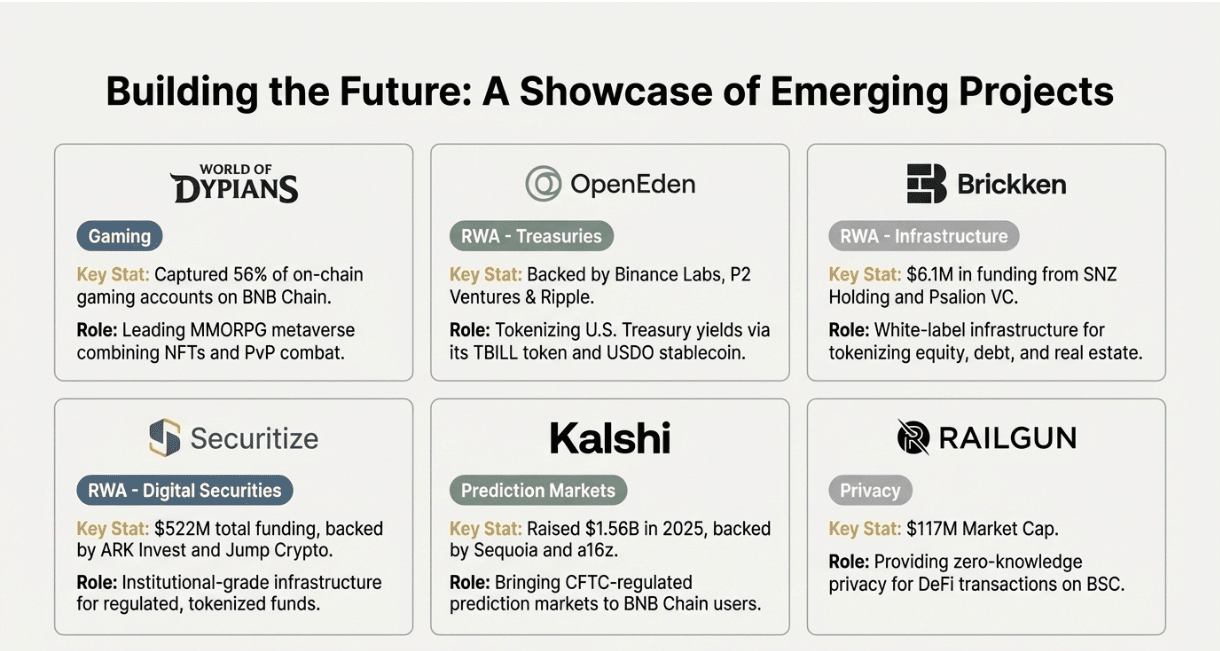
Brickken pioneered real-world asset tokenization on BNB Chain with white-label infrastructure for equity, debt, and real estate. The $6.1 million total funding included a $2.5 million seed round in January 2025 led by SNZ Holding and Psalion VC. BKN token maintained $7.1 million market capitalization with $301,000 daily volume and 80,000 Twitter followers as of late 2025. The platform's ERC-20 and BSC-compatible architecture supported investor management APIs used by asset issuers across multiple jurisdictions. Brickken featured prominently in BNB Chain's RWA ecosystem reports throughout 2025, positioning itself as essential infrastructure for tokenized securities.
OpenEden brought U.S. Treasury yields to BNB Chain through its TBILL tokenization platform and yield-bearing USDO stablecoin. Strategic funding exceeded $5 million including a December 2025 round from P2 Ventures and Ripple, supplementing earlier Binance Labs investment. EDEN token reached $11.5 million market capitalization with $4.5 million daily trading volume, earning Binance spot and perpetual listings in September 2025 and Bithumb listing in December. The platform's Moody's-rated vaults and regulated structure attracted institutional capital seeking on-chain Treasury exposure. OpenEden's 128,000 Twitter followers and active BSC contracts positioned it as a cornerstone of BNB Chain's RWA stack.
Matrixdock specialized in tokenizing physical gold through XAUm (1:1 LBMA-backed tokens) and U.S. Treasuries via STBT tokens, with AI-driven asset selection optimizing yields. The pre-TGE project garnered 40,000 Twitter followers and featured prominently in BNB Chain's May 2025 RWA ecosystem report. On-chain proof-of-reserves and regular audits provided transparency for institutional users seeking regulated precious metals exposure. Integration across BNB Chain's DeFi infrastructure enabled gold-backed tokens to serve as collateral in lending markets, creating novel use cases for traditionally illiquid assets.
Kalshi integrated BNB Chain deposits in December 2025, bringing CFTC-regulated prediction markets to BSC users. The platform raised $1.56 billion in 2025 including a $1 billion undisclosed round from Sequoia and a16z in November, plus $300 million Series D in October. Monthly trading volume ranged from $10-20 million with 268,000 Twitter followers. BSC deposit functionality enabled global users to access regulated event contracts on politics, finance, and sports using BNB and stablecoins. The direct integration with BNB Chain's infrastructure positioned Kalshi as a bridge between traditional prediction markets and crypto-native users.
RAILGUN provided zero-knowledge privacy infrastructure for DeFi transactions across BSC and other EVM chains through confidential 0zk addresses and transaction shielding. The $10 million strategic funding from Digital Currency Group in 2022 supported ongoing development. RAIL governance token maintained $117 million market capitalization with $1.9 million daily volume and 38,000 Twitter followers in late 2025. Featured in BNB Chain privacy discussions throughout December 2025, RAILGUN addressed compliance-conscious users seeking transaction confidentiality without sacrificing DeFi access.
Probable launched as BNB Chain's exclusive on-chain prediction market in December 2025, incubated by PancakeSwap and YZi Labs with zero-fee structure. The platform leveraged UMA's Optimistic Oracle for outcome verification while offering auto-swap deposits to USDT for user convenience. Pre-launch positioning targeted regional markets and unique event categories not available on competing platforms. The PancakeSwap incubation provided immediate user base access and liquidity partnerships, while YZi Labs backing ensured capital and strategic support for rapid scaling.
Securitize operated digital securities infrastructure across multiple chains including BNB, raising $522 million total funding with undisclosed amounts in October 2025 from ARK Invest and May 2025 from Jump Crypto. The platform's compliant tokenized funds including ACRED (VanEck partnership) and HLSCOPE maintained market capitalizations exceeding $100 million. Integration with BNB Chain's RWA ecosystem positioned Securitize as institutional-grade infrastructure for regulated asset tokenization. The platform's 74,000 Twitter followers and partnerships with traditional finance giants like VanEck demonstrated mainstream adoption potential.
These emerging projects represented BNB Chain's strategic expansion beyond DeFi into gaming, RWAs, privacy, and regulated prediction markets. Combined funding exceeded $2 billion in 2025, with institutional investors like Sequoia, a16z, and ARK Invest signaling confidence in BNB Chain's infrastructure maturity. The diversity of sectors (gaming metaverses, Treasury tokenization, prediction markets, privacy tools) indicated the ecosystem's evolution toward comprehensive Web3 functionality beyond its trading-focused origins.