


—Professionals From Impulsive Traders
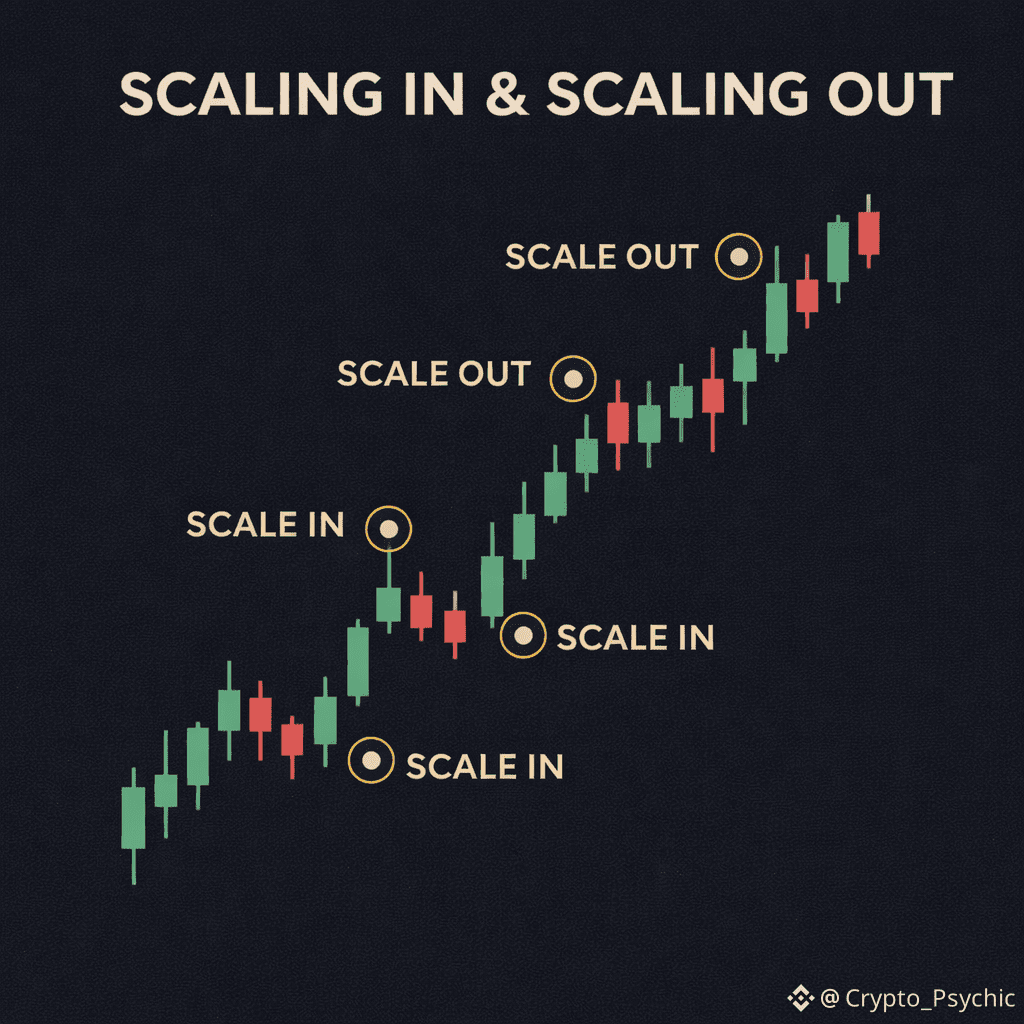
Most traders focus intensely on entries, believing that the precision of a single click determines success or failure. In reality, long-term performance is shaped far more by how positions are managed after entry. Scaling in and scaling out are not advanced tactics reserved for institutions — they are practical tools that reflect a deeper understanding of uncertainty, probability, and risk. When used correctly, they transform trading from a binary outcome into a controlled process.
Scaling in refers to building a position gradually rather than committing full size at once. Scaling out means reducing exposure in stages instead of exiting all at a single price. Both approaches acknowledge a fundamental truth of markets: no trader knows the exact top or bottom. Price moves in phases, not absolutes, and position management should reflect that reality.
Traders who enter with full size immediately place enormous emotional weight on a single decision. If price moves slightly against them, anxiety spikes. If it moves in their favor, greed appears. This emotional instability often leads to premature exits, stop adjustments, or impulsive re-entries. Scaling in reduces this pressure. By committing capital progressively as price confirms structure or reacts at expected zones, the trader aligns exposure with information rather than hope.
Effective scaling in is rooted in structure, not emotion. A trader may initiate a partial position at an area of interest, then add exposure only if price respects that zone, confirms intent, or reacts from an imbalance or order block. Each addition is justified by new information. This approach avoids overconfidence and prevents the common mistake of going “all in” on an idea before the market proves it valid.
Scaling out plays an equally important role. Markets rarely move in straight lines, and even strong trends experience pullbacks, pauses, and liquidity sweeps. Traders who hold full size until a single target often give back unrealized profits or exit emotionally when volatility increases. Scaling out allows profits to be secured while still maintaining exposure to the larger move. It converts uncertainty into flexibility.
Professional traders understand that partial profit-taking is not a sign of weakness — it is a recognition of probability. By reducing risk as price moves in their favor, they remove emotional attachment to the outcome. This creates clarity. Once some profit is secured, the remaining position can be managed objectively, allowing the trade to either extend naturally or exit without psychological pressure.
One of the most overlooked benefits of scaling is how it stabilizes decision-making. A trader who has scaled in properly and scaled out responsibly is far less likely to panic during normal market fluctuations. They are no longer trying to defend a single outcome. Instead, they are managing exposure dynamically, responding to structure as it evolves.
However, scaling is often misused. Adding to losing positions without structural confirmation is not scaling — it is averaging driven by denial. Scaling must always be aligned with validation, not hope. Likewise, scaling out too aggressively can reduce profitability if it is done without a clear plan. The purpose is balance, not indecision.
The true power of scaling lies in its ability to harmonize risk, psychology, and structure. It accepts that markets are imperfect and that execution does not need to be exact to be effective. When traders adopt scaling as part of their strategy, they stop seeking perfection and start managing probability.
In the long run, traders who master scaling develop resilience. They endure drawdowns with composure, ride trends with confidence, and adapt to changing conditions without emotional disruption. Their performance becomes smoother, more consistent, and less dependent on single outcomes.
Scaling in and scaling out are not tactics to chase profits — they are frameworks to manage uncertainty. And in a market defined by uncertainty, that framework becomes a decisive advantage.