

There’s a quiet shift happening in crypto.
Blockchains are no longer just about trading tokens or chasing the next narrative. They’re starting to settle real value — mortgages, supply chains, insurance claims, AI-driven transactions — things that have consequences outside a price chart.
And in that world, one uncomfortable truth becomes impossible to ignore:
If the data feeding the system can’t be trusted, nothing built on top of it truly works.
That’s exactly where APRO Oracle 3.0 steps in. Not as another “oracle project,” but as a system designed to answer a deeper question:
How do you make truth verifiable in a world where information moves faster than trust can catch up?
What is APRO Oracle — in simple terms?
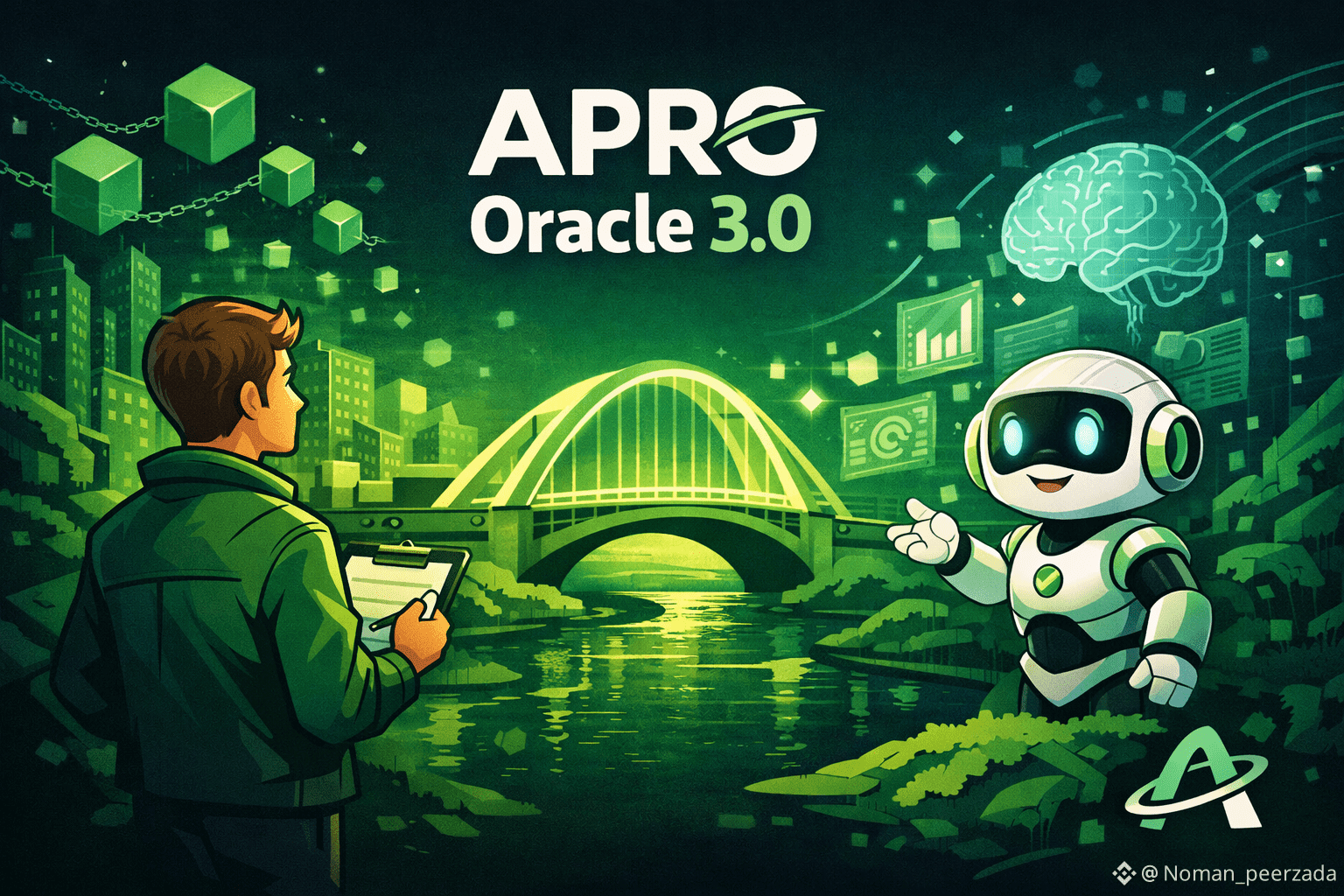
Think of APRO as the bridge that helps blockchains understand the real world — but with a brain attached.
Instead of simply pushing numbers on-chain, APRO uses AI to read, interpret, and verify more complex information. That includes things like financial reports, announcements, outcomes, or RWA audit data — the kind of context traditional oracles often ignore.
Mission: Give DeFi, RWAs, and AI agents data they can actually rely on.
Edge: Oracle 3.0 — intelligence, verification, and finality baked into the pipeline.
Who needs it: Multi-chain apps, RWA protocols, and AI-driven systems where mistakes are expensive.
If a liquidation, payout, or settlement depends on real-world data — APRO wants to be the oracle you trust.
Oracle 3.0 — what actually changes?
Earlier oracle models did their job. They delivered prices. They aggregated feeds. They decentralized the pipes.
But they rarely proved anything.
Oracle 3.0 shifts the mindset: instead of “broadcasting data,” APRO focuses on evidence.
AI helps interpret unstructured inputs — documents, events, sentiment, even multimedia.
Hybrid nodes + staking incentivize honest reporting and penalize manipulation.
On-chain arbitration ensures disputes resolve transparently, not behind closed doors.
It feels less like a simple relay — and more like a truth-verification layer designed for high-stakes environments.
Where AI actually matters (beyond buzzwords)
It’s easy to say “we use AI.” APRO goes further.
Most oracles stop at numbers. APRO trains intelligence into the decision process itself.
It can detect anomalies.
It can flag suspicious updates.
It can cross-reference inputs before publishing final results.
And because it works across dozens of chains, builders don’t have to reinvent trust every time they deploy somewhere new.
For prediction markets, RWAs, insurance, lending, derivatives — that stability becomes the difference between confidence and chaos.
Why RWAs and multi-chain systems care about APRO
Tokenizing real-world assets sounds glamorous — until you realize every asset depends on off-chain truth:
Who owns it?
What is it worth?
What changed since last month?
If the answers are wrong, everything built on top collapses. APRO approaches RWAs with that reality in mind:
Reliable data across multiple chains
Incentivized node operators who have skin in the game
Architecture built to balance speed, cost, and accuracy — instead of sacrificing one
RWAs don’t just need data. They need defensible data. APRO is designing around that difference.
The $AT token — where value plugs in
$AT isn’t just a reward token floating around the ecosystem.
It’s how the network secures itself, pays validators, and settles demand for high-fidelity data.
Stake → secure the network
Use → pay for queries
Earn → supply high-quality data
As AI-driven automation and RWA adoption expand, the demand side grows naturally. Not because of hype — but because trustworthy data becomes infrastructure.
What the road ahead looks like
APRO still has a lot to build — and that’s a good thing. The direction is clear: deeper integrations, more chains, stronger AI decisions, and tighter guardrails around truth.
And as crypto slowly shifts away from speculation into systems that run real economies, one idea stands out:
The oracle layer quietly becomes the trust layer.
APRO’s bet is bold — that tomorrow’s blockchain world needs smarter oracles, not just bigger ones. If that vision is right, APRO Oracle 3.0 won’t simply support Web3…
It will quietly decide which parts of it can actually be trusted.

