
In the fast-moving world of DeFi, most protocols sell you a dream of "up only" yields. But as seasoned participants, we know that the real winners are those who understand the plumbing. Falcon Finance has recently dominated the Mindshare on Binance Square, not because it promises the highest APY, but because it promises a different kind of behavior: keeping your assets while unlocking their value.
However, trust is built on transparency, not just clever mechanics. If you're looking to mint USDf or stake into the $FF ecosystem, you need to look past the "universal collateral" buzzwords and understand exactly where the friction points lie.
The "Hidden" Architecture: How Falcon Really Works
Unlike traditional lending, Falcon functions as a synthetic dollar protocol. You aren't just borrowing; you are transforming your portfolio into a productive engine.
Imagine you hold a significant position in tokenized Tesla stock (xTSA) or a stash of ETH. Usually, if you need cash, you sell. With Falcon, you deposit that asset into a Vault to mint USDf.
The Strategic Flow:
1. Collateralization: You lock up an asset (Crypto or RWA).
2. Minting: You receive USDf, an overcollateralized stablecoin.
3. Yield Generation: You stake USDf into sUSDf, which taps into delta-neutral strategies like funding rate arbitrage.
The Reality Check: 4 Risks Every User Must Monitor
No protocol is a "black box" of free money. To use Falcon professionally, you must account for these four specific risks:
1. The Strategy Underperformance Gap
Falcon’s yield doesn't come from "magic" token emissions; it comes from real-world yield (funding rates and basis trading).
• The Risk: In a prolonged sideways or "flat" market, funding rates can compress. If the cost of maintaining the peg exceeds the yield generated by the strategies, your expected sUSDf returns could dip below treasury-bill levels.
• What to Watch: Keep an eye on the Funding Rate Dashboard. If rates turn negative for extended periods, the "delta-neutral" advantage narrows.
2. Liquidity "Gating" and Slippage
Falcon supports a wide array of collateral, including less liquid Real World Assets (RWAs).
• The Risk: If a specific RWA market (like tokenized real estate) becomes illiquid, the protocol might struggle to liquidate that collateral quickly during a "black swan" event.
• What to Watch: Look at the Collateral Composition in the Falcon app. A healthy vault has a majority of "High-Liquidity" assets (ETH, BTC, stablecoins) vs. "Long-Tail" assets.
3. The "Depeg" Memory
In July 2025, USDf saw a brief fluctuation to $0.9783. While it recovered quickly due to the Insurance Fund acting as the "buyer of last resort," it served as a reminder.
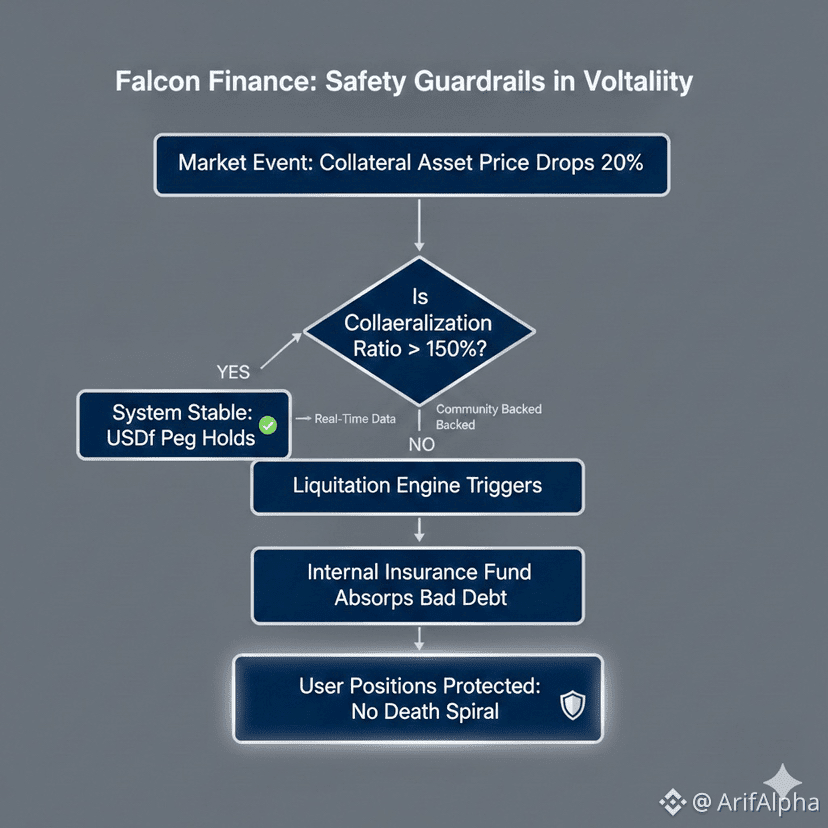
• The Risk: Extreme market volatility can test the 150%+ overcollateralization ratio.
• What to Watch: The Global Health Factor. If the protocol-wide collateralization ratio approaches its minimum threshold, the risk of a temporary depeg increases.
4. Smart Contract & Cross-Chain Fragility
Falcon operates on a multi-chain backbone (Ethereum, BSC, Polygon).
• The Risk: Every bridge and every vault is a line of code. Even with audits (like their ISAE 3000 compliance), "logic errors" can exist in how sUSDf calculates rebalancing rewards.
Visualizing the Safety Guardrails (Flowchart Logic)
To understand your safety, follow this logic when the market gets volatile:
The Verdict: Is the Trade-off Worth It?
Falcon Finance isn't for the "degen" chasing 10,000% APY. It is for the Institutional Mindset—the user who treats their crypto like a real balance sheet. By using $FF for governance and USDf for liquidity, you're betting on the infrastructure of "Hold and Use" rather than "Sell and Regret."
The protocol’s strength lies in its Real-Time Transparency Dashboards and its shift away from inflationary "bribes." But like any flight, you must check the weather (market volatility) and the instrument panel (liquidity metrics) before taking off.
The big question for the community: As we see more Real World Assets (RWAs) like stocks and bonds move on-chain, do you feel more comfortable backing your stablecoins with "Gold and Tesla" or purely with "ETH and BTC"?
Let’s discuss below—how are you balancing your Falcon vaults today?
@Falcon Finance #FalconFinance $FF

