The cryptocurrency market is a dynamic environment characterized by cycles of high-octane volatility and periods of subdued consolidation. For traders and analysts, identifying the transition between these states is paramount. The BLESS/USDT perpetual contract is currently exhibiting classic signs of such a transition, having moved from a directional, bearish trend into a phase of tight consolidation. This period of equilibrium, often described as the market taking a breath, is compressing price action into a narrow range. Such conditions rarely last indefinitely; they typically represent a build-up of potential energy that will eventually be released in a significant, directional move. Understanding the technical structure of this consolidation, the context provided by the prevailing fundamental landscape, and the key levels that define its boundaries is crucial for navigating the next wave of volatility. This analysis will deconstruct the current market structure of BLESS, examine the implications of the current information environment, and outline two primary, data-driven scenarios for its potential trajectory.
Market Snapshot:
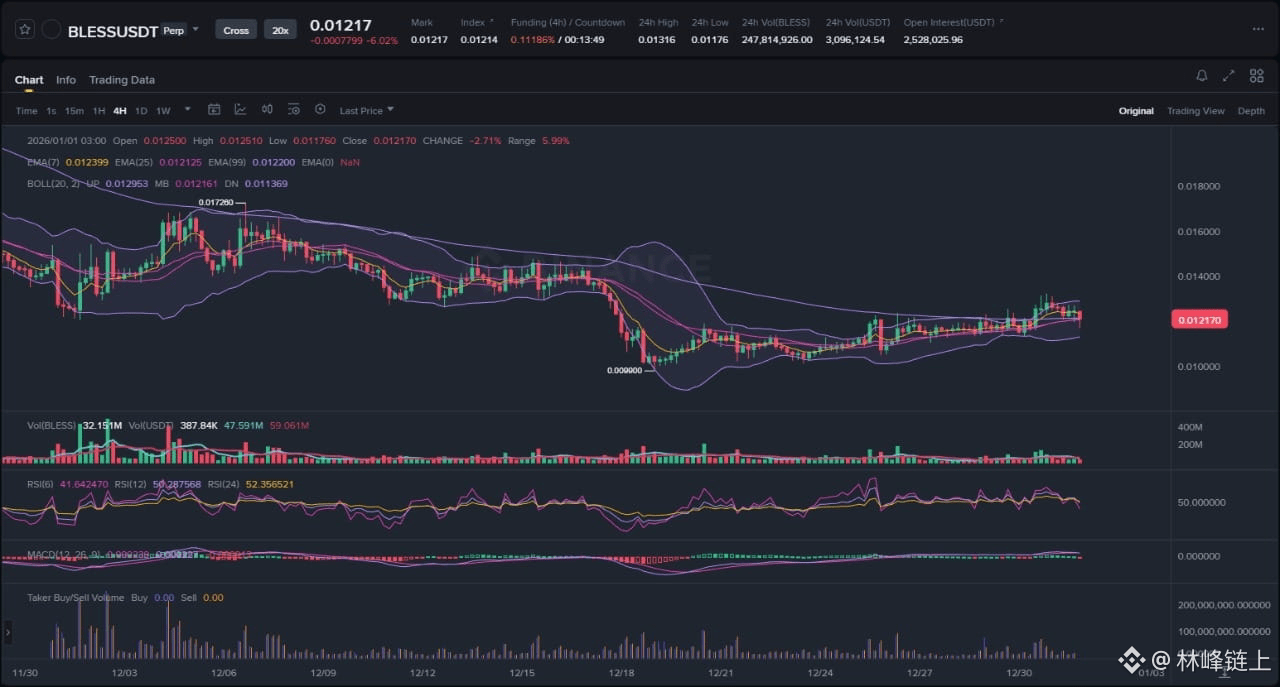
The 4-hour chart for BLESS/USDT provides a clear narrative of the asset's recent performance. The period leading into December was defined by a distinct and persistent downtrend. This is evidenced by the series of lower highs and lower lows, with price consistently trading below key moving averages, which acted as dynamic resistance, capping any attempts at bullish rallies. This bearish phase culminated in a capitulation-style move around mid-December, where price found a local bottom near the 0.009900 level. This marked a critical inflection point. Following this low, the aggressive selling pressure abated, and the market structure shifted from a clear downtrend into a sideways consolidation range. For the latter half of December, BLESS has been oscillating within this newly established range, demonstrating a state of temporary balance between buying and selling interest. This is a common market behavior following a strong directional move, as participants reassess valuations and await a new catalyst. The current price action is therefore best characterized as a horizontal range or a consolidation phase, where control is contested, and no clear directional bias has yet emerged from the equilibrium.
Chart Read:
A granular inspection of the chart reveals several key technical elements that define the current market state. Firstly, the most prominent feature is the significant volatility contraction, visually represented by the squeezing of the Bollinger Bands. This indicator, which plots standard deviations away from a central moving average, narrows when price volatility decreases. The current tight formation of the bands on the BLESS chart indicates that the market is in a low-volatility regime, often a precursor to a substantial expansion in volatility. The price is currently hovering around the 20-period moving average (the middle Bollinger Band), reinforcing the idea of market indecision and mean reversion within the confines of the range.
Secondly, we can observe a failed breakout attempt near the end of December. Price made an impulsive move toward the upside, briefly piercing the upper Bollinger Band. However, this move was not met with sustained buying pressure or follow-through volume. Instead, it was met with supply, leading to a rejection that sent the price back toward the middle of the range. Such failed breakouts, often referred to as liquidity grabs or "fakeouts," can be bearish signals, suggesting that distribution (selling by informed participants) may be occurring at the range highs.
Thirdly, the volume profile throughout this consolidation period has been notably anemic. The volume bars at the bottom of the chart are consistently low, indicating a general lack of market participation and conviction. A healthy accumulation phase would ideally be accompanied by rising volume on upswings, showing strong buyer interest. Conversely, a clear distribution would show volume spikes on downswings. The current low and directionless volume suggests market apathy, where neither bulls nor bears have been able to assert definitive control.
Based on these technical observations, the primary bias remains neutral with a slight bearish tilt. The neutrality stems from the clear range-bound nature of the price action. However, the bearish inclination is informed by two factors: the preceding dominant trend was bearish, and consolidations are often continuation patterns. Furthermore, the recent failure to sustain a breakout above the range high suggests that sellers are still active at key resistance levels. Until buyers can prove their strength with a high-volume breakout and a successful retest of a key level as support, the path of least resistance could favor a continuation of the broader downtrend.
News Drivers:
In the current market, no recent, project-specific news items for BLESS have been identified. This creates what can be termed a "news vacuum." In such an environment, the asset's price is untethered from any fundamental catalysts, either positive or negative. Consequently, its price action becomes almost entirely a function of three main factors: the broader market sentiment (its "beta" correlation to major assets like Bitcoin and Ethereum), the technical picture presented on its chart, and the micro-structure of its own order book.
This lack of narrative can be labeled as a neutral to mixed factor. It's neutral in that there are no negative headlines to create selling pressure. However, in the highly competitive attention economy of the crypto market, a lack of positive news or developmental updates can be a form of passive bearishness. New capital is often attracted to projects with strong, ongoing narratives, such as product launches, significant partnerships, or tokenomic upgrades. Without these, an asset like BLESS may struggle to attract fresh buying interest, leading to the low volume and liquidity observed on the chart. This condition can lead to price drift or heightened vulnerability to the whims of the overall market. If the broader market experiences a downturn, assets without a strong independent thesis are often the first to be sold as investors de-risk their portfolios. Conversely, if the market rallies, they may lag behind assets with more compelling stories. Therefore, the news vacuum reinforces the technical picture of indecision and makes a breakout from the current range heavily dependent on an external market-wide catalyst or a purely technical setup reaching its breaking point.
Scenario A: Bullish Range Breakout and Trend Reversal
The primary bullish scenario requires a definitive and decisive break from the current consolidation range. This is not merely a matter of price ticking above the recent swing high. For this scenario to gain credibility, several technical events would need to unfold in sequence. First, the market would need to see a significant increase in buying pressure, reflected as a notable and sustained spike in volume. This volume surge would need to accompany a strong 4-hour candle closing decisively above the resistance formed by the late-December highs and the upper Bollinger Band. This action would signal that the period of consolidation was indeed an accumulation phase, where stronger hands were absorbing the available supply.
Following the initial breakout, the next critical test would be a potential retest of the broken resistance level. A healthy and sustainable breakout often sees price return to test the previous "ceiling" of the range, confirming it has now flipped into a new "floor" of support. A successful hold of this level, ideally on lower volume than the breakout itself, would provide strong confirmation of a change in market structure. From there, bullish momentum would likely carry the price towards the next significant area of resistance, which would be the price levels observed in early December before the last major leg of the downtrend began. Indicators would support this move: the RSI would need to break above the 60-70 zone, indicating strong momentum, and the MACD would exhibit a clear bullish cross with its histogram bars expanding, signaling a new uptrend is underway.
Scenario B: Bearish Range Breakdown and Trend Continuation
The alternative scenario, which aligns with the pre-existing downtrend, involves a failure to hold the current equilibrium and a breakdown below the established support. This scenario would be invalidated if the bullish conditions above are met but would become the primary expectation if the price begins to show weakness within the range. The first warning sign would be a rejection from the midline of the range (the 20-period moving average), followed by a move toward the support level established at the mid-December low around 0.009900.
The validation of this bearish scenario would occur with a strong 4-hour candle closing decisively below this critical support level. Similar to the bullish scenario, this move must be accompanied by a tangible increase in selling volume to be considered credible. A low-volume drift below support could be a trap, but a high-volume breakdown would indicate that sellers have overwhelmed buyers and that the consolidation phase was merely a redistribution of the asset before the next move lower. This breakdown would cause the Bollinger Bands to expand downwards, signaling an increase in bearish volatility.
Following a breakdown, any attempt to rally back to the broken support level would likely be met with selling pressure, as former support turns into new resistance. The price would then be expected to enter a new phase of price discovery to the downside, seeking the next pocket of liquidity. From an indicator perspective, the RSI would likely fall below the 40 level and head towards oversold territory, while the MACD would show a bearish crossover, confirming the resumption of negative momentum. This would signal a continuation of the broader bearish trend that was in place before the consolidation period began.
What to Watch Next:
For market participants analyzing BLESS, the focus should be on the transition from the current low-volatility state to a new directional phase. The following points are critical to monitor:
1. Volume Confirmation: Any attempt to break the upper or lower boundaries of the current range must be accompanied by a significant and sustained increase in trading volume. A breakout on anemic volume is highly suspect and has an elevated risk of being a fakeout designed to trap participants.
2. Bollinger Band Expansion: The current squeeze will not last forever. Watch for the bands to begin widening. The direction in which price closes outside of the widening bands will provide a strong clue as to the direction of the subsequent, more volatile trend.
3. Reaction at Range Boundaries: Pay close attention to the price action at the late-December high (resistance) and the mid-December low (support). A decisive, high-volume close beyond either of these levels on the 4-hour timeframe will serve as the most significant signal for the market's next intended direction.
Risk Note:
This content is for informational purposes only and should not be construed as financial or investment advice. The cryptocurrency market is subject to high volatility and risk. All participants should conduct their own thorough research and risk assessment before engaging in any trading or investment activities.
The current equilibrium in BLESS will inevitably resolve into a new directional trend.