

As of early 2026, XRP has transitioned from a speculative asset to a foundational pillar of institutional decentralized finance (DeFi). While often conflated with the company Ripple, XRP is a distinct, decentralized digital asset that operates on the XRP Ledger (XRPL)—a blockchain designed specifically for the high-velocity requirements of globa
1. The Architecture of Consensus (RPCA)
Unlike Bitcoin’s Proof-of-Work (mining) or Ethereum’s Proof-of-Stake (staking), XRP utilizes the Ripple Protocol Consensus Algorithm (RPCA). This is a "Byzantine Fault Tolerant" system that achieves agreement without requiring massive energy consumption.
1.Validator Nodes: Instead of a global competition to solve puzzles, specific "validators" (operated by universities, exchanges, and financial institutions) compare their transaction
The 80% Rule: A transaction is only finalized when a supermajority (80%) of trusted validators agree on its validity.
Performance Metrics: This architecture allows for 3–5 second finality and a throughput of roughly 1,500 transactions per second (TPS), scalable to 65,000+ via Layer 2 solutions.
. Strategic Utility: The Liquidity Multiplier
The primary "Alpha" of XRP lies in its role as a Bridge Asset. In traditional banking, cross-border transfers require Nostro/Vostro accounts—trillions of dollars in "dead liquidity" sitting in foreign banks to facilitate exchanges.
3.XRP replaces this with On-Demand Liquidity (ODL). In this model, fiat currency (e.g., USD) is converted into XRP, sent across the XRPL, and converted into the destination currency (e.g., JPY) in
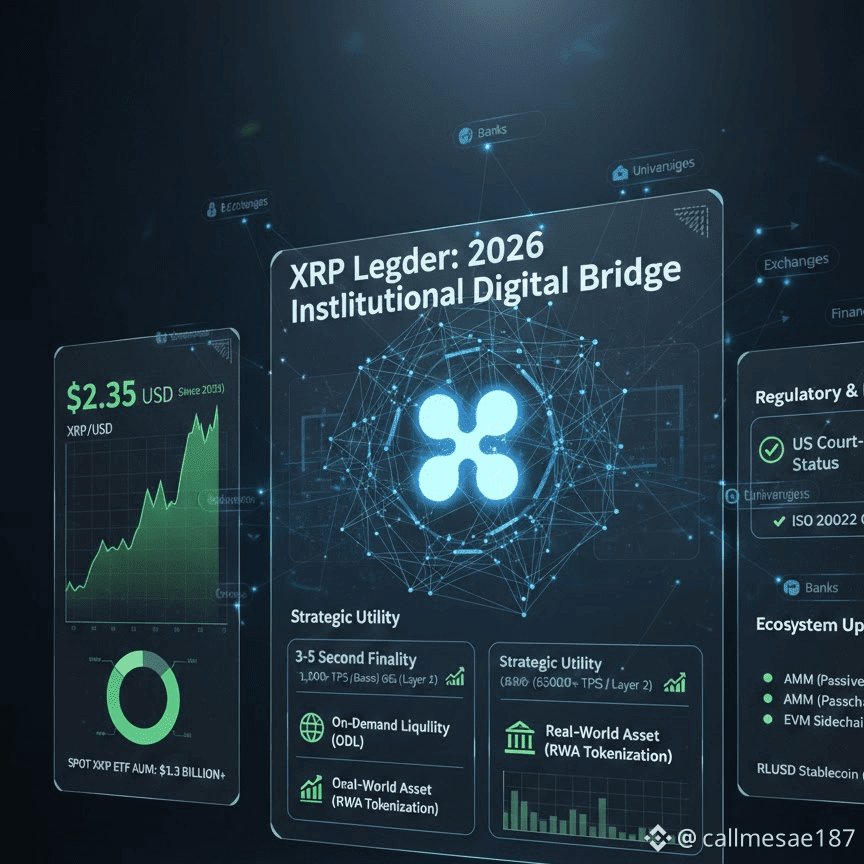
By 2026, the launch of the Ripple USD (RLUSD) stablecoin on the XRPL has created a "Hybrid Liquidity" model. Large institutions now use RLUSD for stable value storage while utilizing XRP as the gas and high-speed bridge for instant settlement.