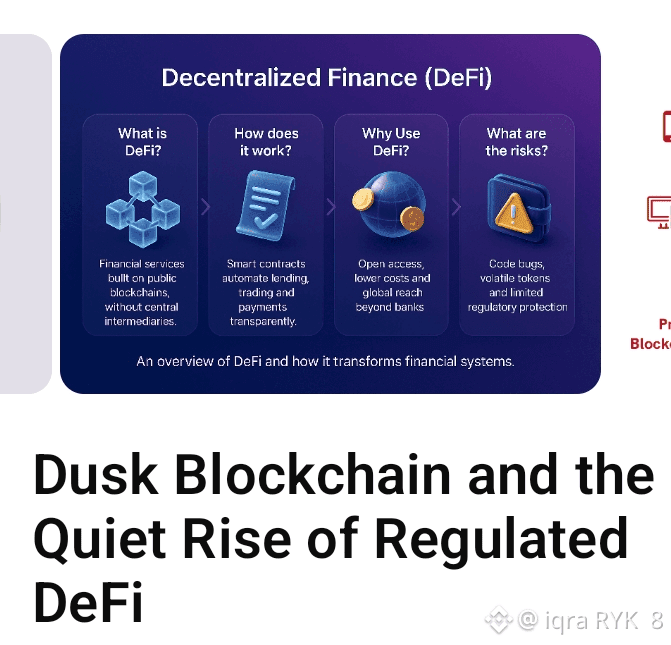
Something important is happening in crypto, and almost nobody is shouting about it. No noise. No urgency bait. No daily excitement loops. Just slow, deliberate building. Dusk sits right inside this moment, not trying to impress the crowd, but preparing for a future that actually lasts.
Right now, the most telling thing about Dusk is not a single announcement or headline. It is the direction. Dusk is choosing to solve problems that only become visible when money is real, responsibility is heavy, and mistakes are not forgiven easily. That choice already separates it from most of the market.
This is the quiet rise of regulated DeFi.
Why regulated DeFi feels inevitable
For a long time, DeFi lived in full public view. Every transaction exposed. Every wallet traceable. Every position open to the world. At first, this felt honest and powerful. Over time, it became uncomfortable.
Real people do not live transparently. Real businesses do not operate transparently. Real financial systems survive because some things are visible and some things are protected.
Privacy in finance is not about hiding. It is about safety. It protects traders from being hunted. It protects companies from losing strategy. It protects users from becoming targets. When privacy is missing, participation shrinks. When participation shrinks, markets weaken.
At the same time, regulation does not disappear just because code exists. Rules are not opinions. They are constraints that real institutions must obey. The problem was never regulation itself. The problem was how regulation was enforced.
This tension pushed serious capital away from DeFi. Regulated DeFi is emerging because that tension can no longer be ignored.
What Dusk understands that others avoid
Dusk does not treat compliance as a necessary evil. It treats it as a design input. From the very beginning, the idea was simple but difficult. Build a blockchain where privacy exists by default, yet rules can still be proven to be followed.
This is where zero knowledge proofs change everything.
Instead of exposing personal data, a participant can prove eligibility. Instead of revealing balances, a system can prove correctness. Instead of trusting a third party, verification happens cryptographically.
This shift is emotional as much as it is technical. It removes fear. Fear of exposure. Fear of misuse. Fear of being permanently visible in a world that never forgets.
Dusk calls this zero knowledge compliance, but at a human level, it is about dignity.
Privacy that respects reality
Crypto often talks about privacy as rebellion. Dusk treats privacy as responsibility.
Confidential smart contracts on Dusk are built for situations where transparency destroys value. Issuance of assets. Settlement of trades. Management of financial products. These workflows require discretion. Without it, they do not move on chain.
Yet discretion without accountability creates mistrust. Dusk balances this by allowing outcomes to be verified even when inputs remain private. That balance is rare. And it matters deeply if on chain finance is meant to grow beyond speculation.
This is not privacy to escape oversight. This is privacy that works alongside it.
Why modular design feels human, not technical
Financial systems evolve because people learn from failure. Laws change. Threats change. Technology matures. A rigid system breaks under that pressure.
Dusk’s modular architecture reflects this reality. It accepts that no design is final. Privacy engines can improve. Execution layers can adapt. Compliance logic can evolve.
That flexibility is not just technical. It is emotional. It signals humility. It signals long term thinking. It signals a network that expects to grow with the world, not dominate it overnight.
Real world assets and the weight of responsibility
Tokenizing real world assets is not glamorous work. It carries legal weight. Human consequences. Regulatory oversight. You cannot afford shortcuts here.
Real assets demand selective disclosure. They demand enforceable rules. They demand systems that respect jurisdiction, ownership, and accountability.
Dusk was built with this burden in mind. By embedding privacy and compliance into the protocol itself, it becomes possible to bring real assets on chain without turning everything into a locked, centralized system.
This is where regulated DeFi becomes real. Not as a narrative, but as infrastructure.
Compliance is not betrayal
One of the deepest emotional divides in crypto is the belief that compliance equals surrender. That belief comes from watching traditional systems fail people again and again.
But surveillance is not compliance. Data hoarding is not safety. Centralized control is not protection.
Dusk challenges that trauma by offering a different path. Prove what must be proven. Reveal only what is necessary. Keep everything else protected.
That approach preserves decentralization while respecting reality. It does not dilute crypto values. It refines them.
Why the silence matters
Dusk does not move loudly because its audience does not respond to noise. Institutions, issuers, and serious builders care about reliability, not excitement. They care about systems that still work when things go wrong.
This is why progress here feels slow. Financial infrastructure always grows slowly. Carefully. With restraint. And when it finally becomes visible, it often feels inevitable.
The future Dusk is preparing for
Regulated DeFi is not replacing open DeFi. It is completing it. It is the layer that allows real capital, real assets, and real responsibility to live on chain without fear.
Dusk is not promising miracles. It is offering something more honest. A place where privacy is respected, rules are provable, and decentralization survives contact with reality.
That is why its rise feels quiet. And that is why it feels real.