
I've been through enough crypto cycles to know what happens when tokens drop 15% in a day. Validators start shutting down nodes because profitability disappears. Developers abandon half-finished projects to chase whatever's pumping. Communities that seemed strong during rallies evaporate when price action turns negative. It's predictable human behavior that repeats every single cycle without exception.
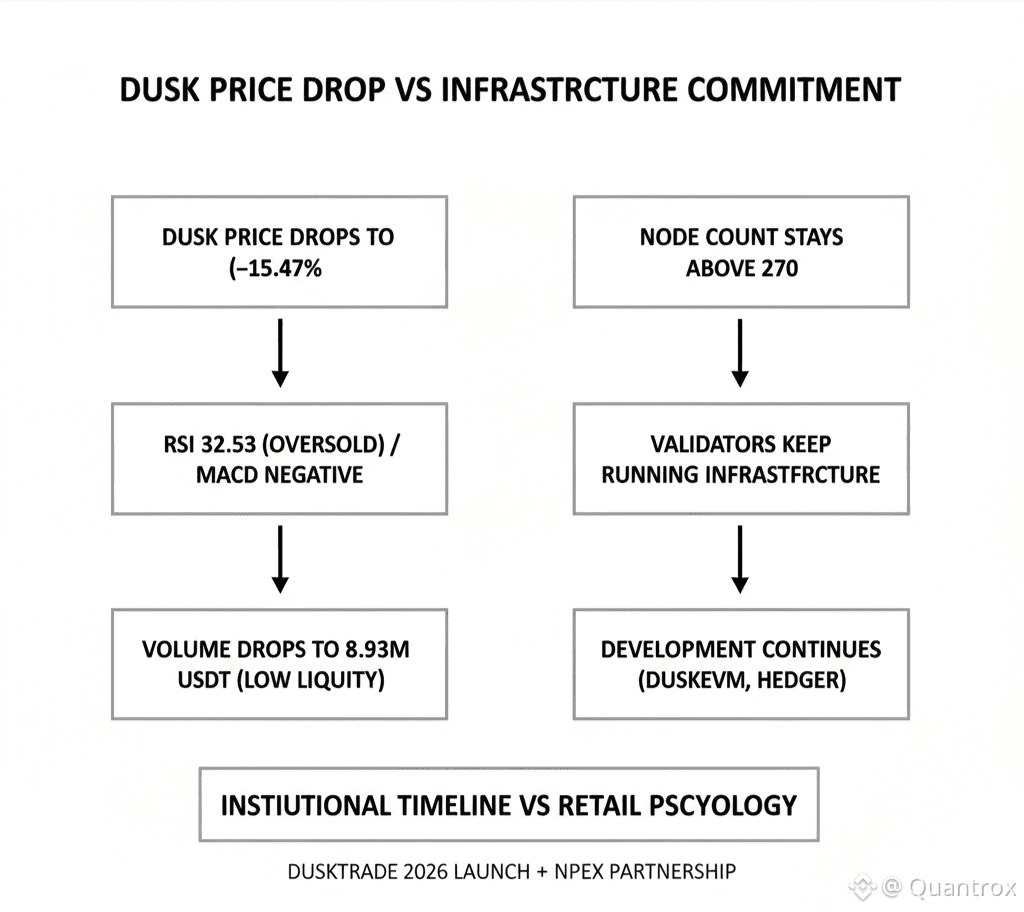
When Dusk dropped from $0.1650 to $0.1339 today, falling 15.47% with volume at just 8.93 million USDT, I expected the same pattern. Node operators would start dropping off. Development activity would slow. The 270+ validators running Dusk infrastructure would quietly wind down operations rather than operate at a loss during extended consolidation.
That's not happening though, and I keep asking myself why anyone would stay committed to Dusk infrastructure while bleeding money on operations.
Dusk sits at $0.1377 right now after hitting a 24-hour low of $0.1339. RSI crashed to 32.53, deep into oversold territory. MACD is negative at -0.0062 with DIF at -0.0135. Every technical indicator screams further downside. Volume dropped to 8.93 million USDT from yesterday's 14.39 million suggesting capitulation selling without much buying interest. EMA(20) at 0.1668 is well above current price confirming the downtrend has momentum.
This is exactly when infrastructure operators normally quit. When daily losses from running servers exceed staking rewards, rational actors shut down. When price charts look terrible and volume dries up, developers move to ecosystems with better momentum. The economic incentives all point toward abandoning ship.
But Dusk node count hasn't collapsed. Operators are holding through drawdown that would normally trigger mass exits. Either these people are financially irrational, or they know something about upcoming developments that justify short-term losses.
My gut says it's preparation for DuskTrade launch in 2026. If you believe NPEX will actually migrate €300 million in assets under management to Dusk infrastructure, then today's price action is irrelevant noise. What matters is being operational when real securities trading starts generating actual fee revenue, not speculative token price movements.
Institutional timelines don't care about daily candles. If NPEX spent months integrating with Dusk, getting regulatory approval from AFM, building custody infrastructure through partnerships like Cordial Systems, they're not abandoning those plans because the token dropped 15%. The regulatory approval process alone takes longer than most crypto market cycles.
That disconnect between institutional preparation timelines and retail trading psychology creates the situation we're seeing now. Retail is selling because charts look bad. Institutions are building because regulatory milestones are being hit. Operators are staying online because they're positioned for institutional usage, not retail speculation.
What makes Dusk's current price action interesting is the low volume. Only 8.93 million USDT traded in 24 hours compared to 14.39 million yesterday. That suggests selling exhaustion rather than panic capitulation. If whales were dumping serious positions, volume would be spiking. Instead, it's declining even as price drops, which typically precedes reversals once sellers are exhausted.
The 24-hour high of $0.1650 to low of $0.1339 represents a $0.0311 range, roughly 20% intraday volatility. For infrastructure operators earning staking rewards denominated in DUSK, that volatility destroys short-term economics. Your daily rewards might be worth 20% less by the time you receive them. Only operators with long time horizons tolerate that uncertainty.
Dusk's 36-year emission schedule means operators betting on the protocol are thinking in years, not months. Current price action at $0.1377 matters if you're trading. It's irrelevant if you're running infrastructure for securities settlement that launches in 2026 and scales over the following decade.
The developer activity pattern supports this interpretation. DuskEVM deployments haven't slowed despite terrible price action. Hedger Alpha usage continues even though nobody's making money on Dusk speculation right now. That's production preparation, not opportunistic development that follows grant programs and token pumps.
Maybe I'm completely wrong about this. Maybe node operators are just stubborn believers who will eventually capitulate when losses get too painful. Maybe developers are building on Dusk because they're already too invested to pivot, not because they see genuine institutional adoption coming. Maybe the whole institutional narrative is marketing and nothing real materializes.
But here's what I keep coming back to. Chainlink integrated CCIP with Dusk for cross-chain securities movement. That's real engineering work from a team that doesn't waste resources on vaporware. TradeOn21X is providing DLT-TSS regulatory navigation specifically for Dusk. That's specialized legal work that only makes sense if someone's planning to actually operate under those frameworks.
NPEX holds MTF, Broker, and ECSP licenses from AFM. Those aren't marketing claims. They're verifiable regulatory approvals that took years to obtain. When they announced partnership with Dusk and DuskTrade launching in 2026, either they're risking those licenses by making false claims, or they're genuinely building what they announced.
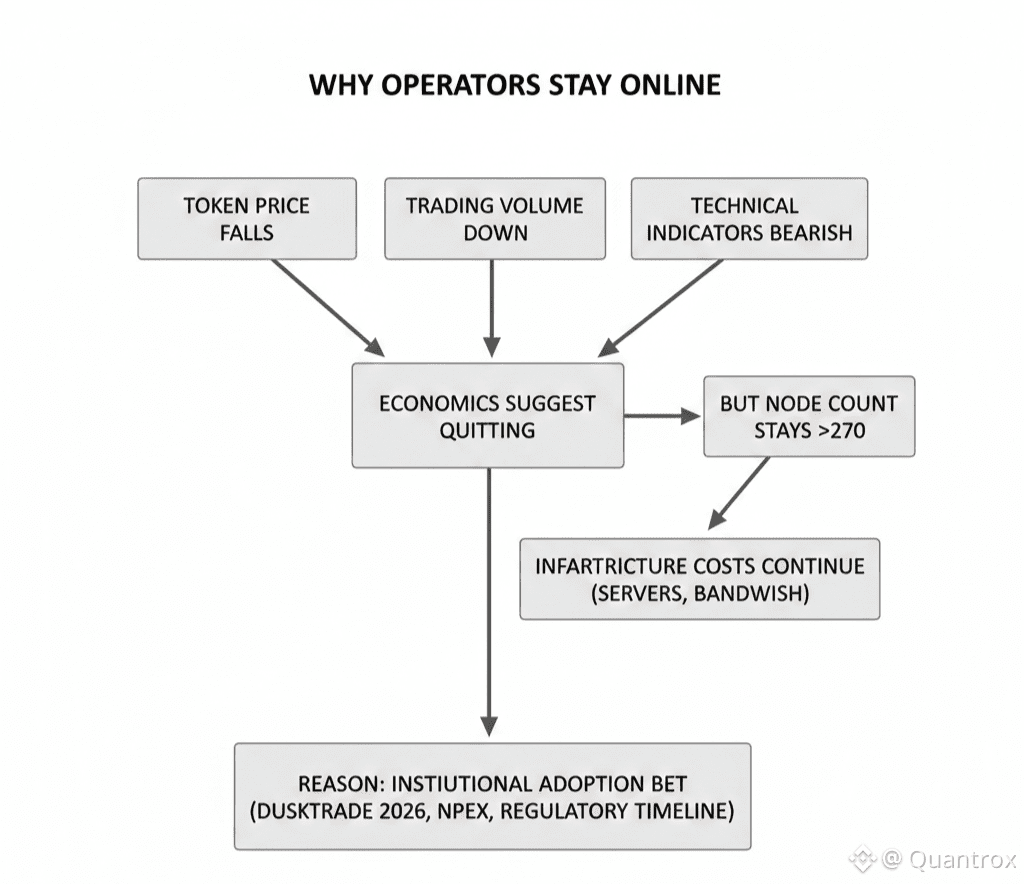
The current Dusk price of $0.1377 doesn't change any of those facts. It just reveals who's operating on institutional timelines versus who's trading retail momentum. Operators staying online through this drawdown are betting on fee revenue from real usage, not staking rewards from token appreciation.
Time will tell whether that bet pays off. DuskTrade launching in 2026 is eighteen months away. A lot can change in eighteen months. Regulatory environments shift. Partnerships fall apart. Technical challenges emerge that kill projects before launch. Betting on institutional adoption of blockchain infrastructure has failed more often than it's succeeded.
But the infrastructure operators running Dusk nodes right now are making that bet anyway. They're committing capital to servers, bandwidth, and maintenance while the token bleeds and retail loses interest. That's either the earliest stage of real institutional adoption or the latest example of true believers funding infrastructure nobody will use.
The volume of 60.54 million DUSK traded suggests some liquidity remains even during selloffs. That's enough depth that institutions could accumulate positions without moving markets violently. Whether they're actually accumulating or this is just retail trading against itself remains unclear from public data.
What is clear is that Dusk infrastructure keeps running despite economic incentives suggesting operators should quit. Node count stays above 270. Development continues on DuskEVM. Hedger processes confidential transactions. All while price action looks terrible and momentum traders abandon the token entirely.
That persistence through adversity either signals conviction about institutional adoption that most people can't see yet, or it signals stubborn commitment to a narrative that won't materialize. The difference won't be clear until DuskTrade actually launches and we see whether real securities trading happens or the partnerships were just announcements.
For now, Dusk operators are betting their infrastructure costs that institutions show up. The token is at $0.1377 and dropping. The bet continues regardless.
