
Vanar Chain came onto my radar during a slow afternoon, the kind where you’re skimming technical updates without expecting much to stick. What caught my attention wasn’t a headline or a chart, but the way Vanar Chain talked about intelligence as something structural, not decorative. In that same first read, Vanry showed up not as a symbol chasing attention, but as a component woven into how the system actually works. That framing stayed with me longer than I expected.
A lot of blockchains today speak about AI the way older software spoke about mobile. Something you add later, once the core is done. Vanar takes a different posture. Vanar assumes intelligence is present from the beginning, shaping how data is stored, how actions are triggered, and how value is settled. That single assumption changes many downstream decisions in Vanar Chain, even if it doesn’t sound flashy at first.
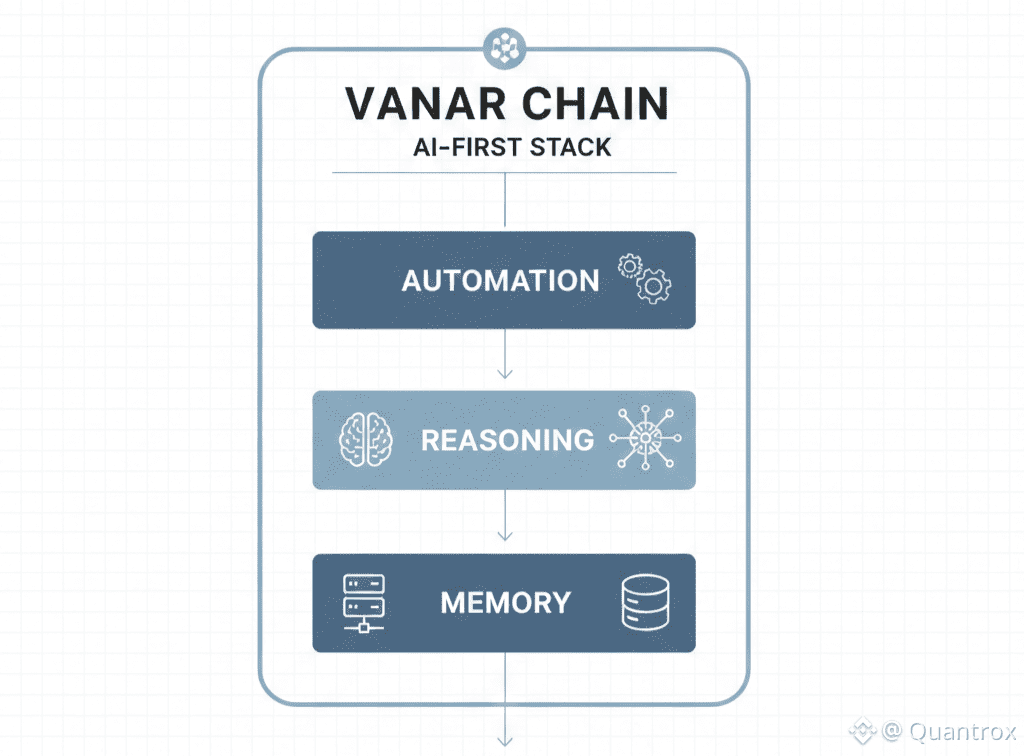
When people talk about AI readiness, speed usually dominates the conversation. More transactions, faster confirmation, higher throughput. Vanar quietly steps around that debate. Vanar Chain treats speed as table stakes, useful but no longer defining. AI systems don’t just act quickly. They remember, they reason, they decide, and they follow through. Vanar is structured around those needs, not around winning a benchmark contest.
Think about memory for a moment. Most chains treat state like a whiteboard that gets wiped and rewritten constantly. Vanar approaches memory more like a notebook an agent keeps over time. With myNeutron, Vanar Chain demonstrates that semantic memory can live at the infrastructure layer, not as a fragile external service. This matters because intelligence without memory feels shallow. Vanar seems to understand that intuitively.
Reasoning comes next. It’s easy to automate tasks. It’s harder to explain why those tasks were chosen. Kayon sits inside Vanar Chain as proof that reasoning and explainability can be native, not bolted on. Vanar doesn’t rush this idea. It presents it calmly, almost cautiously, as if aware that explainable intelligence is still an evolving expectation rather than a solved problem.
Automation follows naturally once memory and reasoning exist. Flows is where Vanar shows how intelligence turns into action without constant human supervision. What stands out is the restraint. Vanar Chain doesn’t frame automation as limitless or chaotic. It’s presented as deliberate, bounded, and safe. That tone feels intentional, and honestly refreshing.
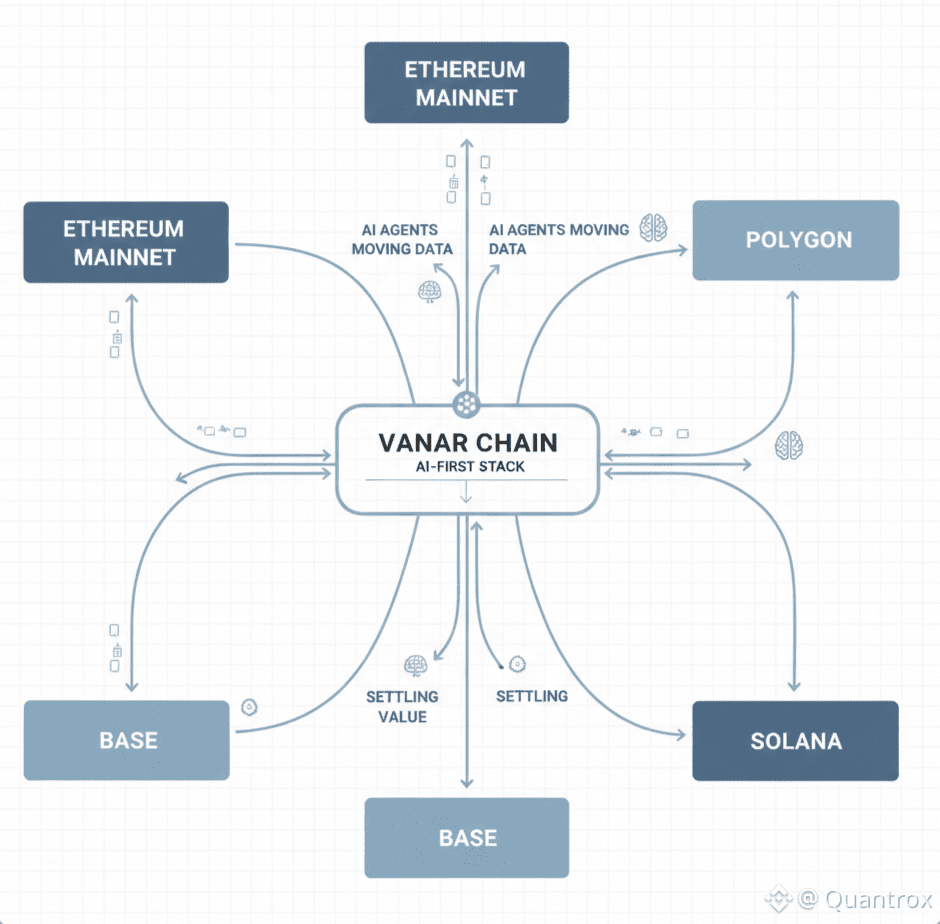
All of this would be interesting even if Vanar stayed isolated. But intelligence doesn’t thrive in isolation. Vanar Chain becoming available cross-chain, starting with Base, changes the conversation. Users, liquidity, and developers already exist elsewhere, and Vanar seems comfortable meeting them where they are. Vanar doesn’t ask the ecosystem to move. It moves itself.
This cross-chain step isn’t about expansion for its own sake. It’s about realism. AI agents don’t live on one network. They operate across environments, pulling data here, settling value there. Vanar Chain acknowledges that reality instead of resisting it. As a result, Vanar feels less like a closed system and more like connective tissue.
New L1 launches still appear regularly, each promising cleaner design or better efficiency. Yet it’s hard to ignore how much base infrastructure is already solved. Vanar doesn’t compete by adding another layer of blockspace. Vanar Chain competes by shipping products that quietly prove readiness. myNeutron, Kayon, and Flows aren’t concept art. They exist, they run, and they expose where older assumptions fall short.
Payments often get discussed last, as if they’re a convenience feature. Vanar flips that order. AI agents don’t open wallets or approve pop-ups. They need settlement to be invisible, compliant, and global. Vanar Chain treats payments as a core primitive, not an afterthought. That framing makes the role of Vanry clearer over time.
Vanry isn’t positioned as a narrative vehicle. Within Vanar, it underpins usage across memory, reasoning, automation, and settlement. The connection isn’t loud, and that may be intentional. Vanar Chain seems more interested in sustained demand than in short cycles of attention. That’s a harder path, but often a more durable one.
There’s a temptation in crypto to chase whatever sounds newest. Vanar resists that impulse. Vanar Chain feels built for agents that operate continuously, enterprises that value predictability, and systems that need to function quietly in the background. Speculation fades quickly. Readiness compounds slowly.
I don’t pretend to know how this all plays out. AI infrastructure is still finding its shape, and Vanar is making specific bets about what will matter. But those bets are visible in code and products, not just words. Vanar Chain doesn’t feel rushed. It feels patient, almost methodical.
In the end, what stays with me is the calm confidence. Vanar isn’t trying to convince anyone overnight. Vanar Chain seems content letting real usage do the explaining, while Vanry reflects that usage over time. Sometimes the most interesting systems are the ones that don’t ask for attention, but quietly earn it.
