
I've tracked enough altcoin selloffs to recognize panic capitulation when I see it. Token drops 15% in a day, volume spikes to 3-5x normal as everyone rushes for exits simultaneously, order books thin out, and you get cascading liquidations that accelerate the drop. It's mechanical and predictable. Fear spreads faster than any other emotion in markets, and once selling starts, it feeds on itself until everyone who wanted out is out.
When Dusk dropped 15.47% today from $0.1650 to $0.1339, I expected volume to explode as holders panicked. That's what happens with tokens this size during double-digit single-day drops. Instead, Dusk traded 60.54 million tokens on just 8.93 million USDT volume. That's actually lower volume than yesterday's 86.18 million tokens when price was stable. Something's wrong with that pattern, and I can't figure out what it means.
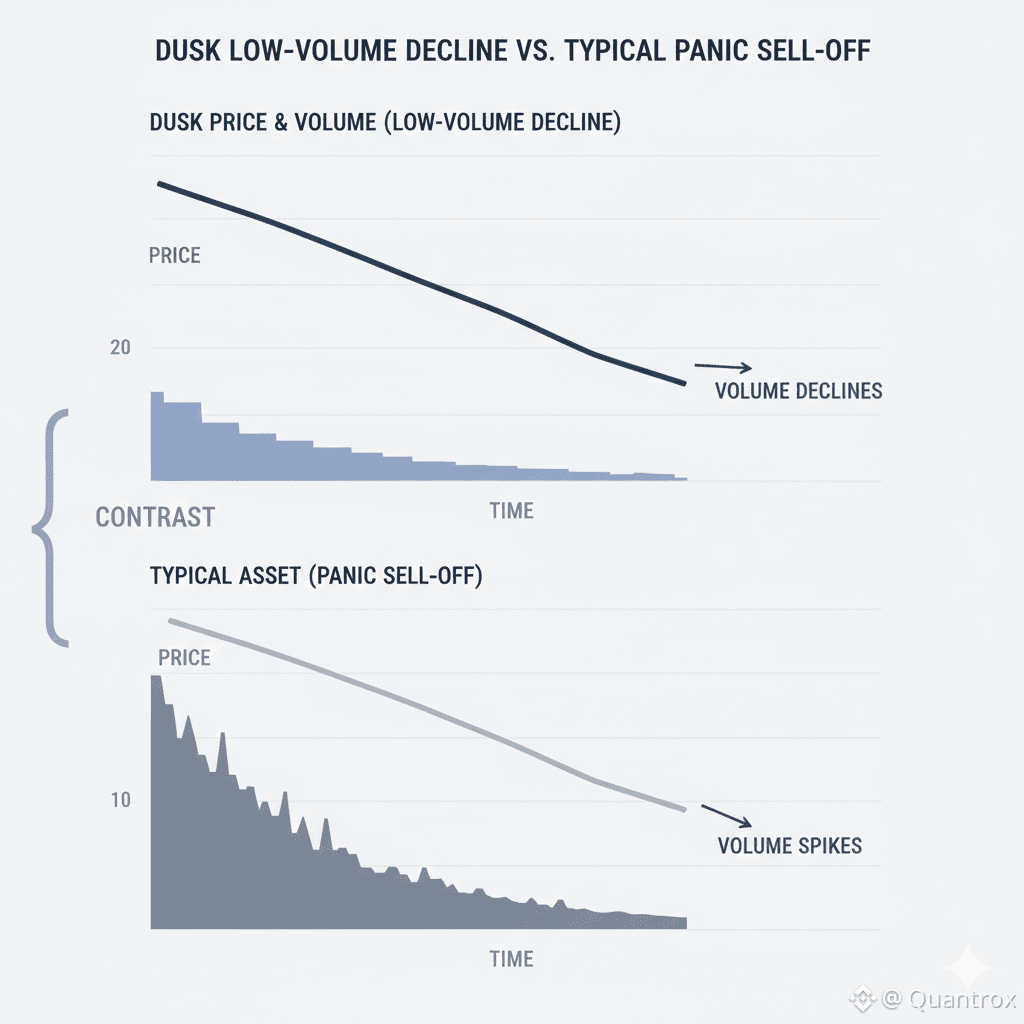
Dusk sits at $0.1377 right now with RSI at 32.53, deep oversold. MACD negative at -0.0062 with bearish momentum. The 24-hour low of $0.1339 held as temporary support but there's no technical reason to believe it's the bottom. EMA(20) at 0.1668 is 21% above current price, confirming this downtrend has room to run. Every indicator says more selling should be coming.
Yet volume is declining as price drops. That's backwards from normal panic selling where volume surges on the way down as fear takes over. Lower volume during steep drops usually means one of two things: either sellers are exhausted and nobody's left to dump, or the holders who remain aren't panicking despite awful price action.
I think it's the second one, and that suggests Dusk's holder base is fundamentally different from typical altcoin distribution.
Most tokens this size have holder bases dominated by retail speculators who bought hoping for quick gains. They have tight stop losses. They panic sell when charts break down. They chase momentum and abandon positions when momentum reverses. That behavior create the classic pattern: volume spikes during dumps as everyone rushes for exits simultaneously.
Dusk's volume declining during a 15% drop suggests the holder base isn't dominated by those traders. Either holders are long-term positioned and ignoring short-term price action, or they're trapped in positions they can't sell for reasons beyond just market timing. Big difference between those two scenarios.
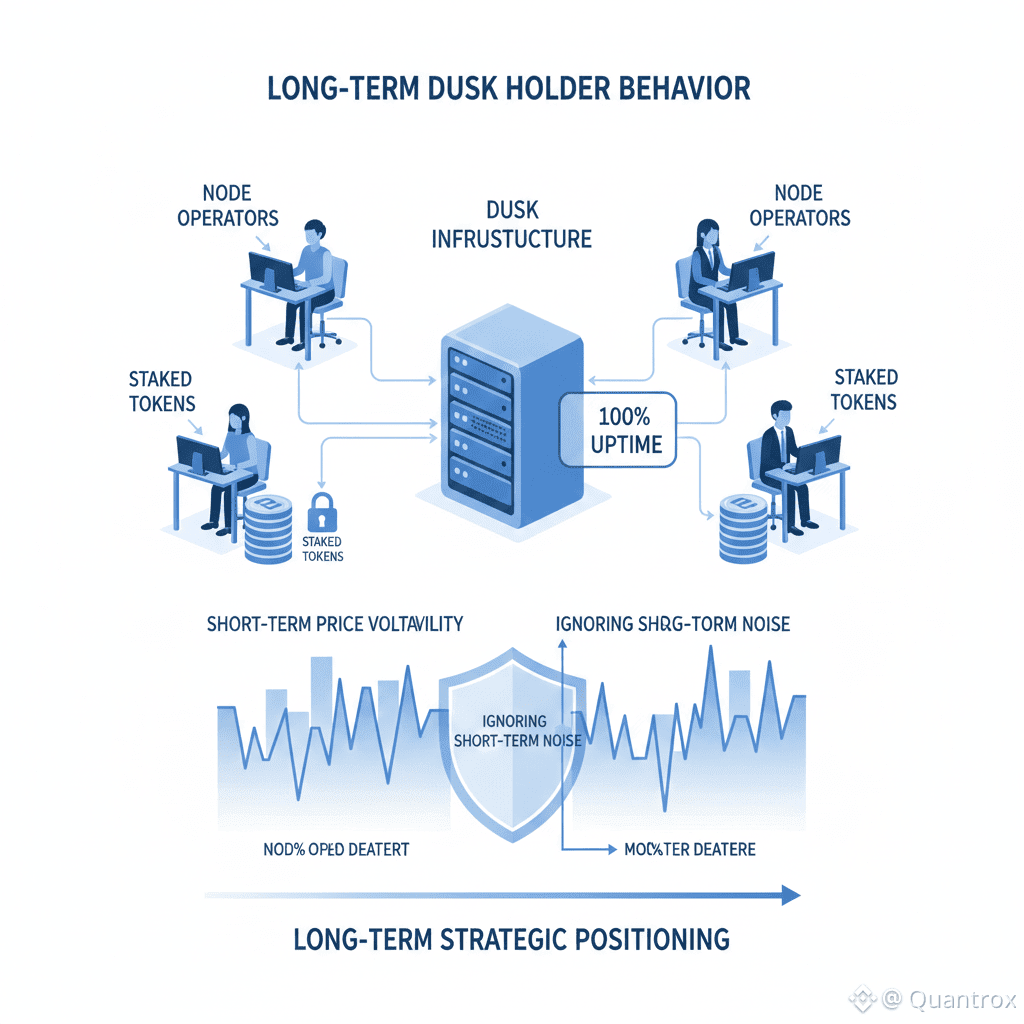
My gut says it's actual long-term positioning, specifically because of the staking mechanics and institutional preparation narrative around DuskTrade. If you're running a node with 1,000+ DUSK staked, you're not panic selling during consolidation. Your thesis is multi-year based on fee revenue from securities trading, not short-term token appreciation. Today's price action is irrelevant to that thesis.
The 4,320 block maturity period before stakes become active creates another friction point against panic selling. If you just staked your DUSK expecting to participate in consensus, waiting through maturity period just to panic sell when price drops makes no sense. You've already committed to the timeline. Might as well see it through.
What makes the volume pattern interesting is what it implies about who's actually selling. Only 8.93 million USDT changed hands during a 15% drop on a token with meaningful liquidity. That's tiny volume for this size price movement. Either there aren't many sellers despite the drop, or sellers are hitting bids so thin that small amounts move price dramatically.
Looking at the 24-hour volume of 60.54 million DUSK tokens versus 8.93 million USDT tells you the average trade price was around $0.1475, which is above the current price of $0.1377. That means most of today's volume happened higher, and relatively little volume is trading at these lows. Sellers aren't capitulating at $0.1377. They're holding.
Maybe I'm reading too much into volume analysis during one day's price action. Could be coincidence. Could be low volume just means nobody's paying attention to Dusk right now and the selloff is happening on thin books that exaggerate moves. Could be retail holders are trapped and can't sell, not choosing not to sell.
But here's what doesn't fit those explanations. Dusk's recent 183% rally to $0.3299 brought attention. Plenty of people know about it. Yet during this 15% pullback, we're not seeing profit-taking volume from people who bought lower and are exiting positions. We're seeing declining volume as price drops, which suggests the people who bought during the rally are holding through the consolidation.
That behavior is unusual for altcoin speculation. Normal pattern is: buy the rally, sell the first signs of weakness, move to the next momentum trade. Dusk holders aren't doing that. They're sitting through drawdown that would normally trigger exits. Either they're all new to trading and don't know when to cut losses, or they're positioned for something beyond short-term price movements.
The 270+ node operators running Dusk infrastructure through this selloff supports the thesis that holders are genuinely long-term positioned. You don't run infrastructure during 15% drawdowns if you're a momentum trader. You shut down nodes and move capital to whatever's pumping. Operators staying online signals they're not trading around volatility. They're committed to the network regardless of token price.
Dusk's emission schedule releasing 500 million tokens over 36 years creates incentive alignment for multi-decade positioning. If you believe the protocol succeeds, buying and staking now means participating in the entire emission curve. Selling during 15% pullbacks makes no sense if your thesis is decades-long institutional adoption.
What I keep coming back to is how different this volume pattern is from typical altcoins during selloffs. Most tokens see volume surge as fear spreads. Dusk sees volume decline as price drops. That's either the earliest signal of a genuinely different holder base, or it's an anomaly that will revert to normal panic selling if price drops much further.
The test will be if Dusk breaks below $0.1339, the 24-hour low. If volume surges on a breakdown, then today's low volume was just temporary and holders will panic like everyone else. If volume stays low even as price makes new lows, then something unusual is happening with Dusk's holder distribution that doesn't match typical altcoin patterns.
DuskTrade launching in 2026 gives holders a concrete catalyst to position for. If you believe €300 million in securities will flow through Dusk infrastructure, then today's price is irrelevant noise. What matters is being positioned before that adoption happens, not timing local tops and bottoms during consolidation.
Whether that belief is justified remains unproven. NPEX could delay indefinitely. Regulatory approval could fall through. Technical issues could emerge that prevent launch. Institutional adoption of blockchain infrastructure fails more often than it succeeds, and there's no guarantee Dusk will be different.
But the volume pattern during today's 15% drop suggests holders are betting it will be different. They're not panic selling despite awful price action. They're holding through volatility that normally triggers capitulation. That's either conviction about institutional adoption that most people don't have, or it's stubborn refusal to accept losses that will eventually break.
Time will tell which. For now, Dusk sits at $0.1377 down 15.47% with declining volume instead of surging volume. Holders aren't panicking. Whether that's because they see something others don't or because they're in denial about a failing investment won't be clear until we see what happens at the next major support level. The volume behavior suggests they're committed regardless. Whether that commitment is visionary or delusional depends on whether DuskTrade actually launches and institutions actually show up.
