
I keep coming back to #Dusk for one reason: it doesn’t feel engineered to win a trend cycle. It feels engineered to survive due diligence. In a market obsessed with speed and storytelling, $DUSK leans into something slower and frankly harder—regulated finance infrastructure where privacy is real, but accountability still exists. That’s why the “long conversations” framing fits. Institutions don’t ape. They test, audit, stress, and only then deploy. Dusk seems comfortable building for that timeline.
DuskEVM Made This Click in 2026
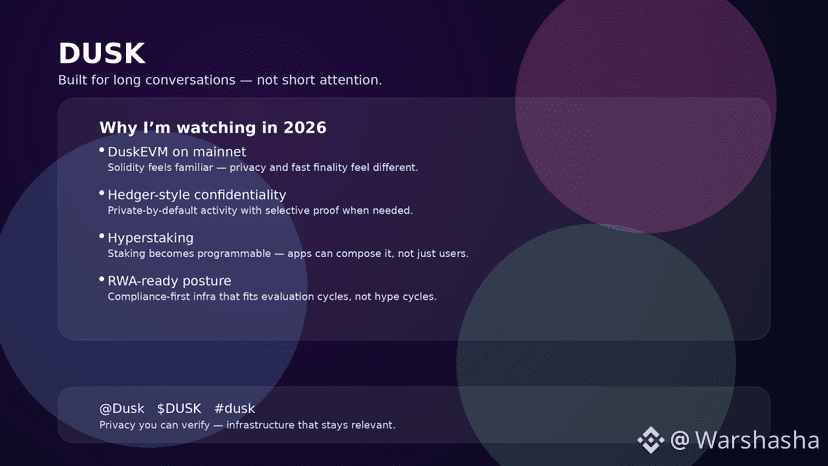
The biggest shift recently is what DuskEVM changes for builders. When an EVM environment goes live, it’s not just a feature—it’s an invitation. Suddenly, Solidity teams don’t have to “learn a new chain” to experiment with compliant privacy. They can bring familiar workflows and still land inside a network whose whole identity is privacy + regulation instead of “privacy or regulation.” That’s a meaningful unlock because it lowers the mental cost of adoption, which is usually the real blocker.
Hedger Alpha Is the Real Story Behind “Compliant Privacy”
What makes Dusk interesting isn’t the marketing phrase. It’s the idea that you can keep sensitive activity private by default, while still enabling selective disclosure when oversight is required. That’s a very different design choice than most “privacy” projects, and it’s also why Dusk keeps showing up in regulated RWA conversations. Hedger Alpha being testable is important here, because privacy claims only matter once people can try to break them.
Hyperstaking Turns Staking Into an App Primitive
Most chains treat staking as a user action. Dusk is pushing it toward being a programmable building block—where contracts can stake, services can automate staking, and applications can create staking-based products without forcing users to manually babysit everything. That changes token behavior too: staking becomes less of a “yield button” and more of a system that quietly pulls supply out of circulation because it’s productive elsewhere.
The Product Layer Is Catching Up
I also like that Dusk isn’t only shipping primitives—they’re trying to surface a real “front door” to tokenized assets through Dusk Trade (waitlist live). That’s the kind of move that signals confidence: you don’t build a user-facing RWA route unless you expect the stack to hold up under scrutiny.
Quiet Ops Are a Feature, Not a Bug
One update that actually increased my trust was the bridge-services incident notice. They detected unusual activity tied to a team-managed wallet used in bridge operations and paused services to harden. For traders, that looks like drama. For institutions, that’s normal risk management. If Dusk wants TradFi-grade adoption, this is exactly the operational muscle they need to build.
What I’m Watching Next
If Dusk succeeds, it won’t be because it became loud. It’ll be because the “boring” things keep compounding: more Solidity teams deploying, more privacy features becoming practical instead of theoretical, more regulated on-ramps appearing, and more evidence that the network behaves predictably when things get messy. In finance, patience doesn’t just outperform hype—it often replaces it, because once trust is established, capital tends to follow.
